
AI Hook Generator for LinkedIn: What Works in 2026
Cut through the noise with an AI hook generator that actually fits LinkedIn. Practical patterns, real examples, and what to skip in 2026.
Grow your LinkedIn to the next level.
Use ViralBrain to analyze top creators and create posts that perform.
Try ViralBrain freeThe popular advice is wrong. A clever first line isn't automatically a good LinkedIn hook. If it doesn't stop the scroll, earn the See more tap, then give people a reason to respond, it's decoration with a job title.
An AI hook generator helps with volume. It doesn't decide whether your opening deserves attention. That part still depends on the reader, the context, the claim, then the data you collect after publishing. In 2026, that measurement layer matters more because LinkedIn hooks are starting to sound like they came from the same tired prompt.
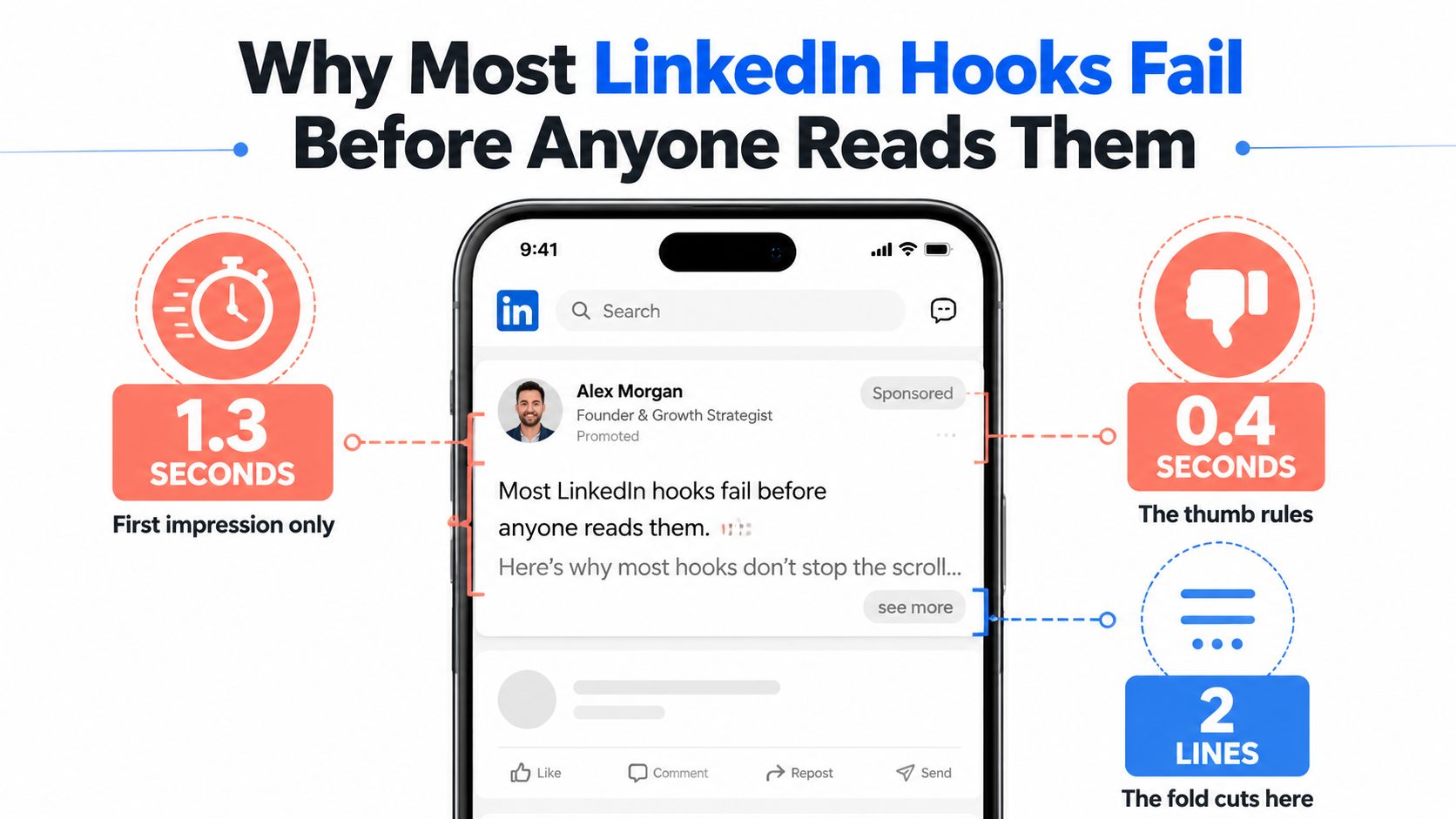
Why Most LinkedIn Hooks Fail Before Anyone Reads Them
A hook has one job, capture attention in the first 1 to 3 seconds. Guidance on social media hook performance identifies early retention as the key measure, with stronger hooks typically improving completion rates by 2 to 3 times compared with slow intros. See the analysis of social media hooks that stop the scroll for the practical measurement logic behind that claim.
That doesn't mean every post needs a dramatic opener. It means your first line must make the reader recognise a problem, tension, promise, or point of view quickly. “I've helped many teams improve their marketing” takes too long to become relevant. “Your content calendar is hiding a positioning problem” creates a sharper reason to continue.
The first day is the useful yardstick
LinkedIn performance doesn't arrive evenly. Metricool reports that impressions fell while engagement increased, with nearly 40% of interactions on personal profiles occurring on the first day. That makes the opening and the first day of distribution useful checkpoints, not vague signals to review whenever you remember. Read the LinkedIn statistics report from Metricool for the benchmark context.
Track what happens early, then compare it with the strength of the body. A post can collect impressions because the topic is timely. That doesn't prove the hook worked. Likewise, a witty line can earn attention while attracting the wrong audience. A founder seeking qualified conversations shouldn't optimise for applause from people who'll never buy.
Practical rule: Treat the hook as a testable claim about the reader's situation, not as a performance of cleverness.
The most common failures are predictable. Credentials delay the point. Borrowed phrases such as “Here's what nobody tells you” sound copied. Soft restatements of the title waste the scarce space before the fold. A better opening names a specific situation, introduces defensible tension, or promises a useful answer.
Formatting still matters. The guide on how to format a LinkedIn post for engagement is useful because line breaks, pacing, and the visible opening work together. For more examples of the underlying writing principles, see this guide on how to make a good hook. Keep the copy plain, make the claim clear, then let the body earn the reader's time.
How an AI Hook Generator Actually Works
Most tools hide a simple process behind a shiny button. You provide a topic, perhaps an audience, then a tone or style constraint. The model returns several opening lines based on familiar patterns such as a question, bold claim, story opening, statistic, contrarian stance, confession, or list tease.
The useful distinction is between generation and selection. A weak tool produces a handful of lines and leaves you with a small pile of polished sameness. A stronger workflow creates variants, checks them against your voice, removes unsupported claims, then ranks the options by fit for the post's purpose.
What the prompt controls
Your input should contain more than a topic. Add the reader, the business context, the desired action, the evidence available, and the tone you use. “Write hooks about sales” is a recipe for beige oatmeal. “Write for SaaS founders who rely on founder led sales, use a blunt tone, avoid hype, then focus on the cost of poor discovery calls” gives the model something to work with.
A useful AI hook generator should let you control at least four things.
- Audience signal: Who should recognise themselves immediately?
- Content goal: Are you seeking reach, saves, comments, qualified DMs, or a click?
- Hook type: Should the line lead with tension, a question, a story, a claim, or evidence?
- Voice constraint: What words, rhythms, claims, and habits should the model avoid?
For a practical grounding in the writing side, this guide on how to write a hook gives useful context before you start generating variants.
Where the human still matters
The model can explore angles quickly. It can't know whether a claim matches your actual experience unless you supply that information. It also can't protect your reputation from a statistic that sounds plausible but has no source.
The best workflow is simple. Let the tool draft. Let it group the lines by style. Review the options for specificity, credibility, and voice. Rewrite the winner yourself, then write the body around the promise made in the opening. The AI LinkedIn post generator guide is helpful for seeing how that wider drafting process can fit together.
Cheap generators stop at output. Useful systems expose enough control for you to understand why one line fits and another doesn't. If you can't explain the tradeoff, you're not choosing. You're hoping.
The Four Hook Styles That Still Work on LinkedIn
Four patterns keep earning attention because they create different reasons to continue. None is universally best. Each creates a different obligation for the body.
| Hook Style | Best For | Tradeoff |
|---|---|---|
| Specific number | Credibility and saves | Needs real evidence |
| Contrarian stance | Reach and debate | Can attract backlash |
| In media res story | Emotional connection and saves | Takes longer to build |
| Uncomfortable question | Comments and discussion | Requires a real answer |
Specific number
A precise number gives the reader a concrete object. “I reviewed 47 onboarding calls” feels more grounded than “I learned a lot from customer research.” It works well for operators with real logs, experiments, interviews, or account data.
The catch is obvious. The number must be yours or properly sourced. Don't manufacture precision because a line looks stronger with digits. Unsupported detail creates a credibility problem before the post reaches its second paragraph.
Contrarian stance
A contrarian hook makes a position visible. “Personal branding distracts founders before product fit” creates friction quickly. That can earn reach, but it also raises the standard for the rest of the post. You need a clear argument, a boundary, or an example that explains where the position applies.
A weak contrarian hook is just disagreement wearing sunglasses. If the body contains generic advice, readers will notice.
In media res story
Start inside the event. “Tuesday night, the rejection arrived” gives the reader a scene rather than a lesson. Story openings can build saves because people want to see how the situation resolves, especially when the ending contains a useful decision or change.
They're less efficient for short posts. The writer needs to move from scene to meaning without turning the opening into theatre class.
Uncomfortable question
Questions create a natural invitation to respond. “Why do you still measure LinkedIn by likes?” can generate comments from people with different answers. But the post must answer the question with something stronger than “likes don't matter.”
Choose the style based on the outcome. A B2B founder seeking inbound conversations will often favour a defensible contrarian claim or a sharp question. A creator seeking saves may get more value from a specific number or a compact story. Learn the mechanics of a pattern interrupt in copywriting, then choose the pattern that matches the reader's intent.
Real Hook Examples, Before and After
The examples below are illustrative rewrites, not lines to paste into your feed. The point is to see what changes when an opening moves from self description to reader relevance.
| Weak Hook | Strong Hook | What Changed |
|---|---|---|
| I've helped many B2B teams improve their sales process. | Most B2B sales teams lose deals during discovery, not negotiation. | Removed the credential and created a claim |
| I decided to change careers, and it taught me a lot. | My first interview after the career change ended in a rejection. | Started inside the event |
| Here are some lessons I learned from building a company. | Three hiring mistakes made our best process harder to run. | Added a specific problem and open loop |
| Nobody talks about how broken personal branding can be. | Personal branding can hide weak positioning from founders. | Replaced borrowed outrage with a precise stance |
| We're excited to announce our new product launch. | We removed one feature before launch because users kept ignoring it. | Added tension and a decision |
| I'm proud to share a personal win. | The client renewed after we stopped sending weekly reports. | Removed vague emotion and named the change |
Why the first versions stall
Most weak hooks lead with the writer's status, mood, or announcement. The reader has no reason to transfer attention from the feed to the post. The stronger versions create a gap. They introduce a problem, decision, or result that the body must explain.
Specificity does the heavy lifting. Replace “a lot” with the actual situation. Replace “excited to announce” with the decision behind the announcement. Remove hedging such as “I think,” “maybe,” and “in my experience” when the sentence can state the point cleanly.
A good rewrite also respects the promise. If the hook suggests a post about discovery calls, don't spend the body discussing brand awareness. Readers forgive plain writing. They don't forgive a bait and switch.
Scrubbing AI tells
AI generated hooks often reveal themselves through rhythm rather than meaning. Watch for em dashes, three part parallel phrasing, inflated vulnerability, generic confessions, and lines that sound designed for every industry at once.
Read the hook aloud. Delete words you wouldn't say to a client or colleague. Swap broad language for an observed detail. If the sentence could appear on a coach, founder, recruiter, or crypto account without changing a word, it's probably too generic.
A human hook usually has a point of view. A machine hook usually has a format.
Where ViralBrain Fits in Your Hook Workflow
An AI hook generator should sit inside a loop, not replace the loop. The useful sequence starts with an idea, checks patterns from posts that performed for a relevant audience, creates several angles, then sends the chosen opening to a human writer.
ViralBrain fits that workflow through hero post analysis, tone personalization, and a hook library. Its product description says the platform analyses high performing posts from selected creators to surface hooks, structures, and calls to action. It can then adapt those patterns to a user's topic and writing voice.
The useful split
Start with one sentence that captures the idea. The analysis layer helps identify repeated structures in your own niche instead of pulling a random template from a giant library. That distinction matters because formulaic hooks are becoming easier to recognise.
Tone personalization should absorb your sentence length, level of directness, preferred vocabulary, and typical use of evidence. It won't produce your voice perfectly on the first pass. You still need to reject lines that feel too neat, too dramatic, or too polished.
The hook library is useful after you find a promising structure. Save the opening, then explore alternate angles for the same thesis. One version might lead with a question. Another might use a claim. A third might open with the uncomfortable detail you usually bury in paragraph four.
The human chooses the angle for the week's point of view. The human writes the body. The tool supports exploration, not identity.
That second image would repeat the same asset, so it shouldn't appear in a real workflow. The correct lesson is less glamorous. Keep the tool away from full ghostwriting if the audience follows you for your judgement. For broader tool research, this curated list of AI tools for marketers offers useful comparison material, but don't confuse a long list with a measurement system.
Prompt Templates and Team Workflows You Can Steep
Prompts work better when they force the model to make choices. Give it a topic, audience, goal, evidence, voice, then exclusions. Ask for variants by type, not ten versions of the same sentence wearing different hats.
Four prompts worth saving
Hook variant generator
Write five LinkedIn hooks for this idea: [idea].
Audience: [audience].
Goal: [reach, saves, comments, or qualified DMs].
Create one question, one contrarian claim, one story opening, one value promise, and one evidence led hook.
Use plain language. Avoid hype, clichés, unsupported statistics, em dashes, and generic openings.
Explain the tradeoff of each option in one sentence.
Contrarian rewriter
Rewrite this claim into three defensible LinkedIn hooks: [claim].
Make each position narrower and more useful.
Don't invent evidence.
State what the claim applies to, then flag the risk of sounding overstated.
Story to hook distiller
Turn this story into five one line openings: [story].
Keep the concrete event. Remove the lesson from the hook.
Use one scene led version, one decision led version, one mistake led version, one result led version, and one question.
Humanizer pass
Review these hooks: [hooks].
Remove buzzwords, fake vulnerability, inflated claims, parallel three part phrasing, and words I wouldn't say aloud.
Keep the meaning. Make each line sound like a specific person with a clear opinion.
Flag any claim that needs a source.
Three ways teams can use them
A solo creator can generate a batch during a weekly planning session, keep the strongest options, then publish only the one that fits the actual idea. The handoff is simple. AI owns volume. You own judgement, body copy, and final edit.
A small team can store approved hooks in a shared library. One person drafts, one reviewer checks specificity and voice, then the writer revises before the post enters the calendar. Compliance review belongs after the creative review, not before it. Otherwise everyone edits the line into beige paste.
An agency needs separate voice profiles for each client. The strategist sets the thesis and rejects weak angles. The model explores variations. A reviewer checks claims, tone, and brand restrictions. The client sees a narrowed set, not the entire machine room.
No hook ships without a human first read. Not a skim. A real read aloud. If the writer wouldn't say it in a meeting, the audience probably won't believe it in a feed.
Measuring Hook Performance Without Lying to Yourself
The wrong metric can make a bad hook look successful. Raw impressions tell you that LinkedIn distributed the post. They don't tell you whether the opening earned attention from the right people.
LinkedIn's average engagement rate is 5.20% in 2026, up 8% year over year, based on analysis of 1.3 million posts across 16,645 business pages, according to Socialinsider's LinkedIn benchmarks. Native document posts lead that benchmark at 7.00% engagement, which means format choice can affect the result before your wording gets judged.
A separate benchmark reports that carousel and document posts can reach about 24.42% average engagement, or 3.7 times more than text posts, while short videos under 60 seconds receive 53% more engagement than longer video. The figures come from this LinkedIn engagement metrics summary. Treat them as comparison points, not promises for your account.
Leading signals versus lagging signals
| Metric | When to Check | What It Tells You | Watch Out For |
|---|---|---|---|
| Early impressions | First 30 minutes | Whether distribution started | Topic timing can distort it |
| Comment velocity | First hour | Whether the opening creates a response | Cheap agreement isn't useful |
| Profile taps | Early distribution | Whether the hook attracts the right curiosity | High taps can still produce poor leads |
| Engagement rate | After the post settles | Broad response relative to reach | Format changes the baseline |
| Follower growth | Later review | Whether the post builds audience value | Attribution is messy |
| Comment quality | Later review | Whether the post attracts useful discussion | Volume hides weak intent |
Use a weekly log with one changed variable. Keep a control post with a familiar format. Record the hook style, format, early impressions, comments, profile taps, then the quality of the conversations that follow.
Don't pretend saves prove hook quality. Saves may reflect useful density in the middle of the post. A strong hook can earn the read, while the body earns the save. Those are different jobs.
Detecting AI sameness
Look for uniformity across your own posts. If every opening uses a bold claim, the same sentence length, the same “nobody tells you” setup, or identical punctuation, your generator is homogenising the feed.
The best result isn't the highest number of variants. It's a clearer link between hook style, audience response, format, and business outcome. Your AI hook generator should help you learn what earns attention from your audience. If it only makes more lines that sound alike, cancel the experiment and write one honest sentence.
ViralBrain offers hero post analysis, tone personalization, a hook library, Smart Suggestions, and analytics for turning proven LinkedIn patterns into drafts you can review manually. Visit ViralBrain to test its LinkedIn hook workflow, then measure the openings against your own first day engagement data.
Grow your LinkedIn to the next level.
Use ViralBrain to analyze top creators and create posts that perform.
Try ViralBrain free