
B2B SaaS Content Marketing Playbook That Actually Works
A practical B2B SaaS content marketing playbook covering audience, pillars, distribution, LinkedIn, and measurement, written for teams that want leads, not
Grow your LinkedIn to the next level.
Use ViralBrain to analyze top creators and create posts that perform.
Try ViralBrain freeMost advice about B2B SaaS content marketing starts with a publishing target. More blog posts. More keywords. More traffic. That advice is tidy, measurable, and often useless when sales asks where the next qualified opportunity came from.
A better system starts with proof. Build assets that help buyers compare options, defend a purchase, understand implementation, and forward something useful to a colleague. Then distribute those assets where buyers already pay attention, especially LinkedIn, and connect the activity to pipeline.
Why Most B2B SaaS Content Programs Stall
The uncomfortable gap is easy to find. A 2025 Content Marketing Institute study found that 97% of B2B marketers have a content strategy, yet only 13% said it significantly improved results and ROI. Another 48% said performance improved only somewhat.
That tells us something practical. Having a strategy document doesn't mean the business has a working content system. Many teams have an editorial calendar, a keyword sheet, and a monthly report. They still can't show which asset helped a real buyer move forward.
The usual failure pattern
Teams often write for broad informational keywords because those topics are easy to find and easy to assign. The result is a library full of educational posts that attract people who want an answer, not a software vendor.
The second problem is measurement. Traffic, impressions, and rankings are useful signals, but they don't explain whether a sales rep received a better-informed prospect. If the report stops at sessions, marketing is measuring visibility while leadership is asking about revenue.
The third problem is internal distance. Content reports to brand or marketing. Sales owns pipeline. Nobody connects the post, campaign, CRM record, opportunity, and assisted conversion. Attribution then becomes a polite fiction with attractive charts.
| What Teams Optimize For | What Actually Moves Pipeline |
|---|---|
| Broad keyword volume | A specific buyer problem |
| Pageviews | Qualified conversations |
| Publishing frequency | Useful proof at the right stage |
| Generic educational posts | Comparisons, use cases, and customer evidence |
| Marketing owned assets | Content sales can forward |
| Impressions | Content influenced opportunities |
A sound operating model needs a clear audience, commercial intent, useful evidence, and a measurement path. Grou's practical guide to building a content engine for B2B is useful for the operating side, but the principle is simple. Stop treating content as a queue of posts. Treat it as sales infrastructure.
Practical rule: If a sales rep wouldn't send the asset to a prospect, ask why the team is producing it.
The rest of the system follows from that rule. Publish less generic material. Build stronger proof. Give every asset a job. Then check whether that job affected demand or pipeline.
Defining the Audience and Positioning That Earns Attention
Content gets vague when the audience is vague. “B2B decision makers” isn't an audience. It's a fog machine.
Start with one primary persona and one named secondary persona. Segment accounts by use case, intensity of the problem, and role in the buying committee. The user may care about speed and ease of use. The finance lead may care about risk and justification. The technical evaluator may care about integrations and implementation effort. One page can't speak to all three with equal force.
Build a pain map
For each stage of evaluation, write four fields.
- Job to be done: What must the buyer accomplish?
- Fear of inaction: What gets worse if nothing changes?
- Trigger event: What makes the problem urgent now?
- Success measure: What metric or outcome is the buyer judged on?
Use the buyer's language from sales calls, support tickets, interviews, and lost deal notes. “Needs better reporting” is weak. “Spends every Monday rebuilding a report before the pipeline meeting” gives a writer something real to work with.
B2B buyers do substantial research before speaking with sales. A 2026 summary of Content Marketing Institute data says buyers consume 13.4 pieces of content on average before contacting sales, while 67% of the buying journey is self directed. Your content needs to answer questions before a rep gets invited into the conversation.
Reduce positioning to four decisions
Use a simple positioning structure.
- Category: What kind of solution is this?
- Obvious alternative: What would the buyer use or tolerate instead?
- Differentiated promise: What can you credibly do better or differently?
- Proof point: What evidence supports the claim?
Avoid adjectives such as “powerful” and “smooth.” They say nothing. State the contrast. For example, a product may help revenue teams replace spreadsheet based handoffs with a shared workflow that shows ownership at every stage. The proof might come from customer interviews, product evidence, or original research. Don't manufacture a number just to make the sentence look impressive.
Draft a one page audience brief with these fields.
| Field | What to write |
|---|---|
| Buyer | Primary role and secondary role |
| Trigger | Event that creates urgency |
| Pain in their words | Exact problem language |
| Promise | Clear change the product supports |
| Proof | Customer, product, or research evidence |
| Next CTA | The action the next asset should drive |
You should be able to draft this in under an hour. If you can't, the content plan is premature. Every hook, topic, channel, and call to action will otherwise be guesswork wearing a branded shirt.
Content Pillars Built Around Proof, Not Just Posts
A content pillar should carry evidence, not merely a theme. “Marketing automation” is a topic. A customer story showing how a team replaced a manual process is an asset buyers can use.
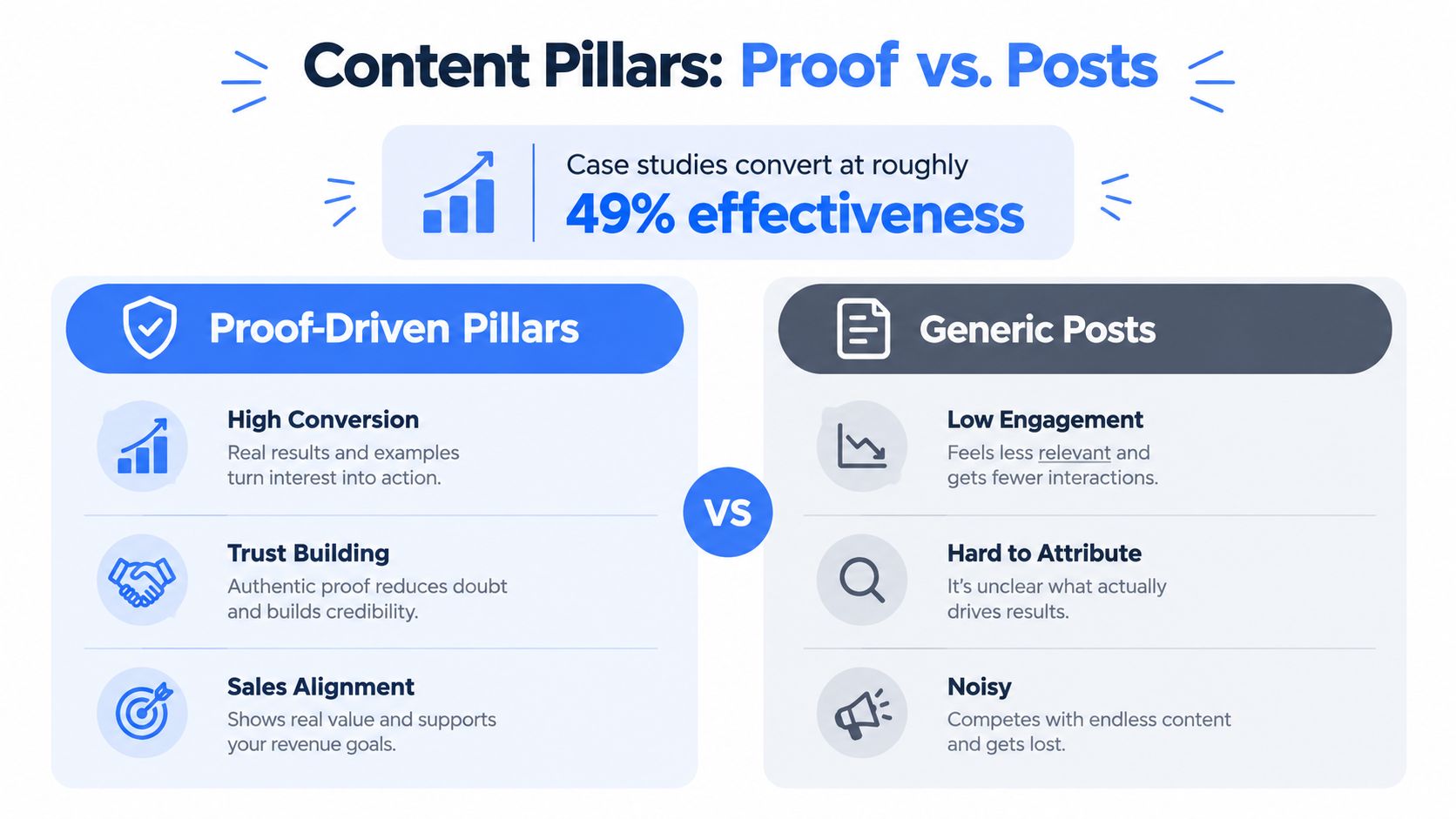
Independent SaaS benchmark data puts case studies at 49% effectiveness for generating sales, ahead of general website content at 20%, eBooks and reports at 11%, and blog posts at 10%. Those figures come from Position Digital's summary of SaaS marketing statistics. The lesson isn't that blogs have no role. It's that generic blogs rarely carry enough proof to close the distance between interest and purchase.
Choose a small set of commercial pillars
Use three or four pillars, each anchored to a proof asset.
- Customer outcomes: Case studies, implementation stories, and evidence from customer work.
- Product expertise: Workflow guides, teardowns, integrations, and product use cases.
- Original research: Surveys, benchmarks, and internal data that others can't copy from a search result.
- Contrarian expertise: A clear point of view based on repeated customer problems.
Map each pillar to one funnel role and one keyword cluster. Give each one internal ownership. A pillar without an owner becomes a shared document that nobody updates.
A practical production ratio is 40% proof led assets, 30% expertise led explainers, 20% narrative LinkedIn posts, and 10% experiments. Treat that as a capacity model, not a universal law. If the sales team keeps repeating the same proof on calls, increase the share of assets that capture it. If prospects keep asking about implementation, an opinion post won't solve the problem.
The content pillar strategy guide from ViralBrain can help structure themes around repeatable ideas. The tool matters less than the decision behind it. Every pillar should answer, “What uncertainty does this remove for a buyer?”
Content that earns attention creates interest. Content that carries proof helps a buying committee agree.
Don't hide the proof at the bottom of a page. Put customer context, limitations, screenshots, process detail, and clear outcomes near the claim they support. Buyers don't need more polished adjectives. They need reasons to believe the product fits their situation.
Ideation Systems and Hook Structures That Scale
Random brainstorming produces random output. A better system starts with patterns that already earn qualified attention in your category.
Review the last 20 posts from relevant creators, brands, and competitors. Tag each by hook type, then score it for proof density. Ignore vanity engagement if the comments contain no buyer language. A post with modest reach and several relevant DMs may be more valuable than a post with broad applause from people who will never buy.
Build a monthly backlog from three inputs.
- Customer call language
- Sales objections
- Competitor comment sections
Aim for 30 ideas in the backlog, then cut aggressively. Ideas that lack a specific buyer, a credible point, or a useful payoff should not survive because they sound clever.
Use a four part hook
A reliable hook has four pieces.
- Pattern interrupt: Challenge a familiar recommendation.
- Credibility anchor: Show the experience or evidence behind the claim.
- Tension: Name the cost, tradeoff, or mistake.
- Payoff: Tell the reader what they can do differently.
For example, “Your SaaS blog doesn't need more topics. It needs more evidence” creates tension. The body can then show which sales objections became case study angles and which generic posts failed to help evaluation.
| Hook Type | Best For | Example Opener | Format |
|---|---|---|---|
| Contrarian claim | Challenging common advice | “More posts won't fix weak proof.” | Text post |
| Specific number | Framing a bounded problem | “Three objections kept appearing in every call.” | Carousel |
| Named mistake | Teaching from failure | “The keyword mistake that filled our calendar with noise.” | Text post or video |
| Before and after | Showing a process change | “We replaced a topic list with a buyer question map.” | Carousel |
| Story driven | Making evidence memorable | “A prospect forwarded one paragraph to the CFO.” | Video or long post |
A hero post can become a carousel, a short text post, a thread, an email, and a sales snippet. ViralBrain can analyze high performing creator patterns, adapt a draft to a user's voice, and support repurposing into LinkedIn content. It belongs in the workflow as a production option, not as a substitute for customer evidence.
For teams producing video derivatives, Nereo's guide to scaling video creation offers useful production context. The same rule applies there. Scale a proven idea, not empty filler.
LinkedIn First Distribution and Format Mix
LinkedIn deserves priority because B2B attention and leads cluster there. A 2026 benchmark summary says 97% of B2B marketers use LinkedIn for content distribution, 77% report the best organic results there, and LinkedIn accounts for 80% of B2B social media leads.
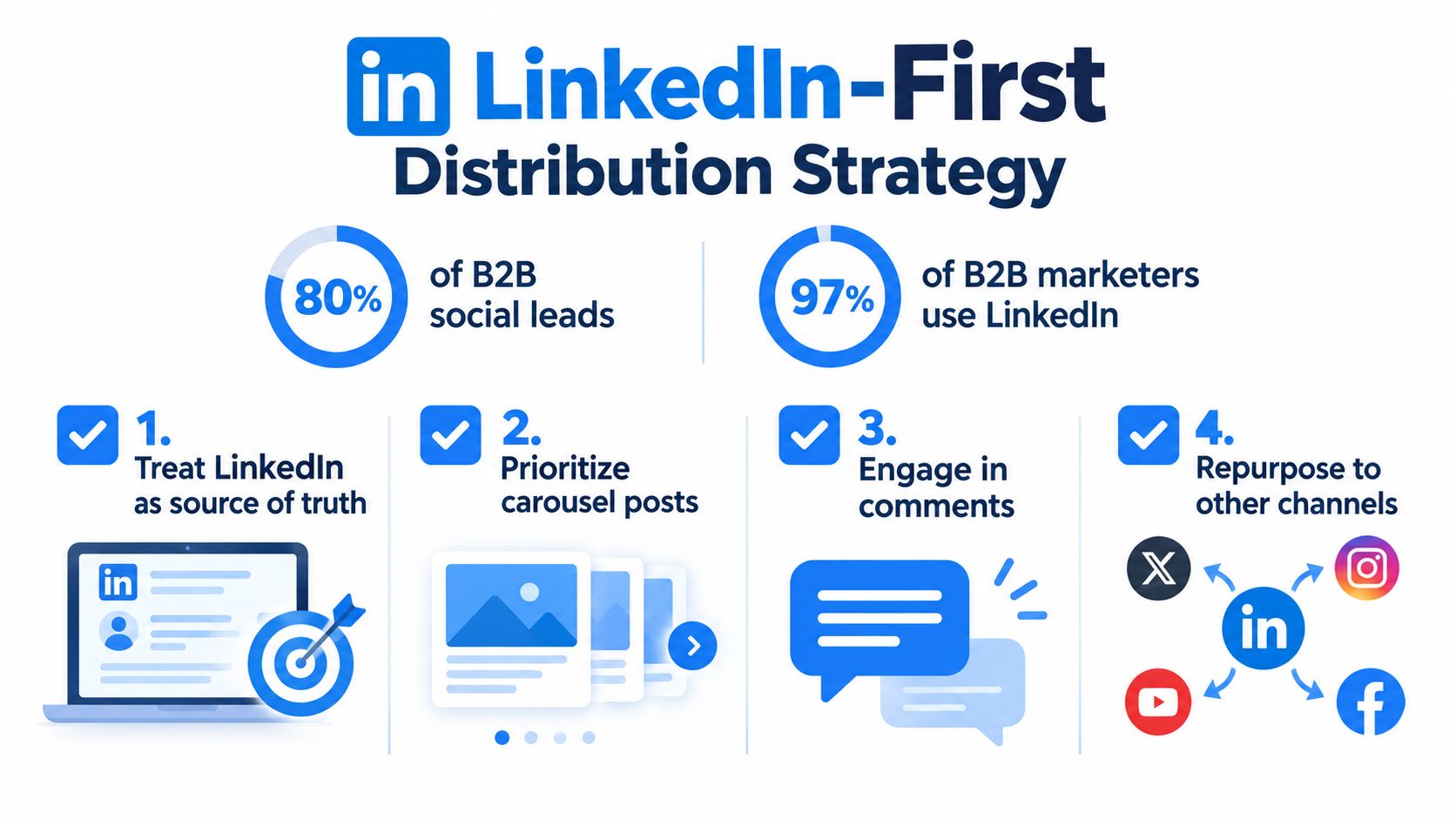
Treat LinkedIn as the source of truth, then cut the strongest ideas for email, communities, and other channels. Don't paste a blog introduction into a LinkedIn post and call that distribution. The platform needs a native point, a clear tension, and a useful ending.
A workable weekly mix includes text posts, carousels or PDFs, a longer article, and a founder or customer video. Keep the formats tied to jobs. Text posts test opinions. Carousels teach a process. Video shows product use or customer context. Long form pieces collect the argument in one place.
Format choice affects engagement. Socialinsider's 2025 LinkedIn benchmark reports average engagement rates of 6.60% for multi image posts, 5.60% for video, 4.85% for image posts, 4.40% for polls, and about 4% for text only posts. Engagement isn't pipeline, but the pattern supports a practical choice. Use visual or structured formats when you need attention for a process, comparison, or proof point.
Comments deserve a real operating plan. Leave useful comments on accounts followed by your ICP. Add a point, example, or counterargument. “Great post” is not distribution. It's a tiny public admission that you had nothing to say.
Track profile views, connection requests from target roles, and DMs containing relevant keywords. Likes can tell you that a post travelled. They can't tell you whether the right people took the next step. Use the LinkedIn posting strategy guide from ViralBrain to tighten the publishing workflow, then connect those interactions to CRM notes and opportunities.
Repurposing One Asset Into a Quarter of Content
One strong case study or webinar can support a long run of useful distribution when each derivative has a distinct job. The source asset should contain real customer language, a clear problem, the implementation context, and evidence of what changed.
A practical chain starts with a customer interview. Turn it into a long form case study, then extract a carousel, several LinkedIn posts built around separate insights, a short founder video, a sales one pager, nurture emails, and a podcast pitch. The exact mix depends on the audience and the source material. Don't force a quote into a format where it loses meaning.
Keep the tracker boring
Boring trackers prevent expensive omissions. Record the owner, channel, publication date, and CTA before production begins. If a derivative has no clear CTA, it may be an interesting observation rather than a useful asset.
| Source Asset | Derivative Format | Channel | Owner | CTA |
|---|---|---|---|---|
| Customer interview | Long form case study | Website | Content lead | Read the full story |
| Case study | Carousel | Social lead | View the workflow | |
| Case study | Text posts | Founder or marketer | Reply with the objection | |
| Case study | Short video | LinkedIn and email | Video owner | Watch the walkthrough |
| Case study | Sales one pager | Sales enablement | Product marketer | Share with the account |
| Case study | Nurture emails | Demand lead | Book an evaluation | |
| Case study | Podcast pitch | Partner channel | PR or founder | Request an interview |
| Case study | Comparison angle | Website | SEO lead | Compare approaches |
| Case study | Internal objection notes | Sales team | Revenue enablement | Use in active deals |
The goal isn't to pretend one interview creates endless content. The goal is to avoid wasting the expensive part, which is getting access to a customer with something real to say.
Review derivatives by saves, relevant comments, DMs, assisted conversions, and sales usage. Retire formats that repeatedly attract the wrong audience. Keep the source asset alive when it continues to answer a buyer question, but don't keep reposting the same sentence with a new background colour.
Measuring Pipeline Impact and Running the 90 Day Loop
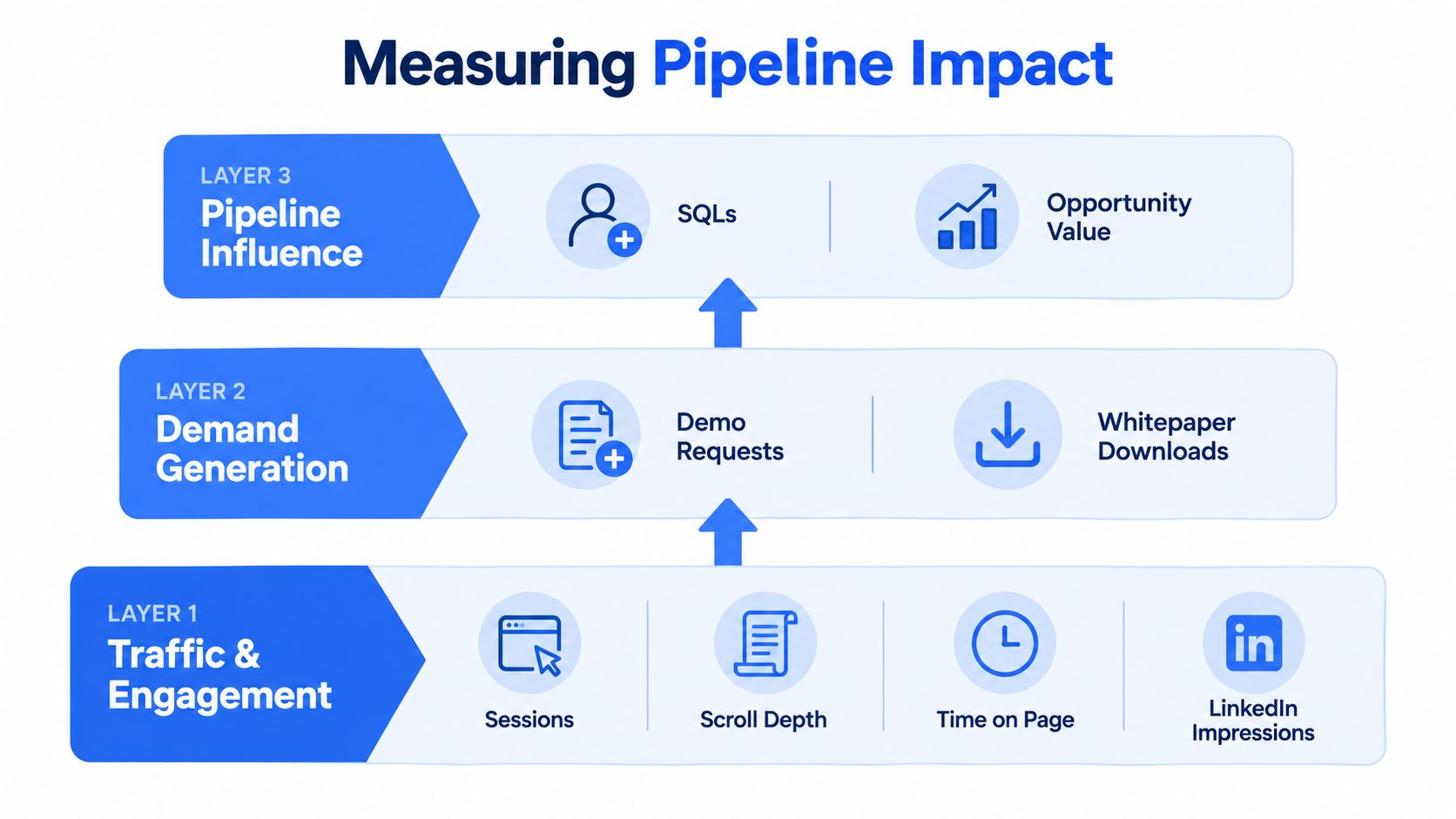
Content measurement needs three layers. The first shows attention. The second shows intent. The third shows commercial influence.
Track sessions, scroll depth, time on page, LinkedIn impressions, and comments at the attention layer. Track demo requests, pricing page visits, content UTMs, qualified leads, and content sourced trials at the demand layer. At the pipeline layer, connect first touch, multi touch, assisted conversions, and closed won opportunities to the assets people consumed.
A 2026 B2B SaaS benchmark report from Contentful says 59% of teams track direct conversions and 54% track pipeline influence. That shift matters. A content program can help a deal without being the first or last interaction, especially when several stakeholders read different assets before sales gets involved.
Wire the system before judging it
Use consistent UTMs for channel, format, campaign, and asset. Store the asset name in the CRM when a lead converts. Add content consumption to opportunity records where possible. Sales should be able to see whether a case study, post, webinar, or comparison page appeared during the deal.
If the team needs outbound support alongside content, Lead Printer's guide to choosing an outbound lead generation service is a useful reference for evaluating that separate motion. Keep the reporting distinct. Outbound activity shouldn't take credit for content influence, and content shouldn't claim an opportunity it never touched.
Run the operating loop in four phases.
- Weeks 1 and 2: Set a baseline, define three KPIs, and instrument the CRM.
- Weeks 3 through 6: Ship the pillar assets and distribute their derivatives.
- Weeks 7 through 10: Review funnel drop offs, sales feedback, and assisted conversions.
- Weeks 11 and 12: Prune weak assets, refresh strong ones, and present pipeline influence.
The first review should answer three questions. Which asset attracted the right people? Which asset helped them evaluate? Which asset appeared in opportunities that progressed? If the dashboard can't answer those questions, improve the tracking before increasing output.
Use a 90 day checklist. Pick three KPIs. Build the dashboard. Ship a focused set of assets. Run one hook test. Remove the weakest ideas. Present the pipeline evidence to leadership with caveats, not theatre.
A content system works when it gives buyers useful proof, gives sales material worth forwarding, and gives leadership a credible view of commercial impact. ViralBrain helps teams analyze proven LinkedIn patterns, create posts in a consistent voice, repurpose source material, and manage the publishing workflow. Visit ViralBrain to see whether its LinkedIn workflow fits your B2B SaaS content process, then test it against one real pillar asset and measure what happens next.
Grow your LinkedIn to the next level.
Use ViralBrain to analyze top creators and create posts that perform.
Try ViralBrain free