
10 Best Digital Marketing Strategy Tactics
Compare the best digital marketing strategy tactics for 2026, with practical steps, LinkedIn methods, KPIs, examples, and tool workflows.
Grow your LinkedIn to the next level.
Use ViralBrain to analyze top creators and create posts that perform.
Try ViralBrain freeThe popular advice is to “be everywhere.” That usually means producing more posts, buying more tools, then measuring applause instead of business results. Busywork gets a calendar. Useful marketing gets a measurable path from audience insight to channel execution, then from execution to leads, sales, or retained customers.
This ranking treats the best digital marketing strategy as a working system, not a favorite channel. Each tactic is ranked by four tests: how clearly it fits a defined audience, how well it works in a real channel, how cleanly it can be measured, and whether a team can repeat it without heroic effort. Track reach, engagement, clicks, leads, conversion rate, cost, and revenue where the data exists. If a tactic can't answer what happened after publication, it's probably decoration with a login.
Digital channels now take the largest share of media spending. One 2026 digital advertising summary reports about $740 billion in digital advertising, roughly 73% of global media spend, while another 2026 brief places digital at about 67.5% of marketing budgets. That makes disciplined execution less optional. Use this guide to prove content ROI in 2026, then give LinkedIn extra attention because it offers a clear test case for content, profiles, community, and analytics.
1. Pattern Recognition and Reverse Engineering
Random posting is not a strategy. It's a small experiment performed repeatedly with no notes.
Start by studying strong content from creators who serve the same audience. Look for the underlying structure, not the words. A B2B SaaS founder might examine how other founders frame product launches. A sales leader might study how respected closers explain objections. A marketer might compare LinkedIn carousels that teach a process with those that merely decorate a claim.
This approach works because it turns vague inspiration into observable choices. Note the opening, sequence, proof, format, point of view, and call to action. Then adapt the pattern to your own experience. Copying language makes you forgettable. Borrowing structure gives your useful idea a fair chance.
Practical rule: Study patterns to understand why a post works, then replace the subject, proof, and voice with your own.
What to record
Build a small research sheet. For each post, capture:
- Audience problem: What pain or decision does the post address?
- Opening move: Does it lead with a mistake, tension, observation, or practical promise?
- Proof type: Does it use experience, data, an example, or a clear process?
- Format: Is it a text post, carousel, video, or document?
- Action: Does it ask for a comment, click, conversation, or nothing?
Review enough examples to spot repeated choices. ViralBrain supports this workflow by analyzing high performing LinkedIn posts, surfacing hooks, structures, and calls to action, then helping adapt them to a user's topic and voice. You can also use the TransClipper reverse engineering method as a useful model for breaking finished content into parts.
For a practical test, choose one audience, collect a focused sample of relevant posts, and create several versions using different structures. Measure reach, engagement, profile visits, clicks, and leads. Keep the patterns that attract the right people, not merely the largest crowd.

2. Niche Positioning and Audience Clarity
A message aimed at everyone usually lands with nobody. The problem isn't a lack of creativity. It's a lack of a specific reader.
Choose an audience by job, industry, problem, or buying stage. “Marketing professionals” is broad. “B2B demand generation leads trying to turn LinkedIn attention into qualified pipeline” gives a writer something useful to say. It also gives analytics something useful to measure.
Specific positioning sharpens content decisions. A founder writing for bootstrapped software companies will discuss cash discipline, pricing, and product focus. A sales professional serving enterprise buyers will write about procurement, internal consensus, and risk. Neither needs to compete for attention with every general business account publishing another post about waking up early.
Test the audience before you marry it
Write a small run of posts for one narrow group. Watch the quality of reactions, not only the count. Relevant comments, profile visits from the right roles, direct messages, clicks from target accounts, and qualified leads matter more than broad applause.
Use the language your audience already uses. Don't force industry terms into every sentence. Clear language often reveals whether you understand the problem or are hiding behind vocabulary.

The channel mix should follow the audience. As of April 2026, 6.12 billion people used the internet worldwide, equal to 73.8% of the global population, while 5.79 billion social media user identities were active. Mobile access matters too. 96.2% of internet users went online via mobile at least some of the time, and mobile devices generated 51.6% of global web traffic, according to SEOProfy's digital marketing statistics. Those figures support mobile first discovery, but they don't tell you which channel will produce buyers. Your own audience data still has the final vote.
3. Value First Content Strategy
A sales page starts with a request. Useful content starts with a decision the reader needs to make. That difference determines whether LinkedIn becomes a trust-building channel or another stream of low-context promotion.
Value first content gives readers a method, framework, example, or decision rule they can apply immediately. A sales manager might explain an objection-handling process. A founder could show the reasoning behind a pricing decision. A demand generation lead might map an audience problem to a channel, offer, measurement plan, and repeatable workflow.
The commercial boundary should be clear: publish the method, then charge for implementation, access, service, or accountability. Hiding every useful detail behind a form protects a claimed “secret sauce” while giving prospects little evidence that it works.
Judge value by the next action
A strong post changes what the reader can do. They might rewrite a landing page, choose a channel, prepare for a sales call, or create a reporting view. The test is practical, not flattering. If a reader cannot apply the idea without booking a meeting, the post is probably a pitch with educational decoration.
Use three checks:
- Show the process: Explain the order of actions, not only the conclusion.
- Name the constraints: Include the audience, context, trade off, or failure that shaped the approach.
- Place the offer after the help: Connect the lesson to a paid service without turning each paragraph into a sales prompt.
Only 29% of B2B marketers say their content strategy is extremely or very effective, while 58% call it moderately effective, according to Content Marketing Institute's 2025 B2B research. The useful conclusion is narrower than “publish more.” Teams need a clearer connection among audience need, usable content, measurement, and a business outcome.
A growth consultant could publish the framework used to audit a demand program, measure which recommendations affect qualified opportunities, and sell the audit and implementation. The post demonstrates the thinking. The service handles the work that requires context, coordination, and accountability.
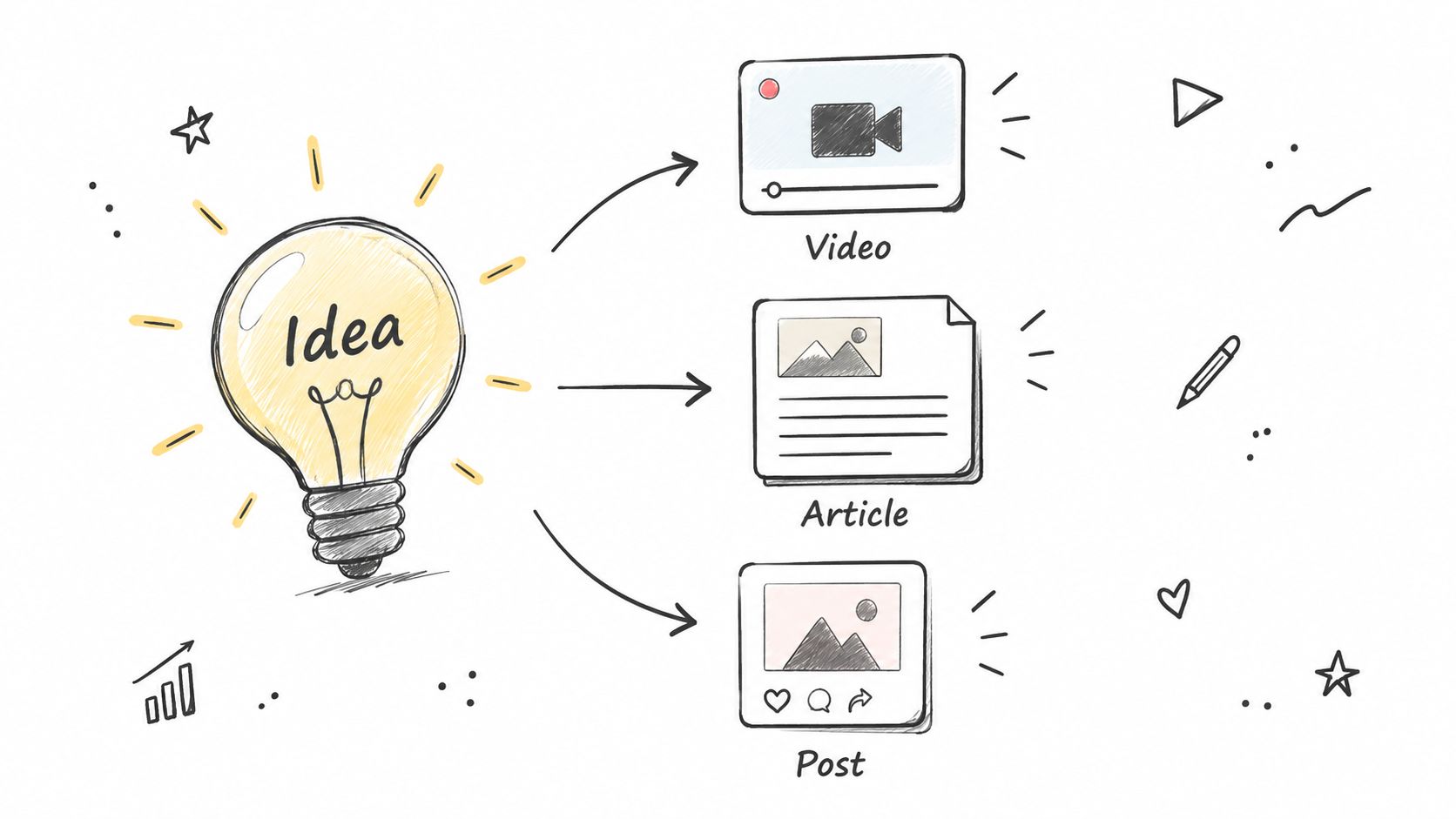
That service logic also appears in Crescade's solutions. Teach enough to prove competence, connect the lesson to a measurable next step, and make the paid offer specific.
4. Hook Driven Content
The first line has one job. It must earn the second line.
A hook can state a surprising problem, name a costly mistake, introduce a useful observation, or create tension around a decision. It shouldn't promise a result the post can't support. “Your LinkedIn profile is costing you deals” is only useful if the post explains which profile choices create friction and how to fix them. Otherwise, it's bait wearing a tie.
Write several openings before choosing one. Test the type of hook, not only the topic. A contrarian opening may suit an experienced audience. A direct process may work better for buyers searching for practical help. A personal admission can work when it leads to a clear business lesson rather than a diary entry.
A clean hook test
Keep a record of the opening, format, audience, and outcome. Compare reach, early engagement, clicks, profile visits, and leads. Don't call a hook successful because it attracts comments from people who will never buy. A crowded comment section can still produce an empty pipeline.
Short openings often help readers understand the point quickly, but brevity isn't a substitute for relevance. The strongest hook and the weakest body create a fast route to distrust.
Use this guide to making a good hook for ideas, then rewrite every suggestion in language your audience uses. A LinkedIn post for CFOs should sound different from one for startup marketers. The platform is the same. The reader isn't.
The hook earns attention. The proof earns trust. The next step earns the conversion.
5. Data Backed Claims and Original Research
Evidence strengthens a marketing argument only when readers can inspect its source, relevance, and limits. A number without context is decoration with better formatting.
Start with a decision, then gather the evidence that can inform it. Compare lead sources, content formats, sales-cycle movement, landing-page actions, and conversion quality. A small test with a clear audience, method, and outcome can teach more than a large figure whose conditions remain unknown.
For original research, record four details: what changed, who was included, how the test ran, and what result shifted. “Our test improved performance” leaves too much unresolved to guide a campaign. State the baseline when available, explain the comparison, and separate observed movement from a conclusion about cause.
A useful benchmark illustrates the point. CMI reporting places content outcomes in this order: brand awareness at 87%, demand or lead generation at 74%, nurture at 62%, loyalty at 52%, and sales or revenue at 49%, as reported by Business Growth Assistant's B2B content goal benchmarks. The sequence supports an operating logic: build recognition, create demand, support consideration, then connect content with revenue. It also warns against assigning every business outcome to one post.
LinkedIn distribution adds another requirement. A chart should change a campaign choice, sales action, or editorial decision. Otherwise, it is a spreadsheet looking for an audience.
Use this evidence filter before publishing:
- Source: Link to the original report where possible.
- Limit: State what the evidence cannot prove.
- Action: Show which decision the finding should affect.
For a practical framework connecting research with planning, use this data driven content strategy guide. Precision should clarify uncertainty, not disguise it.
6. LinkedIn Carousel Posts and Visual Content
A carousel earns attention by controlling the reader's next question. Use it to explain one comparison, process, timeline, mistake pattern, or before-and-after change. Each slide should advance that explanation. Crowded slides turn a useful idea into a formatting problem.
Start with the audience insight that gives the topic relevance. A B2B marketing team might know that buyers struggle to compare demand sources. That insight can become a sequence showing the options, decision criteria, and a practical scoring model. A sales leader could map one deal stage per slide, while a founder could trace a product decision through its timeline. The format works when the visual order mirrors the reader's decision process.
The first slide names the problem or promise in plain language. Middle slides carry one idea at a time, with enough space for phone reading. The last slide gives a takeaway or relevant next action. A ten slide explanation can work if every slide moves the argument forward. Ten slides of tiny type are an unpaid eye exam.
Judge the asset as part of a workflow, not as a design exercise. Track impressions, engagement, saves, profile visits, clicks, and leads, then compare the carousel with other formats addressing the same audience and topic. Saves may indicate reference value, while clicks and leads connect more directly to a business action. None of these measures makes attractive design a substitute for a useful decision, example, or method.
Use consistent visual choices so readers recognize a series. Canva can handle production without turning the marketing team into a part time studio. The difficult work is selecting evidence and decisions that deserve a slide, then recording results for the next iteration.
7. Content Repurposing Across Channels
Repurposing is efficient only when the idea survives the change in format.
Start with one strong source, such as a webinar, article, podcast conversation, or detailed LinkedIn post. Extract the central claim, supporting proof, examples, and next step. Then rebuild the material for each channel. Don't paste a blog paragraph into LinkedIn and call it a distribution strategy. Different channels reward different reading habits.
A founder's product lesson could become a LinkedIn text post, a carousel showing the decision process, a short video, an email explanation, and a sales enablement note. A Reddit discussion about customer pain could become a post that answers the problem without exposing the original user. A podcast transcript can provide several distinct ideas, but only if each one stands on its own.
Keep the angle, change the shape
- LinkedIn: Lead with a clear observation, then explain the reasoning.
- Email: Add context and a direct reader action.
- Video: Use a spoken example and visual proof.
- Carousel: Break the process into steps or contrasts.
HubSpot's 2026 marketing report says 35.08% of marketers repurpose content across channels, while 48.57% use AI to create personalized content and 47.38% use automation, according to HubSpot's state of marketing report. The figures show that reuse and automation are established practices, not permission to publish identical material everywhere.
Use an AI content repurposing tool to speed up extraction and drafting, then edit for audience, channel, and truth. Automation can multiply a good idea. It can multiply a dull one too, which is less helpful than it sounds.
8. Community Engagement Over Broadcasting
A LinkedIn feed is not a noticeboard. Publishing creates exposure, while useful participation creates evidence that your team understands the problems its audience discusses.
Start with the conversations your buyers already join. Read posts from relevant accounts, identify a recurring question or weak assumption, then add an example, distinction, correction, or follow-up question. Replies to your own posts deserve the same standard. “Great post” occupies space without adding information, which makes it closer to office decoration than marketing.
The operating model is simple: employees and executives contribute informed perspectives, while the company page supplies context, product detail, and proof. One 2026 benchmark roundup reports 8 times more engagement on personal profile posts than company pages and 5.6 times more organic reach for personal profile content, according to Owlclaw's LinkedIn benchmarks. Those figures support testing personal-profile participation, not abandoning the company page or treating benchmarks as guarantees.
A workable routine needs three connected steps:
- Read target accounts: Track the topics and objections appearing in buyer discussions.
- Write useful comments: Add a concrete example, distinction, or practical correction.
- Continue the thread: Answer serious replies and record repeated questions for future content or sales conversations.
Measure profile visits, connection quality, inbound conversations, and qualified meetings. Activity alone is a weak outcome. Hours spent commenting will produce little commercial value if the profile, audience, and offer remain unclear.
The same benchmark source reports LinkedIn lead to opportunity conversion at 14.6%, compared with a 1.7% outbound average, plus an average 38 day lead to SQL timeline for LinkedIn sourced leads. Use those figures as benchmark context rather than a forecast. Audience, offer, sales process, and attribution rules can change the result, so community engagement needs a measurement loop, not a tally of comments.
9. Strategic Timing and Frequency
A posting schedule is a measurement system, not a superstition about the perfect minute.
Set publishing days your team can maintain, then use LinkedIn analytics to compare timing against a consistent content objective. Track reach, engagement, clicks, profile visits, and leads. An unusual high-performing time belongs in the evidence log, not in a new doctrine.
Cadence should reflect production capacity. A small B2B team might publish twice each week on fixed days. A founder could batch drafts in one session and reserve space for timely responses to customer questions or industry events. Repetition makes patterns visible, while an overloaded calendar usually reduces the quality of research, writing, and review.
Use a simple operating rule:
- Fix the publishing days: Remove daily scheduling debates.
- Batch repeatable work: Group research, drafting, design, and review.
- Log the variables: Record topic, format, opening, audience, timing, and outcome.
- Review business value: Reduce formats that attract attention without useful action.
The schedule also needs a failure test. Can it survive holidays, client work, product launches, and a week when nobody wants to open the content calendar? If not, the cadence is too ambitious.
Deloitte recommends choosing three “must win” channels per audience segment and adapting one narrative across platforms, according to its 2026 marketing trends perspective. Applied to LinkedIn, that means selecting a primary audience, defining the action the post should support, and adapting only where another channel adds reach or context. The result is a repeatable workflow with fewer channels to maintain and clearer evidence about what deserves more time.
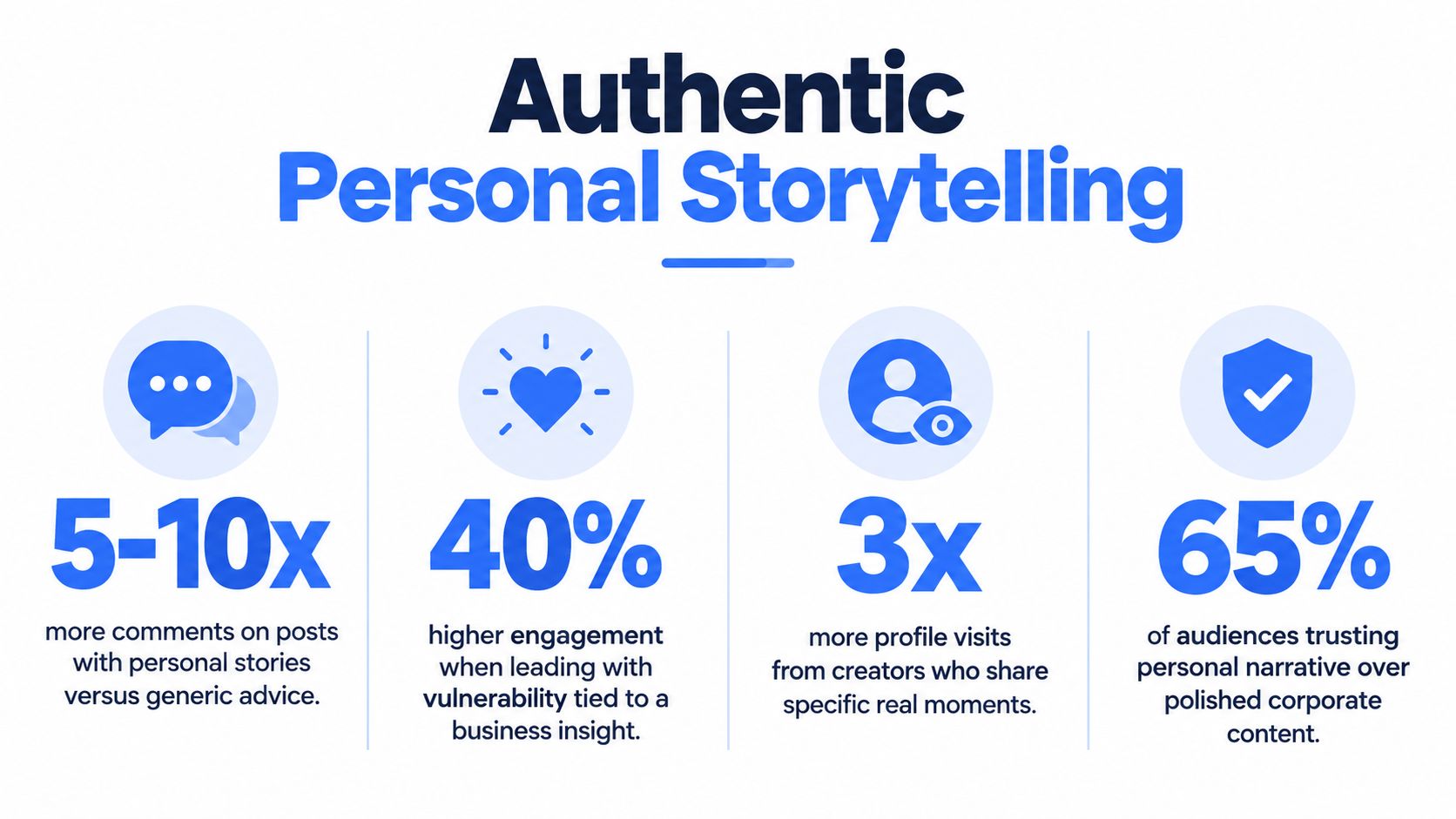
10. Authentic Personal Storytelling
Personal stories work when they prove a business lesson. They fail when the writer turns a minor inconvenience into a leadership epic.
Share a specific moment from work. Explain the decision, mistake, customer conversation, failed campaign, or change in direction. Then let the detail support the lesson. A founder can describe the reasoning behind a product pivot. A marketer can explain why a campaign missed its audience. A sales leader can show how one objection changed the call process.
The story should serve the reader. Personal detail is useful when it helps someone recognize a problem, avoid a mistake, or make a better decision. It doesn't require oversharing. It requires accuracy.
Keep the story commercially honest
Lead with what happened, not with a polished moral. Include context that changes how the reader interprets the event. If a deal was lost, explain the buyer's concern and what the team changed afterward. If a campaign failed, separate the creative problem from the audience, offer, timing, or measurement problem.
LinkedIn's B2B research highlights attention as a major concern, while its AI research points to education, authenticity, and human connection as important planning themes, according to the LinkedIn B2B marketing research hub. That doesn't mean every post needs a dramatic confession. It means anonymous advice has a trust problem.
Use personal stories alongside practical content, not instead of it. Track comments for relevance, profile visits, direct conversations, clicks, and leads. A story that attracts empathy but no business signal can still be worthwhile for brand building, but label the role clearly.
Top 10 Digital Marketing Strategy Comparison
| Approach | Implementation complexity | Resource requirements | Expected outcomes | Ideal use cases | Key advantages |
|---|---|---|---|---|---|
| Pattern Recognition and Reverse Engineering | Medium, systematic analysis + testing | Competitor data, analytics tools, time to map patterns | Faster learning curve; 3–5× engagement lift for proven structures | Optimizing formats, launch content, creators studying top performers | Reduces guesswork; speeds path to viral mechanics |
| Niche Positioning and Audience Clarity | Medium, research and narrowing focus | Audience interviews, niche research, time to iterate messaging | Faster authority in a defined space; smaller but higher-quality audience | Solopreneurs, B2B specialists, vertical-focused brands | Clear differentiation; easier referrals and partnerships |
| Value-First Content Strategy | High, sustained production of high-value assets | Time, deep expertise, templates/resources, occasional paid tools | Strong trust and inbound leads; higher conversion from free→paid | Consultants, educators, product-led growth, service providers | Builds credibility and loyal audience; differentiates from gatekeepers |
| Hook-Driven Content | Low, craft and iterate short openers | Creativity, A/B testing, basic analytics | 40–60% higher engagement when hooks land | Short-form posts, social captions, attention-driven content | Stops the scroll quickly; rapid measurable gains |
| Data-Backed Claims and Original Research | High, design, collect, and analyze data | Surveys/tools, analysis time, possible budget for sampling | 2–3× more shares; strong credibility and citations | Thought leadership, reports, PR campaigns, B2B insights | Defensible authority; highly shareable and quotable content |
| LinkedIn Carousel Posts and Visual Content | Medium, design-focused, slide planning | Design tools (Canva/Adobe), templates, time for layout | ~3× engagement vs single-image; better information retention | Step-by-step guides, comparisons, data walkthroughs | Higher engagement; excellent for complex or visual info |
| Content Repurposing Across Channels | Low–Medium, process and format adaptation | Scheduling tools, repurposing workflow, minimal design/time | 3× more traffic/engagement by extending reach | Organizations with limited ideas, multi-platform strategies | Maximizes ROI of each idea; maintains cross-channel presence |
| Community Engagement Over Broadcasting | Low, habit-driven but disciplined | Daily time (e.g., 20 min), monitoring, authentic interaction | Increased visibility, profile visits, algorithmic boost | Network-driven growth, B2B pros, creators building relationships | Organic growth; builds genuine relationships without ad spend |
| Strategic Timing and Frequency | Low, planning and analytics-based | Scheduling tools, analytics, content calendar | Improved initial reach and consistent growth from algorithm favor | Teams and creators seeking predictable reach and cadence | Predictable audience habit; algorithmic favor for consistency |
| Authentic Personal Storytelling | Medium, curation and narrative skill | Time to craft stories, willingness to be vulnerable | 5–10× more comments; deeper audience connection and loyalty | Founders, personal brands, creators seeking emotional resonance | Builds trust and memorability; drives strong engagement |
Build the System, Then Cut the Noise
A thirty day test is enough to expose obvious weaknesses, provided you run it like a test rather than a mood.
Pick one audience, two content formats, and one primary channel. LinkedIn is a practical choice for B2B teams because personal profiles, native posts, comments, carousels, and analytics create a visible path from message to response. Keep the scope narrow. A broad audience, six formats, and several channels will produce a pile of activity with no clean explanation.
Publish on a fixed schedule. Record reach, engagement, profile visits, clicks, leads, and conversions. Add cost when paid distribution or staff time makes it relevant. Add revenue when your attribution rules can support the connection. Don't call a result “pipeline” because someone liked a post and later appeared in a spreadsheet. Define the conversion event before publishing.
Review the pattern after enough posts to see a signal. Look for repeated relationships between audience problem, opening, format, response, and next action. A post may earn reach but no profile visits. Another may earn modest reach and several relevant conversations. Those outcomes support different decisions. The first may help awareness. The second may support demand. Treat them differently instead of crowning a single winner.
The wider channel mix matters too. Deloitte's portfolio approach supports choosing three must win channels by segment, then adapting one narrative across them. That approach fits the current attention problem better than scattering a team across every platform with a pulse.
Budget pressure makes this discipline more practical. One 2026 digital marketing report places average marketing budgets at 7.8% of company revenue, up slightly from 7.7% in 2025, while 56% of CMOs say they lack enough budget to deliver strategy, according to Stripo's 2026 digital marketing trends report. When money is tight, the answer isn't a larger tool stack. A 2025 survey summary reports martech utilization at 49%, with only 15% of organizations qualifying as high performers, according to Digital Applied's martech data. Reduce unused tools, standardize reporting, and tie each platform to a revenue KPI.
AI can help with research, hooks, drafting, repurposing, profile improvement, and analytics. PathFactory's 2025 benchmark found only 4% of marketers were already using AI agents, while 45% planned to implement them within a year, as noted in the LinkedIn research hub. Adoption is still early. The useful question is how to use AI without sanding away judgment, experience, and a recognizably human point of view.
ViralBrain fits parts of this LinkedIn workflow. It can help discover high performing patterns, generate drafts in a selected voice, repurpose source material, improve hooks, refine profiles, save drafts, preview posts, and review analytics. Manual posting remains supported. Use it to reduce repetitive work, not to outsource your audience definition or offer.
Tools can speed up a clear system. They can't rescue a vague audience, weak proof, or an offer that nobody needs. Start with one audience, publish with a fixed plan, measure the path to action, and cut whatever produces noise without useful learning.
ViralBrain helps B2B teams study proven LinkedIn patterns, shape them into drafts, repurpose ideas, improve profiles, and review post performance. Visit ViralBrain to turn your next thirty day test into a repeatable content workflow.
Grow your LinkedIn to the next level.
Use ViralBrain to analyze top creators and create posts that perform.
Try ViralBrain free