
Competitor Content Analysis That Actually Works
Run competitor content analysis like a pro. Real workflows, smart benchmarks, and practical steps for marketers ready to outgrow the competition.
Grow your LinkedIn to the next level.
Use ViralBrain to analyze top creators and create posts that perform.
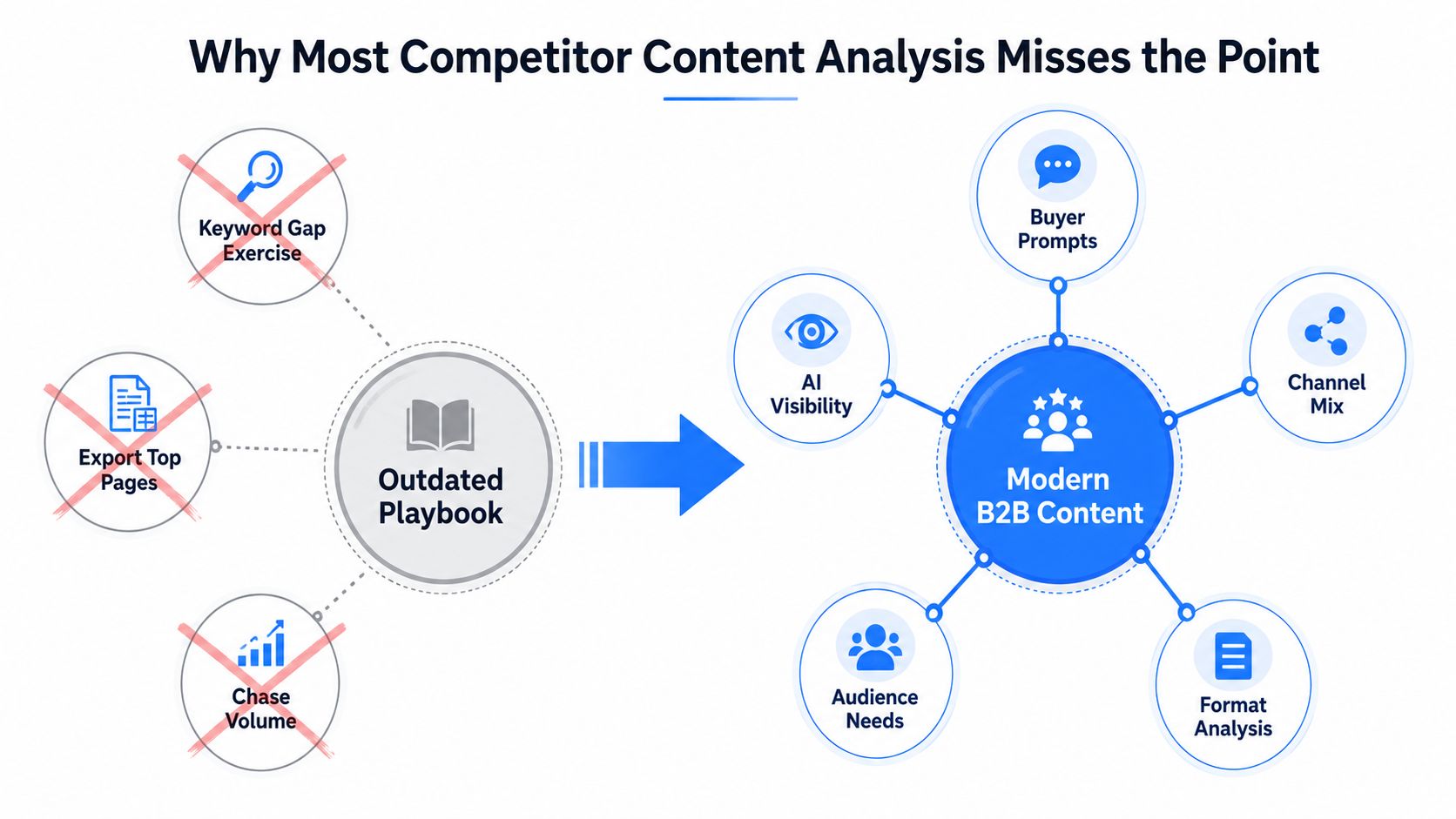
Try ViralBrain freeMost competitor content analysis is a keyword gap exercise wearing a serious face. A marketer exports rival pages, sorts them by search volume, copies a few headings, then calls the spreadsheet strategy. That process misses where content travels, how it gets consumed, which buyer problem it solves, and whether AI systems cite it before anyone clicks a result.
A useful audit needs four lenses: topics, channels, formats, and audience needs. Add a fifth, AI visibility. A competitor might rank for a query because its founder posts on LinkedIn, appears on podcasts, earns newsletter mentions, or gets cited in answer engines. A keyword tool won't show the full path.
Content analysis has been used in social science since the 1920s, with historical use on newspapers, advertisements, speeches, and other texts reaching back more than 200 years. Marketing researchers were introduced to the technique in 1977, and its use grew sharply in the mid to late 1980s, when 17 articles appeared between 1985 and 1989, nearly half of the sampled set. The method has history because structured review beats intuition. (Historical review of content analysis)
Why Most Competitor Content Analysis Misses the Point
The popular advice says to find what competitors rank for, locate missing keywords, then publish a longer page. That's lazy advice. It treats search position as the whole content system, even though buyers encounter the same company through its website, social posts, videos, emails, communities, reviews, and AI answers.
A better audit asks four practical questions:
- Topics: What problems, use cases, objections, and comparisons does the competitor cover?
- Channels: Where does the content appear, and where does distribution create attention?
- Formats: Does the message travel as an article, carousel, video, case study, webinar, or opinion post?
- Audience needs: Which job is the buyer trying to complete, and what proof helps them move?
AI visibility adds another check. Test priority prompts in ChatGPT, Perplexity, and Google AI Overviews. Record which brands appear, which pages get cited, and what traits the answer assigns to each brand. A page with a weak organic position can still matter if an answer engine uses it as a source.
Practical rule: Don't copy a competitor's coverage until you know which channel, format, and buyer need made that coverage useful.
The broader competitive intelligence market reflects this shift. One 2024 estimate valued it at USD 50.87 billion and projects USD 122.77 billion by 2033, at a 9.1% CAGR from 2025 to 2033. A separate tools market estimate places the category at USD 6.63 billion in 2024, rising to USD 7.22 billion in 2025 and USD 15.45 billion by 2034. (Competitive analysis market data)
The point isn't to admire market forecasts. It's to recognize that competitor content analysis sits inside a serious intelligence function. Before choosing tools, document how the audit will answer a business question. A practical B2B market analysis with Breaker can help organize that wider context without turning your content review into a pile of disconnected screenshots.
Set Your Goals and Pick the Right Competitors
Start with the decision, not the dashboard. “Beat competitors on content” tells a team nothing. A useful goal ties the audit to an outcome, such as earning three more demo requests per month from organic search in Q2. That goal changes what you measure. You'll care about commercial prompts, conversion paths, proof, freshness, and distribution, not just a rival's biggest traffic page.
Write down three inputs:
- Business question: What decision will this audit support?
- Success metric: Which measurable result will show progress?
- Time budget: How much research can the team finish without delaying actual publishing?
Use three competitor tiers. Keep the list narrow enough to study properly.
| Tier | Count | Inclusion Criteria | What to Steal | What to Ignore |
|---|---|---|---|---|
| Direct rivals | 3 to 5 | Same product and buyer | Positioning, proof, useful formats | Features your product can't support |
| Aspirational peers | 2 to 3 | Similar audience, different product | Distribution habits, editorial standards | Tactics built for a different sales model |
| Serendipity sources | 2 to 4 | Adjacent category serving your buyer | Fresh angles, neglected needs | Content with no buyer relevance |
The direct tier deserves the most attention. Aspirational peers can reveal how a mature content system behaves. Serendipity sources often expose a useful topic or format before direct rivals notice it. Don't use a generic top ten list from a software tool as your final set. Those lists mix huge brands with irrelevant companies and waste audit hours.
For every competitor, record why it's included. Add a note saying what you'd copy, what you'd test, and what you'd ignore. A solo audit can take 8 to 12 hours per competitor over two weeks, so scope matters. That estimate comes from the practical workflow described in the brief, not from wishful calendar planning.
Use the competitor analysis guide from ViralBrain to frame the wider review, then build a separate sheet for content evidence. Your list of competitors and your written goal should exist before anyone opens an SEO platform.
The Five Pass Audit Framework
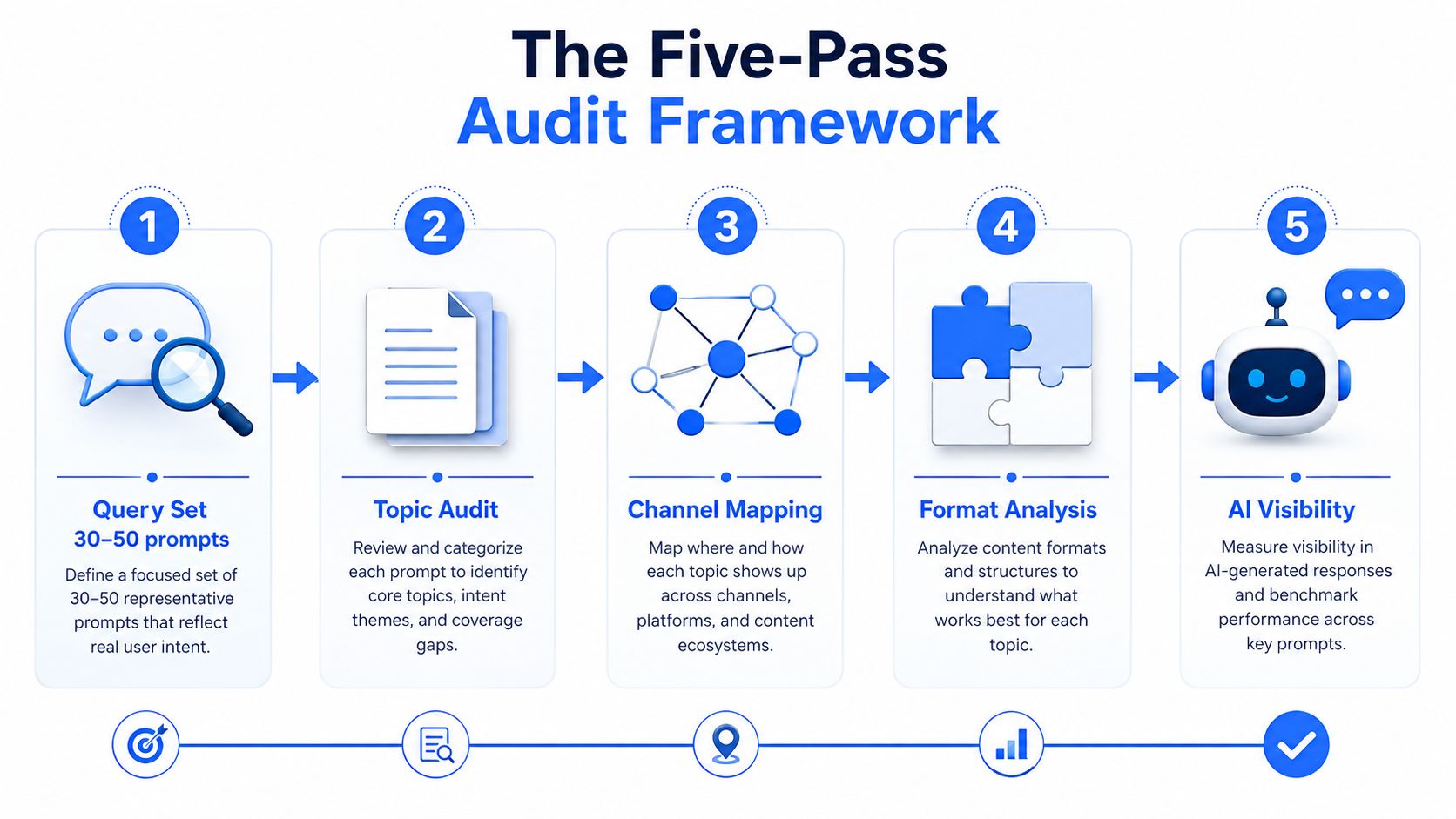
Run the audit in five passes. Give each pass its own spreadsheet tab. This keeps evidence visible and stops a clever observation from becoming an untraceable opinion.
Pass one builds the query set
Write 30 to 50 buyer prompts, grouped by funnel stage. Include search queries, comparison prompts, objection prompts, and questions a buyer might ask an AI system. Build the set from your ranking keywords, competitor keywords, sales call language, customer questions, and product use cases.
For each prompt, record your rank, the competitor's rank, and the gap. A practical workflow recommends this overlap method, with query sets built from your keywords plus competitor keywords. (SERP overlap workflow)
Pass two maps sources
For every prompt, record which competitors appear. Add the content type, channel, URL, and position or visibility type. A result may be a blog article, a landing page, a video, a LinkedIn post, or an AI citation.
The basic gap audit starts to fail when two competitors cover the same topic, but one distributes it through several channels while the other leaves it buried in a blog archive.
Pass three inventories formats
Tag every asset as a how to guide, comparison, case study, opinion post, data study, carousel, video, webinar, or another clear format. Add a length bucket without inventing precision. Note structure, heading pattern, media use, calls to action, and evidence.
HubSpot's benchmarking guidance recommends reviewing the top five ranking pages for each of five to ten core keywords, then recording word count, headings, multimedia, featured snippet format, domain authority, indexed pages, organic traffic estimates, backlinks, freshness, and keyword overlap. (Competitive analysis kit from HubSpot)
Pass four captures engagement signals
Collect likes, comments, reposts, shares, backlinks, and estimated traffic where available. Don't trust one metric. A post with many likes and no useful discussion may have broad appeal but weak buying intent. A page with modest traffic and strong backlinks may deserve more attention than a popular listicle.
Pass five scores hooks and angles
Rewrite each headline in plain language. Then fill five columns: Headline, Hook Type, Promise, Proof Element, Weakness. Score each row from 1 to 5 for clarity, relevance, proof, distinctiveness, and audience fit.
Don't average everything into one neat score. Raw scores expose the outliers worth copying or avoiding. You can use a tool to analyze competitor keyword gaps, but the spreadsheet still needs human judgment. Software can surface overlap. It can't decide whether a competitor's point of view is useful or merely loud.
Budget roughly two hours per pass per competitor if you want a serious review. Faster work usually means fewer signals, not better efficiency.
Reading LinkedIn Performance With Real Numbers
LinkedIn analysis fails when teams mistake publishing volume for performance. Measure impressions, engagement rate, follower movement, and comment quality together. Frequent posting proves activity, not memorability or buying intent.
Metricool reports these per-post LinkedIn averages: 831.96 impressions, 115.63 interactions, 102.32 clicks, 11.67 likes, 0.49 comments, 1.16 shares, and a 13.90% engagement rate. (Metricool LinkedIn analytics benchmarks) Treat these figures as a platform reference, not a target that every account, industry, audience, or format should match.
| Reference | Avg. Impressions/Post | Engagement Rate | Comment Quality | Follower Growth |
|---|---|---|---|---|
| Platform reference only | 831.96 | 13.90% | Review manually | Compare with your baseline |
The benchmark does not separate account sizes or provide verified standards for comment quality and monthly follower growth. Keep those fields qualitative. Fabricated tiers make the analysis look precise while hiding the limits of the source.
Normalize the comparison with:
Competitor engagement rate ÷ your engagement rate
Use that ratio to compare accounts, not to declare a winner. A smaller account with a higher rate may generate stronger discussion, while a larger account may deliver greater reach. Engagement rate gives a better comparison than raw likes because it relates interactions to audience size, as described by Hootsuite's competitive analysis platform. (Hootsuite competitive analysis platform)
Read the comments yourself. A structured test plan requires a minimum sample size, but no single verified number applies to every situation. A practical workflow is to choose 3 to 5 competitors, review the past 30 days of posts, inspect the top 5 to 10 posts, and read 10 to 20 comments from those posts. (LinkedIn competitor audit workflow)
Flag vanity performance when comments avoid the problem, clicks fail to support the stated goal, the call to action attracts the wrong audience, or a repeated format earns attention without creating a useful next step. Measure the four audit lenses separately, topics, channels, formats, and audience needs, then add whether the content earns AI visibility through clear, citable answers.
Spotting Patterns, Hooks, and AI Visibility Gaps
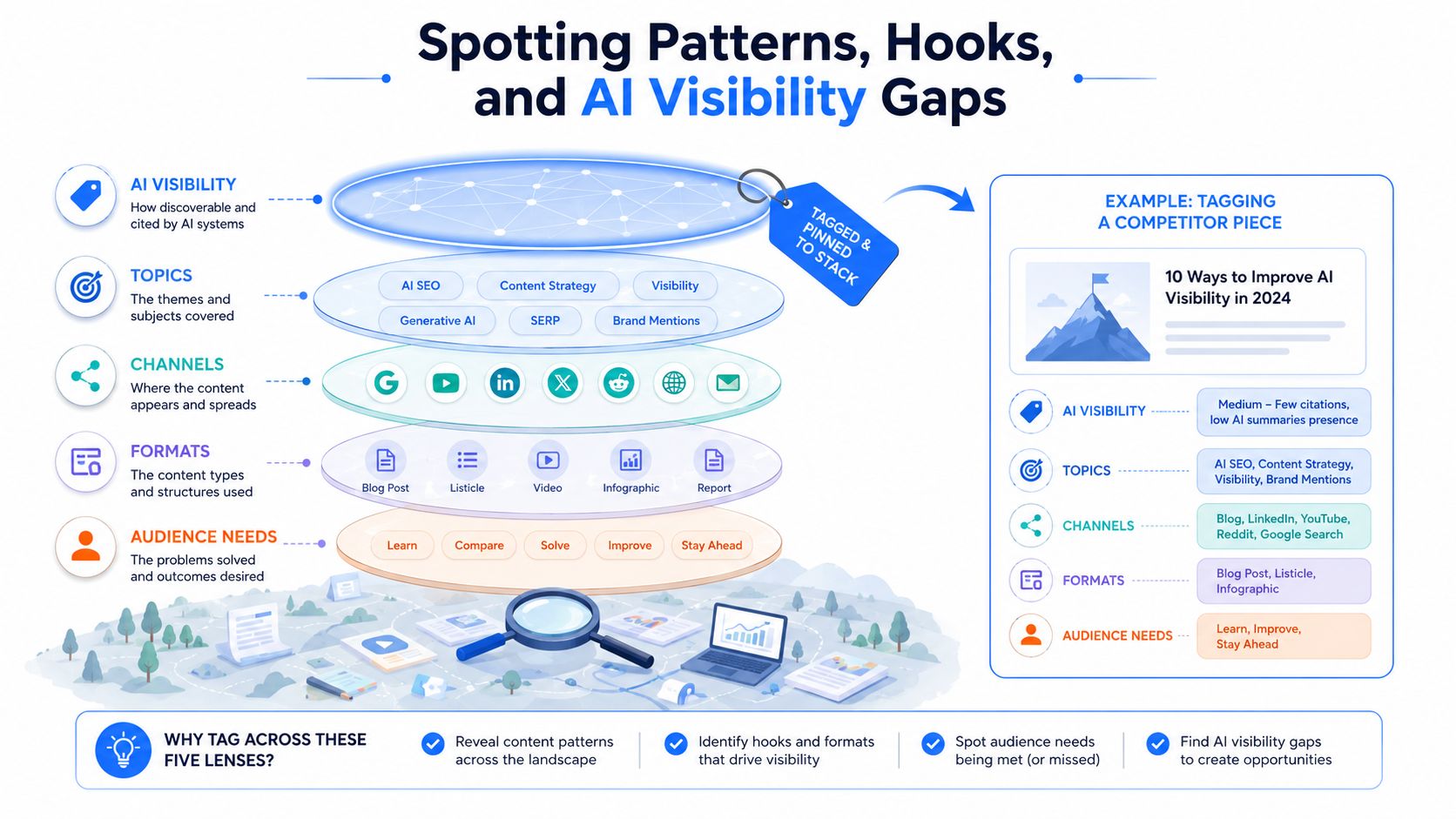
A pattern becomes useful when it repeats across lenses. Tag every competitor asset with a topic, channel, format, audience need, and AI visibility status. Then sort the matrix by combinations rather than by keyword.
For example, a competitor may publish comparison topics as long form articles, explain the same ideas through founder LinkedIn posts, and support both with customer proof. Another may cover the topic only through product pages. The first has a stronger distribution system. The second may have a content gap even if its page ranks well.
Three hook types show up often:
- Contrarian hooks challenge accepted advice. They fit opinion posts, founder content, and sharp comparison pages.
- Numeric hooks promise a measurable frame. Use them only when the number is real and sourced.
- Narrative hooks begin with a situation, mistake, decision, or change. They suit LinkedIn posts, case studies, and video scripts.
Don't force every hook into every format. A contrarian headline can work on LinkedIn, but a buyer comparing vendors may need a clear table and proof. Format has a job.
AI visibility needs its own column. Test the same priority prompt in ChatGPT, Perplexity, and Google's AI Overviews. Record the competitors mentioned, the source pages cited, the wording used to describe them, and whether your brand appears. Recent guidance treats AI visibility and SERP features as distinct gap types, because ranking alone doesn't capture answer box or citation exposure. (AI visibility gap guidance)
Use a gap map with five fields: Missed lens intersection, competitor evidence, buyer need, proposed asset, citation target. This turns “we should post more” into a brief with a reason.
For teams assessing production tools, a practical guide to compare AI tools for creators can help separate drafting features from research, repurposing, and analysis features. Trend signals can add another input, but don't confuse a rising topic with a buyer need. A structured trend forecasting workflow keeps that distinction visible.
Turning Findings Into Briefs and Tests
An audit has value only when it creates work someone can publish. Use a one page brief with six fields: target lens, query or hook source, audience job to be done, format, success metric, and AI visibility angle.
A useful example starts with a B2B SaaS competitor whose how to carousel repeatedly earns strong interaction. Don't copy the slides. Extract the structure, then build a 1,200 word article that answers the same buyer need with clearer proof, stronger internal links, and a direct product path. Create a 5 post LinkedIn test sequence from the article, with each post using a different hook while keeping the core lesson stable.
The test order matters:
- Hook variations: Keep the topic and format stable. Change the opening promise.
- Format swaps: Turn the strongest hook into a text post, carousel, or article.
- Distribution timing: Compare publishing windows only after the message has evidence behind it.
Set the runtime before publishing. The brief should include a kill criteria column, so weak variants get removed after 14 days rather than living forever in a draft folder. The provided plan requires a minimum sample size, but no verified number is available for that threshold. Set a consistent internal rule, document it, and apply it to every test.
Measure the result tied to the original goal. Impressions matter for reach. Clicks matter for traffic. Qualified comments may matter for demand creation. Demo requests matter when the brief targets pipeline. Don't declare a winner because one post looks busy.
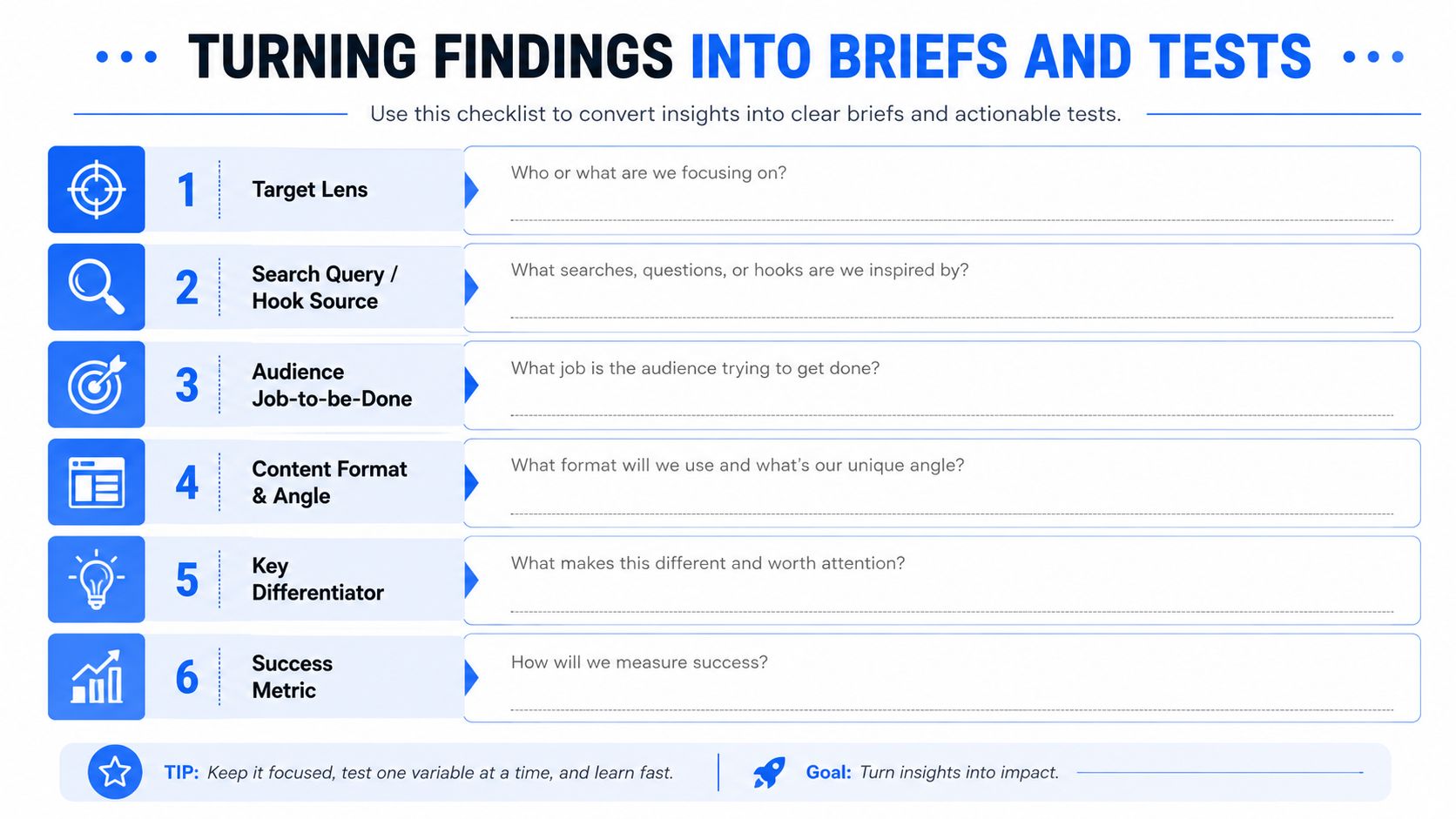
Store the brief beside the evidence that created it. That makes later review faster and stops the team from repeating the same audit every quarter.
Building a Repeatable Cadence and Fixing Common Stalls
Run the full five pass audit every 90 days. Take a LinkedIn performance snapshot every 30 days, then check AI citations every 60 days. Assign the work in blocks: research on day one, scoring on day two, pattern synthesis on day three, briefs on day four, review and distribution planning on day five.
Four stalls appear repeatedly:
- Stale competitors: Refresh the set every quarter.
- Metric overload: Keep the dashboard to six key performance indicators.
- Analysis paralysis: Ship one test brief before the audit is finished.
- Lost context: Store evidence in a shared Notion or Sheets hub with version tags.
Use the content creation workflow from ViralBrain to keep research, drafting, review, and distribution connected. Your printable checklist should cover goals, competitor selection, source collection, scores, patterns, gaps, briefs, and the next review date.
ViralBrain helps marketers study high performing LinkedIn posts, identify hooks and structures, translate those patterns into drafts, and review performance with analytics. Visit ViralBrain to turn competitor content analysis into a repeatable LinkedIn publishing process, then test the findings instead of leaving them trapped in a spreadsheet.
Grow your LinkedIn to the next level.
Use ViralBrain to analyze top creators and create posts that perform.
Try ViralBrain free