
10 Content Creation Examples and Why They Work in 2026
Ten content creation examples with hooks, structure, and quick templates you can adapt. See why each format works and when it backfires.
Grow your LinkedIn to the next level.
Use ViralBrain to analyze top creators and create posts that perform.
Try ViralBrain freeYou're staring at a blank draft, three browser tabs are open, and the deadline is doing that cheerful little thing where it gets closer without helping. That's the usual start. Good content creation examples are less about genius and more about repeatable structure, which is why the same formats keep showing up across strong posts on LinkedIn, blogs, and short-form video. The useful part is not copying the wording, it's copying the machine underneath it. A clean hook. A clear path. A payoff that doesn't wander off into a hedge maze.
The modern creator economy grew by turning publishing into a system, not a one-off stunt. YouTube's Partner Program in 2007 made revenue sharing scalable for creators, TikTok's rise showed how fast a distribution channel can create demand for repeatable formats, and by 2023 Goldman Sachs estimated the creator economy at about $250 billion with a projection that it could nearly double in five years, while The Washington Post reported YouTube creators supported the equivalent of 390,000 full-time jobs in the United States as reported in the creator economy timeline. That history matters because it explains why the best posts usually follow a system, not a mood.
These ten formats keep showing up because they do different jobs. Some earn trust. Some get comments. Some move buyers. Some fail in public, which is still useful if the failure is honest. Use the one that matches the job, not the one that feels safest.
1. The Hook and Story Arc
A hook works because it refuses to waste the first line. It opens a loop, then the story pays it off. That's why a plain opener like "today I want to talk about X" usually dies while a tighter line makes people keep reading.
The structure is simple. Start with a sharp sentence, add a second line that raises the tension, then move into the story. If the first sentence can stand alone, test it on someone who has no patience and even less interest. If they say, “what happened next,” you've got something.
Practical rule: keep the hook short enough that it doesn't start sounding like a trailer for a bad movie.
What works and what breaks
This format works for personal lessons, contrarian moments, and “I was wrong” posts. A post that starts with “I was wrong about LinkedIn carousels” has a built-in reason to continue, because the reader wants the correction. It breaks when the hook promises drama and the body delivers oatmeal.
The fix is boring but effective. Keep the hook honest. Keep the story specific. Don't stretch a small point into a soap opera, because readers can smell that from across the feed.
Use this template
Hook
I thought [belief]. Then [event] happened.
Story
I tried [action].
It produced [result].
The part I missed was [lesson].
Takeaway
If you're trying to [goal], start with [specific move].
For a cleaner version of this pattern, the guide to stronger hooks is a useful internal reference. And if you want to see how hook-writing turns into short-form attention, our analysis of viral caption patterns shows the same logic in a different wrapper.
2. The Contrarian Take
Contrarian posts work because people react to friction. If your post says what everyone already says, there's no reason to argue, save, or share it. If it politely pokes the default belief, people lean in, mostly to prove you wrong or to see if you're onto something.
The trick is to challenge the idea, not the person. “Your best practice is slowing you down” is usable. “Everyone in your industry is an idiot” is just a tantrum with a keyboard. One gets attention. The other gets muted.
Where this format helps
This format works well when the category is full of lazy advice. It also works when a tool, framework, or habit has become a checkbox instead of a decision. A decent example is saying that “move fast” is not useful without a real operating constraint, because speed without focus just makes more mistakes, faster.
Back it up with your own results or real evidence. The stronger the accepted belief, the more proof you need. If you are just being loud for sport, people notice. They may not say it, but they notice.
Practical rule: disagree cleanly, then explain the tradeoff. Readers trust a hard opinion more when it sounds measured.
For a sharp take on why hot takes often waste reach, see Michael Browne's piece on when hot takes kill reach.
Use this template
Claim
The common advice to [belief] is overrated.
Why
It fails when [context].
The problem is [specific flaw].
What to do instead
Use [alternative] when [situation].
3. The Before and After Framework
This format is sturdy because people understand change faster than explanation. You show the mess first, the fix second, then the result. No mystery. No performative storytelling. Just the shape of the change.
It works for career moves, content systems, product improvements, and personal brands. A weak version says, “things are better now.” A better version says, “I had no inbound, I changed the posting rhythm, now I get replies from the right people.” The first is vague. The second gives the reader a path.
What makes it land
The before state has to be specific enough to feel real. “I struggled” is mush. “I spent three months posting with no clear hook and no replies from buyers” is usable because readers can see themselves in it. The after state should be concrete too, or the whole post feels like a LinkedIn charm bracelet.
If the transformation took time, say so. Overnight success stories usually read like lies with nice formatting. People know work takes longer than a montage.
The LinkedIn profile examples page is useful if you want to see how a profile story can carry the same before and after logic without turning into a biography nobody asked for.
Use this template
Before
I had [problem].
It showed up as [pain point].
After
I changed [specific action].
Now I [result].
Bridge
The key change was [one move].
4. The Myth Busting or Misconception Post
Myth busting works because people love having something neat taken apart, as long as it's done with receipts. The format says, “the thing everyone repeats is only half true,” then proves it. That's satisfying. It also saves readers from repeating nonsense in their own meetings.
The best version starts with the belief, then shows where it fails. You don't need to act smug about it. The audience already knows the internet has enough people pretending certainty is a personality trait.
What to do with the myth
Use real data, real examples, or both. Explain why smart people believe the myth in the first place. That part matters because it keeps the post from sounding like a cheap dunk. A good myth-busting post says, “I get why people believe this, but the actual pattern is different.”
Then give the corrected approach. Don't stop at “that's wrong.” That's lazy. Readers need a usable replacement, not a smug exit.
Smart people often repeat bad advice because it works in one narrow case, then gets promoted as universal truth.
Use this template
Myth
People think [belief].
Why it survives
It seems true when [context].
That's why it keeps getting repeated.
Reality
The better rule is [replacement].
Use it when [condition].
5. The Unfiltered Lesson or Failure Post
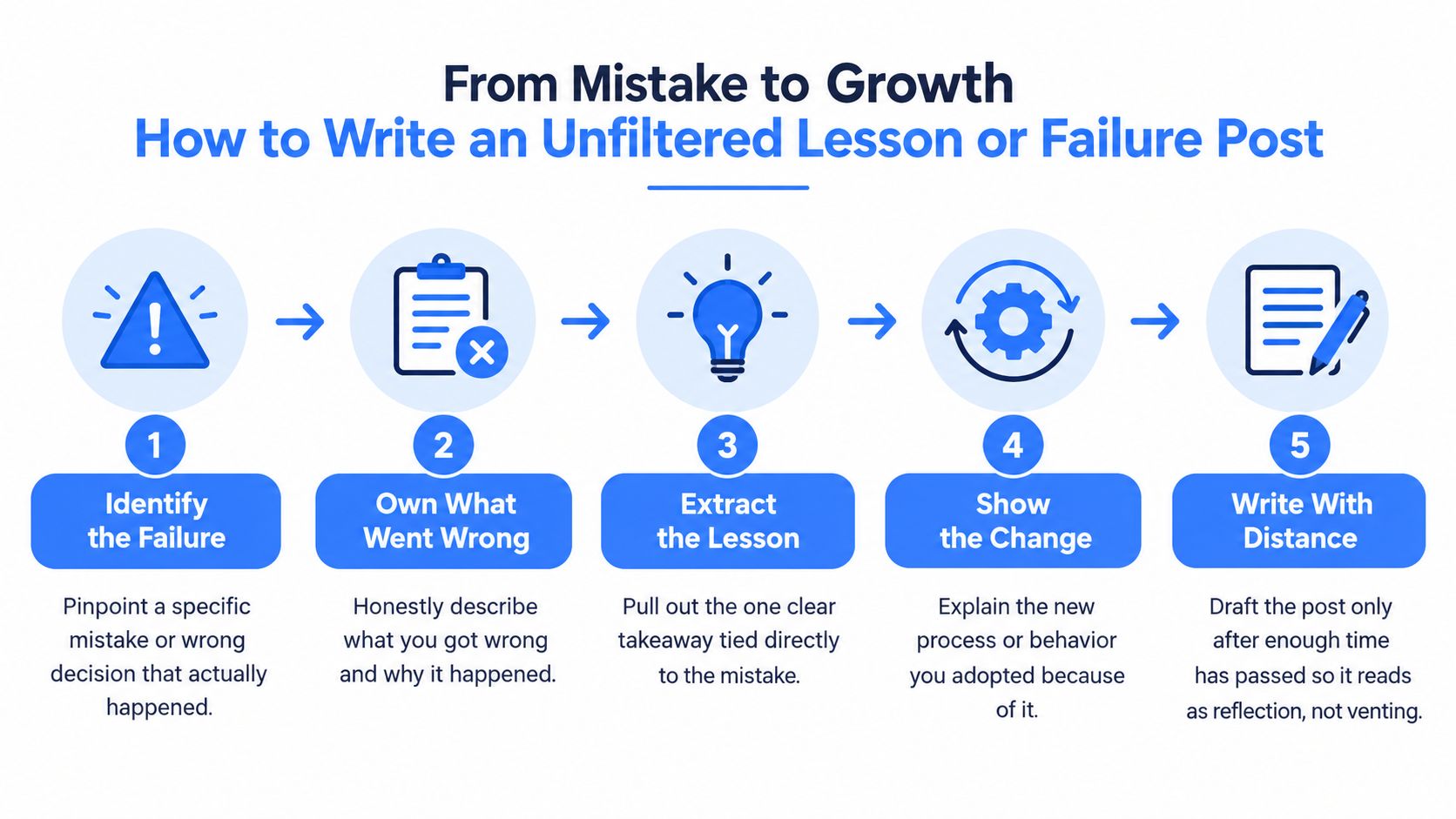
Failure posts work because many people are buried under polished success stories and fake certainty. A specific mistake, told plainly, gets attention because it feels human. Nobody trusts someone who says every move was brilliant. That person is either lying or unbearable.
The post should be old enough that you're not still angry. If it's too fresh, it reads like a complaint. If enough time has passed, it reads like judgment. That difference matters.
How to keep it useful
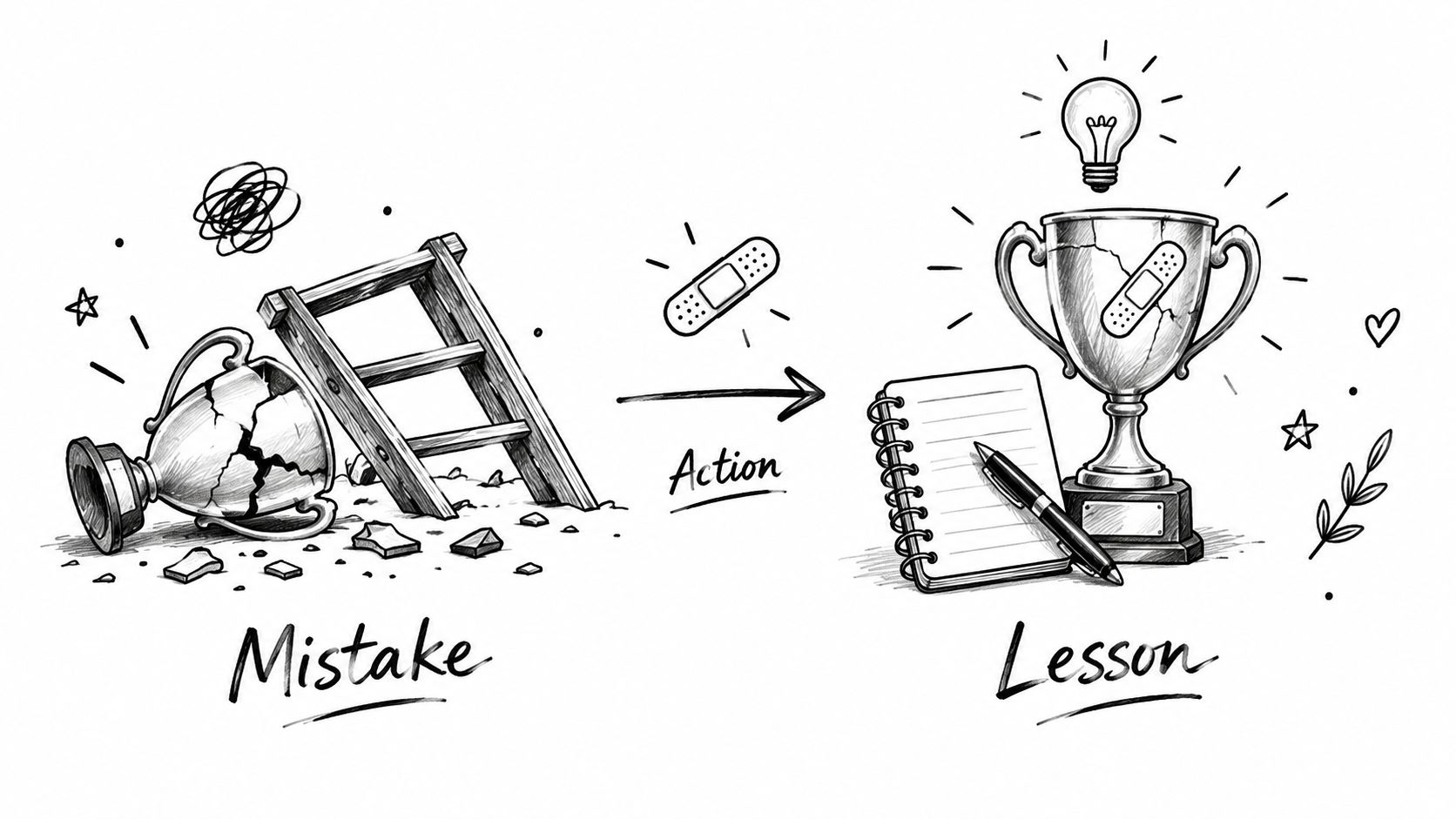
Name the mistake. Show the cost. Then show the change you made. The whole point is to leave the reader with a better decision, not a dramatic confession and a pile of feelings. A real failure post says what you'd do now, not just what hurt.
This format is strong for hiring mistakes, bad vendors, weak posting strategies, and product decisions that looked smart in the room but were dumb in the wild. The best ones connect the failure to a common reader pain point so it doesn't feel like a diary entry with a business casual shirt on.
Use this template
Mistake
I did [action].
It failed because [reason].
Lesson
The part I missed was [insight].
New rule
Now I [changed process].
6. The Tactical How To or Process Breakdown
Tactical posts work because they respect the reader's time. They say, “here's the process, use it today.” No fluff. No grand theory. Just steps that can be stolen, adapted, and tested before lunch.
This format is great for content calendars, analytics setup, cold email structure, and interview synthesis. It works best when the steps are tight and the order matters. If the process can be shuffled without breaking, it's not really a process. It's a pile.
Keep the steps usable
Use five to seven steps if you can. More than that and people start feeling like they need a project manager. Include the mistakes you made while learning it, because that keeps the post honest and gives the reader warning labels.
A tactical post gets stronger when each step has a visible output. That way the reader knows what “good” looks like before they move on. If step three should produce a short list of themes, say so. If the reader should see a rough dashboard by step five, say that too.
And yes, video can help here when the steps are visual. Wyzowl's survey of 266 marketing professionals and consumers found that 91 percent of businesses use video as a marketing tool, while 63 percent measure return through engagement and 52 percent measure leads or clicks in Wyzowl's video marketing statistics. That split matters because not every popular clip does real work. Sometimes it just got applauded and sent home.
Use this template
Step 1
Do [action].
Expect [output].
Step 2
Do [action].
Expect [output].
Finish
You should now have [result].
7. The Contrasting Comparison or Apples to Oranges
Comparisons are useful because people hate making decisions in a vacuum. If you show them two options side by side, they can finally stop pretending one answer fits every case. Spoiler, it doesn't.
The best comparison posts start with context. “It depends” is not a cop-out. It's the point. A good comparison says which option wins in which scenario, then admits the tradeoff. That earns more trust than pretending one side is always better.
Where this format wins
This format works well for organic versus paid content, personal brand versus company brand, or building in public versus staying quiet. The reader gets a practical frame, not a lecture. If you're choosing a format, strategy, or channel, this style gives you a simple decision tool without all the consultative fog.
Bias is fine if you name it. Readers trust a comparison more when they know where the writer leans. Pretending to be perfectly neutral often just makes the post smell like committee work.
Use this template
Context
If you're trying to [goal], the choice is between [A] and [B].
A works when
[Scenario].
The upside is [benefit].
The downside is [cost].
B works when
[Scenario].
The upside is [benefit].
The downside is [cost].
8. The Observation or Pattern Recognition Post
Pattern posts work because they make people feel like they've just been handed a better pair of glasses. You point out something that's been there the whole time, then explain why it keeps happening. That's the useful part, not the smug little “I noticed this” ending.
This format gets stronger when you name examples people can verify. If you say certain creators all use the same structure, show the structure. If you say successful companies hire in a pattern, show the pattern. Don't leave readers with a vague aura of insight and call it strategy.
Why people save these
They feel like insider knowledge without needing insider access. That's the draw. The danger is oversimplifying and pretending every company or creator behaves the same way. They don't. Counterexamples exist, and pretending otherwise makes the whole post feel brittle.
The best pattern posts explain why the pattern exists. Maybe it reduces risk. Maybe it helps speed. Maybe it makes the content easier to repeat. Whatever the reason, name it. That's where the insight lives.
Use this template
Pattern
Across [group], I keep seeing [pattern].
Examples
[Example 1].
[Example 2].
[Example 3].
Why it happens
The reason is [mechanism].
9. The Contrarian Career or Life Advice
This format works when it pushes against a script people have heard too many times. Go to college, job-hop fast, chase the bigger title, take the flashy role, say yes to everything. Some of that advice is fine. Some of it is just recycled certainty with a good haircut.
The useful version doesn't pretend one path works for everyone. It says, “consider this alternative if your situation looks like mine.” That's the difference between advice and preaching. Readers can smell preaching, and they rarely thank you for it.
What keeps it credible
Be honest about luck, access, and timing. If your path worked because you had runway, name it. If a lower-paid role accelerated your growth because the team was unusually strong, say that. People trust the writer who can admit context more than the one selling pure hustle mythology.
The post should include the result. Not the fantasy. The actual result. If you ignored common advice and it paid off in clearer work, better opportunities, or faster learning, say that plainly. If the outcome was mixed, say that too. Mixed outcomes are still useful. Often more useful, frankly.
Practical rule: advice gets stronger when it sounds like a tradeoff, not a sermon.
Use this template
Default advice
People told me to [common advice].
What I did
I chose [alternative path] because [reason].
Result
That led to [outcome].
I'd recommend it only if [condition].
10. The Data Point or Research Backed Post
Data-backed posts work because numbers cut through vague opinion. A surprising stat can reset how people think, but only if the stat changes behavior. Random trivia is not strategy. It's just trivia wearing a tie.
The strongest version adds context. It explains why the number matters now, what it changes, and what readers should do next. If you skip that part, the post becomes a museum label. Interesting, maybe. Useful, not much.
Use the number carefully
Don't cherry-pick. Don't stuff the post with five stats when one would do. Pick the number that shifts the decision. A clean example is the 2024 Edelman and LinkedIn study, which surveyed 3,484 management-level professionals across the United States, Canada, the United Kingdom, Germany, Singapore, Australia, and India. It found that 52 percent of decision makers spend at least one hour each week reading thought leadership, and 73 percent consider it a more trustworthy basis for judging a company's capabilities than marketing materials or product sheets in the Edelman and LinkedIn report. That's the kind of data that changes how you write. It says substance beats fluff because buyers still read, and they remember what helps them think.
Use this template
Stat
[Number] says [finding].
Why it matters
That means [implication] for [audience].
Action
So the next post should [specific move].
10 Content Creation Formats Compared
| Format | Implementation complexity | Resource requirements | Expected outcomes | Ideal use cases | Key advantages |
|---|---|---|---|---|---|
| The Hook and Story Arc | Low–Medium, needs a clear story | Low, writing time, occasional visuals | Higher engagement and scroll-through (3–5x) | Short social posts, personal narratives, B2B problem-to-solution threads | Versatile, easy to replicate, strong attention capture |
| The Contrarian Take | Medium–High, requires credible argumentation | Medium, research or evidence, authority | Higher comments and debate (≈40% more) | Opinion pieces, challenge prevailing practices, thought leadership | Stands out in feeds, sparks conversation, positions as critical thinker |
| The Before and After Framework | Low, straightforward structure | Low–Medium, measurable outcomes or metrics | Shareable, high saves, consistent performance | Transformations, case studies, product/process improvements | Relatable, provides measurable proof, easy to repurpose |
| The Myth Busting or Misconception Post | Medium–High, careful sourcing and framing | High, studies, citations, careful analysis | Builds trust and long shelf life, educational engagement | Debunking industry assumptions, correcting widely held errors | Establishes credibility, high informational value, lasting relevance |
| The Unfiltered Lesson or Failure Post | Medium, requires honest reflection and timing | Low, personal experience, emotional investment | Higher saves and trust (2–3x), credibility boost | Leadership lessons, hiring or product failure retrospectives | Signals authenticity, teaches through real mistakes, deepens trust |
| The Tactical How To or Process Breakdown | Medium–High, must be specific and actionable | Medium, expertise, examples, steps | High saves and authority, practical adoption | Tutorials, playbooks, operational guides, onboarding | Highly actionable, repeatable, builds expertise and utility |
| The Contrasting Comparison or Apples to Oranges | Medium, balanced analysis of tradeoffs | Medium, examples or comparative data | Clarifies decisions, steady engagement | Tool/strategy comparisons, audience segmentation choices | Helps decision-making, highlights context-dependent tradeoffs |
| The Observation or Pattern Recognition Post | High, requires broad visibility and analysis | High, multiple examples, cross-checking | Thought leadership potential, viral shareability | Trend spotting, industry insights, investment theses | Positions you as an observer, creates shareable insights, builds reputation |
| The Contrarian Career or Life Advice | Medium, needs nuance and acknowledgment of context | Low–Medium, personal data and context | Higher shares and community resonance (2–3x) | Non-traditional career narratives, alternative life choices | Resonates with dissenters, encourages new pathways, sparks discussion |
| The Data Point or Research Backed Post | High, sourcing and correct interpretation required | High, quality research, citations, analysis | Increased credibility and saves (≈30% better than vague claims) | Benchmarks, evidence-led recommendations, industry reports | Authoritative, verifiable, long-lasting reference value |
What to Copy and What to Ignore
Pick one format and write one draft this week. Not three. One. Then check whether the hook does the work and whether the structure carries the idea instead of just decorating it. A lot of content looks good for six seconds, then collapses under its own noise.
The thing to copy is the mechanics. The thing to ignore is the costume. A strong hook, a clean arc, a clear point, that's the part that travels. The fancy phrasing, the overworked positivity, the fake certainty, leave that in the draft bin where it belongs.
The other thing worth copying is measurement discipline. CloudKnox's structured LinkedIn program showed that a repeatable content loop can move impressions, engagements, post clicks, and followers in a consistent measurement window in the CloudKnox case study. Spigit's LinkedIn program tied content to clicks, engagement, and eventually ROI, which is the part many creators skip because the numbers get less glamorous after the applause in the Spigit case study. That's the job. Find the format, tag the post, and see what it does.
If you want more than a pile of decent drafts, use a system that helps you repeat what works. ViralBrain can surface hooks, structures, and post patterns from your niche so you're not guessing from a blank page every week. And if you're comparing formats for LinkedIn specifically, tweet examples for 2026 can also help you think in tighter, more usable post shapes.
If you're building a weekly content system, ViralBrain helps you turn strong patterns into drafts you can use. Visit ViralBrain to find hooks, formats, and examples that fit your niche, then turn them into posts without starting from scratch every time.
Grow your LinkedIn to the next level.
Use ViralBrain to analyze top creators and create posts that perform.
Try ViralBrain free