
Content Creation vs Content Production, a Practical Guide
Content creation vs content production explained with clear criteria, real LinkedIn examples, and decision frameworks teams and individuals can use today.
Grow your LinkedIn to the next level.
Use ViralBrain to analyze top creators and create posts that perform.
Try ViralBrain freeMost advice about content creation vs content production is too neat to be useful. It says creation means making the post and production means publishing it, then draws a tidy workflow diagram. That explanation falls apart the moment a LinkedIn post needs a strategist, writer, designer, editor, scheduler, and analyst.
The difference matters because teams often fix the wrong problem. They generate more ideas when the bottleneck is review. They buy production help when the issue is weak positioning. On LinkedIn, a polished post with no sharp point is still forgettable. A strong idea that sits in a draft folder is still invisible.
The practical split is simple. Creation decides what deserves to exist. Production makes sure it gets made, adapted, approved, and distributed well. Solo creators usually need more creation discipline first. Teams usually need production discipline earlier.
Why Content Creation and Content Production Get Confused
Creation and production aren't interchangeable labels for “making content.” They overlap, but they solve different problems.
The confusion comes from job titles. A content creator may write, design, film, edit, publish, and analyze alone. An agency may sell “content production” while handling strategy, copy, visuals, and distribution in one package. LinkedIn creators often use both terms loosely in captions because nobody wants to write a small operating manual every time they describe their work.
That looseness has a cost. If your team spends its time brainstorming new angles while approvals take days, you don't have an ideation problem. If every post gets published on schedule but sounds like a recycled company announcement, you don't have a scheduling problem. You have a creation problem.
The LinkedIn version of the problem
Take one carousel about pricing strategy. A strategist chooses the audience and argument. A subject expert checks the substance. A writer turns the argument into slides. A designer creates the visual hierarchy. A social manager formats the caption, adds the call to action, schedules the post, and records the result.
Treating those people as one generic “content” role hides the points of influence. It also makes performance reviews vague. Nobody knows whether the weak result came from the idea, the writing, the design, the approval delay, or the distribution choice.
The creator economy's history helps explain why the terms drifted apart. “Weblog” appeared in 1997, Blogger launched in 1999, WordPress followed in 2003, and YouTube's Partner Program opened scalable ad monetization for individual creators in 2007, as documented in this creator economy timeline. By 2023, Goldman Sachs estimated the creator economy at $250 billion and projected nearly $500 billion within five years, according to the same source. Original expression became commercial output, then commercial output became a system.
Practical rule: If you can't name the owner of the idea, the asset, the approval, and the result, your workflow is already hiding waste.
For a solo creator, the first question is usually whether the idea is worth publishing. For a team, the first question is often whether the system can turn good ideas into consistent output without sanding off the point.
Defining Content Creation and Content Production
Content creation is the strategic and original work behind the message. It answers three questions: what should be said, who needs to hear it, and why should they care?
That work includes audience insight, topic selection, positioning, original frameworks, narrative angles, examples, hooks, and the first draft. It requires judgment. A tool can suggest an opening line, but the operator still has to decide whether the argument is useful, credible, and worth attaching their name to.
Content production is the operational work that turns an approved idea into a finished asset. It includes editing, design, formatting, caption adjustments, visual selection, repurposing, approvals, scheduling, queue management, and final quality checks.
The cleanest distinction is this:
Creation chooses the message. Production prepares the message for delivery.
A LinkedIn example for creation
A founder notices that prospects keep asking for discounts. She decides to write a contrarian post arguing that unclear pricing creates more negotiation than high pricing does. She chooses the audience, frames the point, selects a customer-facing example, writes the hook, and drafts the argument.
That is creation. The founder hasn't designed a carousel, selected a cover image, or scheduled anything. She has made the central intellectual decision.
A LinkedIn example for production
The approved draft becomes a carousel. A designer breaks the argument into four slides. An editor tightens the caption. A social manager chooses the first slide as the visual cover, adapts the call to action, checks the asset dimensions, routes it for approval, and adds it to the LinkedIn queue.
That is production. The team hasn't invented the argument. It has made the argument usable and publishable.
A quick calendar test
Tag each task on your calendar.
If the task changes the idea, audience, argument, or point of view, it belongs to creation. If it changes the format, finish, timing, channel, or delivery, it belongs to production.
Researching objections belongs to creation. Turning a post into a document carousel belongs to production. Writing the first version of a founder's opinion belongs to creation. Correcting spacing on slide three belongs to production.
The distinction also explains why production has become a measurable commercial function. Grand View Research estimated the global digital content creation market at USD 32.28 billion in 2024 and projected USD 69.80 billion by 2030, with a 13.9% CAGR from 2025 to 2030 in its digital content creation market report. The same report's framing supports a useful operating view: ideas are one layer, while budgets, workflows, teams, distribution, and monetization form the larger production system.
You shouldn't ask which stage is more important. You should ask which stage is currently limiting the other.
Comparing Goals, Processes, Roles, KPIs, and Outputs
The easiest way to stop mixing the terms is to compare them across the work a LinkedIn team does.
Content Creation vs Content Production Across Five Dimensions
| Dimension | Content Creation | Content Production |
|---|---|---|
| Goal | Originality, audience fit, useful perspective | Consistency, completion, reach, reliable delivery |
| Process | Research, positioning, outlining, drafting | Editing, design, formatting, scheduling, repurposing |
| Roles | Strategist, subject expert, founder, writer | Editor, designer, social manager, virtual assistant |
| KPIs | Hook strength, save rate, comment quality | Posting frequency, turnaround time, format completion, reach per asset |
| Outputs | Angles, drafts, frameworks, source material | Polished posts, carousels, videos, scheduled queues |
Creation aims to make the message worth attention. Production aims to make attention possible at a repeatable pace. A team that measures only reach may miss a weak idea. A team that measures only originality may ignore the approval queue eating the calendar.
Vodori recommends operational measures such as total workflow duration, on-time delivery rate, bottleneck frequency, and average production length from idea to publication in its guide to content production performance metrics. Those measures tell you where execution slows. They don't tell you whether the original argument was smart.
For creation, CodeWords recommends tracking content velocity, first-pass acceptance rate, and cycle time per stage. Its benchmark places a strong first-pass acceptance target above 80%, because clear briefs and better upstream inputs usually reduce revision loops, as explained in its content creation workflow guide.
Ownership changes as volume grows
A solo creator may own every row in the table. That doesn't mean every row deserves equal time. The creator still needs to protect the thinking stage from endless formatting work.
A team needs explicit ownership. The strategist owns the brief. The subject expert owns accuracy. The writer owns the draft. The designer owns visual clarity. The social manager owns publication hygiene. The analyst owns feedback, not the original opinion.
For teams building a repeatable system, Social Media Content Production offers useful context on the operational side, especially when one idea must become several channel-ready assets. The same principle applies to LinkedIn. Production isn't clerical work. It determines whether the team's strongest ideas leave the building.
A practical content production scaling model should therefore assign one owner to each handoff, define what “done” means, and record the reason for every revision. Otherwise, every late post gets blamed on “the process,” which is a convenient way for nobody to fix anything.
How LinkedIn Data Exposes the Difference
LinkedIn analytics often reveal the stage that failed, but only if you read the numbers by job.
Creation decisions show up in the response to a specific post. The hook, point of view, example, and argument influence whether people stop, read, save, comment, or share. Production decisions show up across the publishing pattern. Formatting, cadence, repurposing, scheduling, and queue discipline determine whether good ideas reach people often enough to learn from the results.
Posting frequency gives production a concrete benchmark. Buffer's analysis found that posting 2 to 5 times per week was the sweet spot for improving LinkedIn reach and engagement. Compared with posting once a week, that pattern produced about 1,182 more impressions per post and a 0.23 percentage point lift in engagement rate, according to its LinkedIn posting frequency analysis.
RivalIQ's 2024 benchmark reported that the median brand posted about 3.3 times per week, or roughly 13 posts per month, in its LinkedIn benchmark report. That isn't a command to copy the median. It is a useful capacity check. If your team has no production system, even a sensible cadence becomes a recurring emergency.
LinkedIn metrics tied to each stage
| Metric | Signals Creation | Signals Production |
|---|---|---|
| Impressions per post | Topic and hook fit | Distribution consistency |
| Engagement rate | Relevance and argument quality | Format choice and publishing pattern |
| Save rate | Practical value of the idea | Repurposing of useful assets |
| Comment quality | Strength of the point of view | Audience access through steady output |
| Post frequency | Available idea supply | Queue and scheduling reliability |
| Turnaround time | Brief clarity | Handoff efficiency |
Socialinsider's 2026 LinkedIn benchmark reported an average engagement rate of 5.20%, up 8% year over year. It also reported engagement increases across formats, with videos up 7%, images up 9%, and text posts up 12%, as shown in its LinkedIn benchmarks. Format is therefore a production choice with performance consequences, while the message inside that format remains a creation choice.
One excellent post can prove that creation works. A steady run of acceptable posts can prove that production works. A serious team needs both signals, not a single vanity number.
Two LinkedIn Stories, Solo Creator vs Team
A freelance designer posts from her kitchen table three times a week. She keeps no formal queue. On Monday, she writes about a client mistake she noticed. On Wednesday, she shares a before and after from a recent project. On Friday, she reacts to a design discussion she saw that morning.
Her creation process is strong when experience gives her a sharp point quickly. Her production process is fragile because every post needs fresh formatting, caption editing, image selection, and manual publication. One strong idea can consume the same evening she needed for three routine tasks.
Her practical result is a three-post weekly rhythm, matching the lower end of the cadence described in Buffer's LinkedIn analysis. The output is viable, but the system depends on her memory, energy, and access to a laptop. When client work expands, production becomes the ceiling.
The team setup
A B2B SaaS marketing team runs a four-post weekly cadence. It uses a shared Notion board, holds a weekly brainstorm, assigns each idea to a subject expert, and gives scheduling to a social manager.
Creation sits in the brainstorm, customer research, product conversations, and founder interviews. Production sits in the board status, editing pass, design template, approval step, repurposing map, and scheduled queue. The team can turn one approved insight into a text post, a carousel, a short visual, and a sales enablement excerpt without asking the founder to rebuild every asset alone.
Its practical result is a four-post weekly cadence, which fits the 2 to 5 times per week range identified in Buffer's analysis. The team trades some spontaneity for reliable output, but it gains room for review and learning.
The solo creator protects originality because she owns the whole message. The team protects throughput because it separates ownership. Neither setup is automatically better. The mistake is copying a team's production habits before you have a useful point of view, or copying a solo creator's improvisation after several people depend on the queue.
Where AI Tools Like ViralBrain Fit In
AI should sit beside the judgment, not above it. Give it repetitive thinking support, formatting work, and pattern analysis. Keep audience ownership, factual responsibility, and final approval with a person.
Use AI during creation
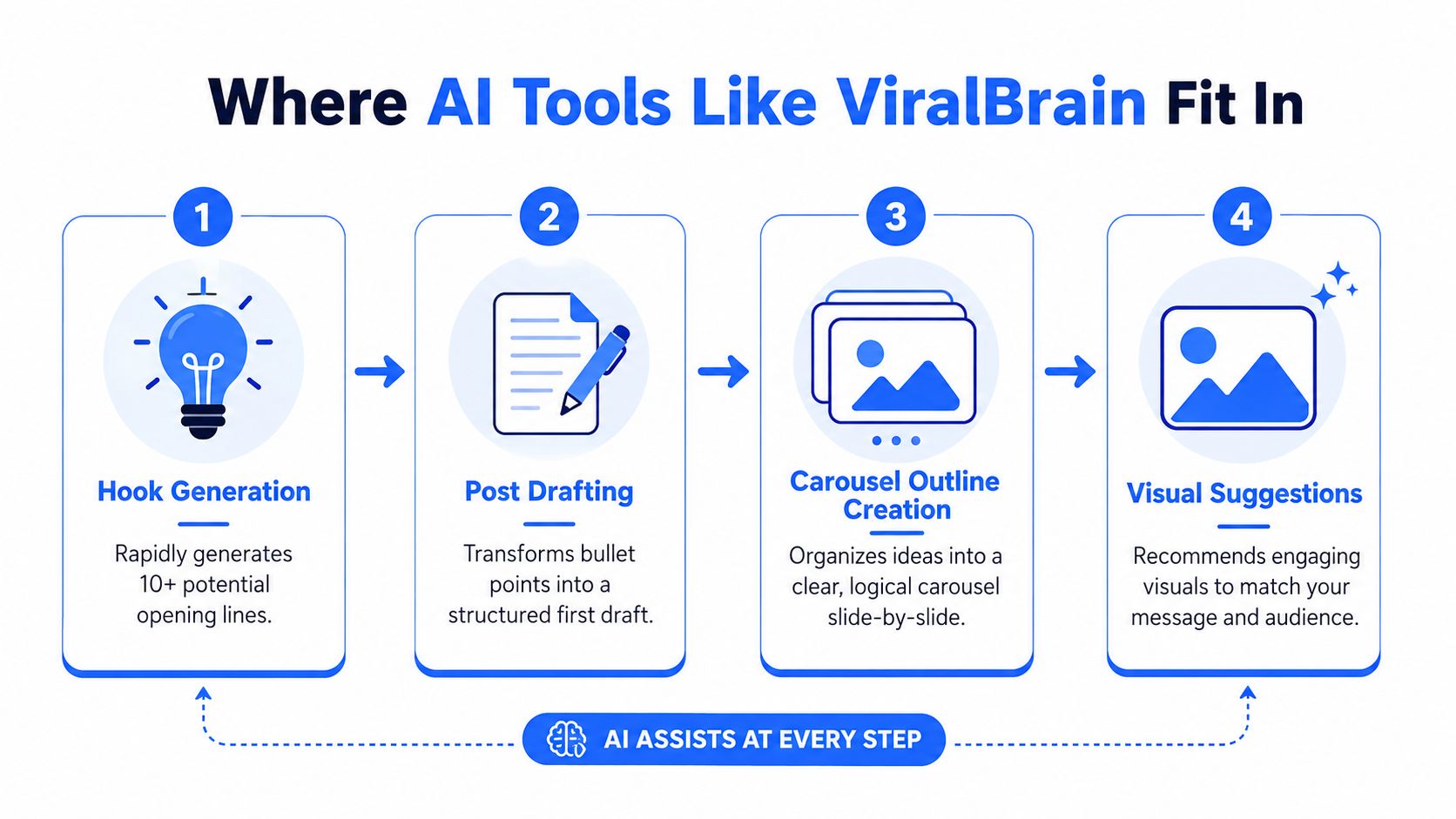
Hook generation is a useful first pass. Feed an AI tool the audience, problem, and opinion. Ask for several opening directions, then reject the bland ones. A founder writing about pricing might ask for hooks built around a mistake, a counterintuitive claim, and a short story.
Post drafting helps when the operator already has raw material. Give the tool five bullets from a customer call. Let it shape those bullets into a LinkedIn draft, then restore the founder's language and judgment.
Carousel outlines are another creation assist. Ask for a slide sequence that moves from problem to explanation to example to action. The tool can create structure, but the strategist still decides whether the sequence teaches anything.
Visual suggestions help a designer start faster. An AI assistant can suggest a simple diagram, comparison layout, or image direction for a post about sales qualification. It shouldn't decide the brand's visual system without review.
Use AI during production
Production is where AI earns its keep through reuse. A long LinkedIn post can become a shorter text version, an image caption, a carousel outline, and a follow-up question. The human owner should approve the meaning of each variation before anything enters the queue.
ViralBrain can generate LinkedIn drafts from user input, suggest improvements, repurpose material, surface post ideas, and provide analytics for iteration. Its competitor benchmarking can feed creation by showing which topics and structures deserve another test. Use it as an operating layer, not as a substitute for an opinion.
A practical AI content creation workflow starts with one source idea. Draft the core post. Ask for alternate hooks. Create a carousel outline. Produce a short variant. Review every version against the original point. Schedule only the versions that still sound like the owner.
For broader practitioner reading, a blog for professionals can help teams compare how people use AI across professional content workflows. The useful question isn't whether AI made the asset. It is whether the team knows which decision AI supported and who approved the final result.
Decision Framework for Individuals and Teams
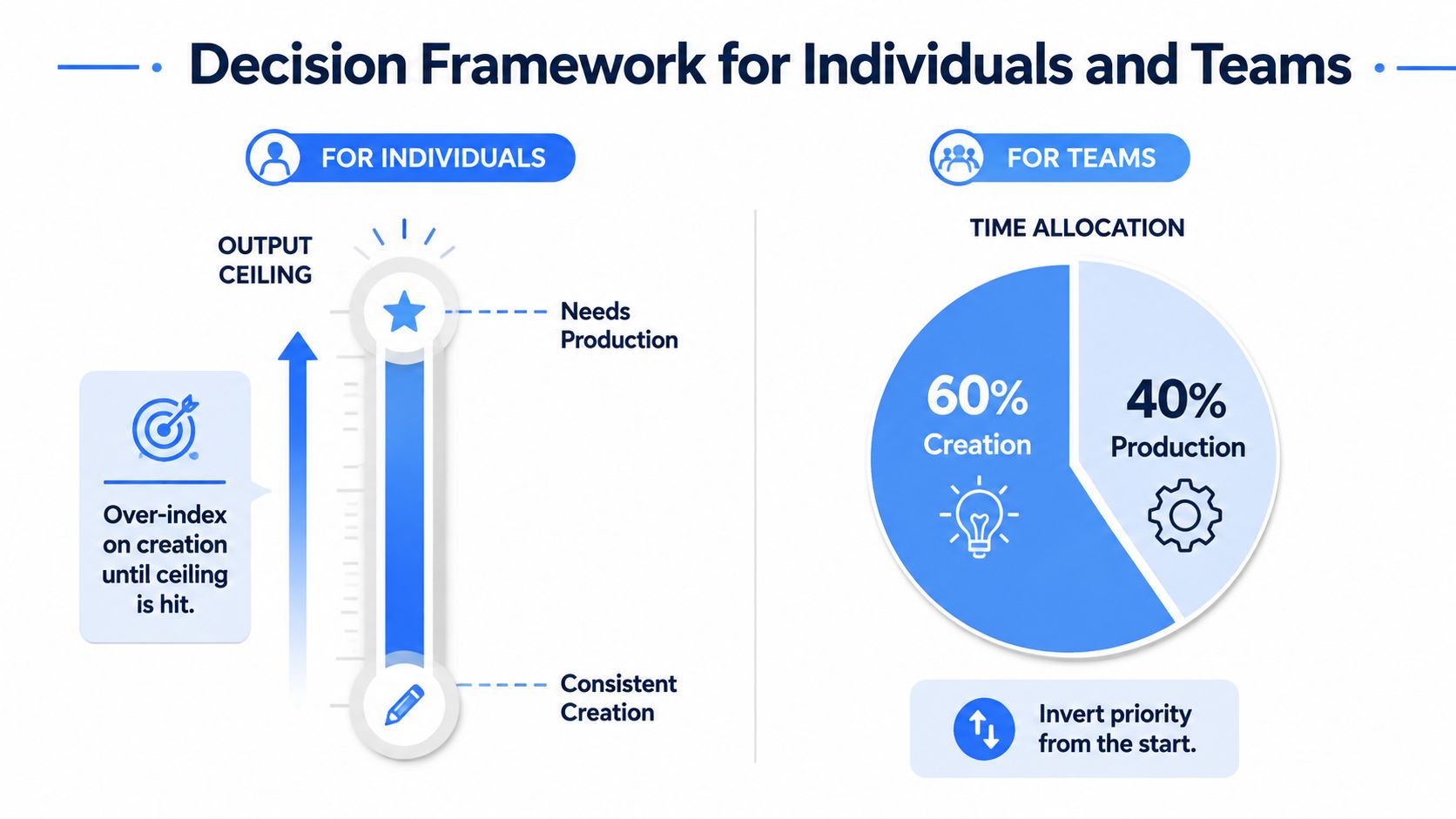
Individuals should over-index on creation until they hit a consistent output ceiling. If you still struggle to find a useful opinion, a production system will only help you publish weak opinions faster.
Teams should invert the priority from the start. Allocate 60% of the cycle to creation and 40% to production, as a practical operating recommendation, not a market benchmark. The split protects original thinking while giving the team enough capacity to edit, format, approve, repurpose, and schedule.
Use three questions before changing the workflow
-
Who owns the audience? If the founder owns the relationship, the founder should own the final point of view. A writer can shape the draft, but shouldn't manufacture conviction.
-
What is the bottleneck? Count the stalled stage. Is the team short of good ideas, or are approved ideas waiting for design and sign-off? Fix the queue, not the part of the process you enjoy most.
-
What does the data say? Weak hooks and poor comment quality point toward creation. Low post frequency, missed publishing windows, and unfinished formats point toward production.
Solo creators often trade depth for speed when they over-produce. They spend an evening adjusting a graphic that supports a mediocre idea. Teams make the opposite mistake. They trade originality for polish when every draft passes through too many reviewers.
For a 90-day operating cycle, a solo creator can reserve several focused work blocks each week for audience research, idea development, and drafting, then protect a smaller block for formatting and scheduling. A team can reserve its larger share for customer insight, positioning, and expert input, while assigning the remaining share to production operations. The exact hours depend on capacity. The ratio matters more than theatrical precision.
Useful warning signs include repeated revisions caused by unclear briefs, a queue full of unfinished assets, declining originality, or a cadence that collapses whenever one person is unavailable. A content creation workflow should make those signals visible before they become a monthly postmortem.
For a human review of design tradeoffs, the Kraken Socials designer approach is a useful comparison point. Use AI for speed where the task is repeatable. Keep human judgment where taste, context, and brand risk matter.
If your last five posts underperformed because the ideas were weak, you need creation. If they underperformed because distribution was weak, you need production.
Checklist and Frequently Asked Questions
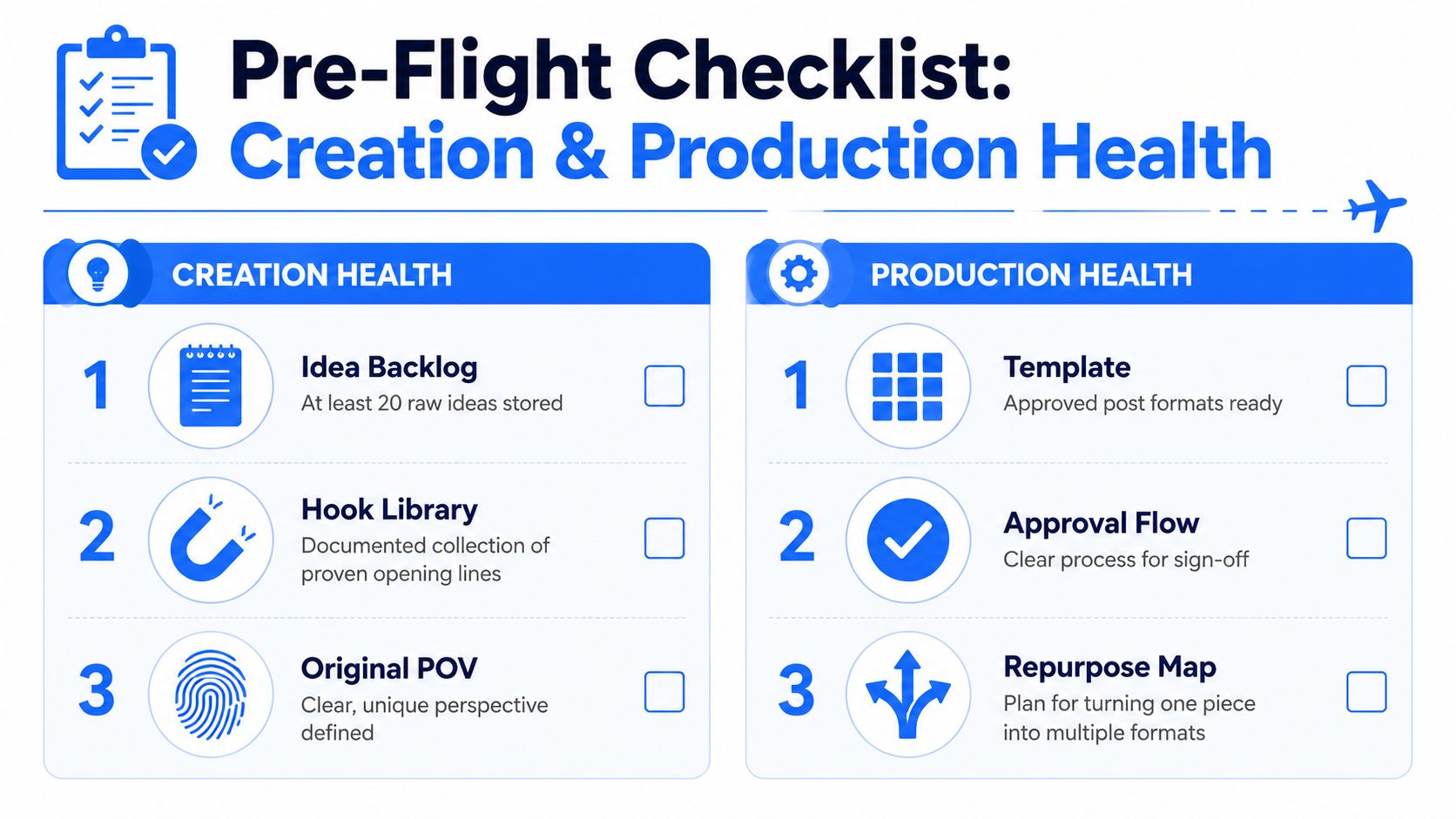
Use this pre-flight check before blaming LinkedIn.
Creation health
- Idea backlog: Keep raw ideas in one place.
- Hook library: Save opening lines worth testing.
- Original point of view: State the belief behind each post.
- Audience problem: Tie the post to a real reader need.
- Evidence or example: Add something concrete to the argument.
Production health
- Approved template: Keep usable post and carousel formats ready.
- Approval flow: Give each reviewer a clear responsibility.
- Repurpose map: Decide which formats can come from one source.
- Posting cadence: Set a schedule your team can maintain.
- Asset specifications: Check dimensions, links, captions, and accessibility before publication.
Should we repurpose the same post across platforms? Repurpose the idea, not the exact packaging. LinkedIn readers expect a different opening, length, and call to action than readers on another platform.
How often should we audit the creation to production ratio? Review it during each planning cycle. Audit sooner if the queue is full but engagement quality is falling, or if good ideas keep missing their publishing window.
Do AI-generated hooks count as creation or production? They support creation because hooks shape the message. The human still owns the final choice, audience fit, and truth of the claim.
ViralBrain connects idea generation, draft improvement, repurposing, pattern analysis, and LinkedIn analytics in one workflow. Visit ViralBrain to give your team a clearer handoff between creation and production.
Grow your LinkedIn to the next level.
Use ViralBrain to analyze top creators and create posts that perform.
Try ViralBrain free