Hook in Writing: Make People Read
Learn how to use a hook in writing with proven types, examples, and templates for LinkedIn, blogs, and tweets that actually stop the scroll.
Grow your LinkedIn to the next level.
Use ViralBrain to analyze top creators and create posts that perform.
Try ViralBrain free79% of test users scan each new page instead of reading every word. Your first line must make the subject and its value clear before a hurried reader scrolls away.
That's the working definition of a hook in writing. It's not a decorative flourish. It's the first decision point in the piece. The reader asks, often without thinking, “Why should I continue?” Your opening needs a useful answer.
A clever sentence can earn a pause. A clear promise earns the next sentence. Those aren't the same result.
Why Your First Line Is Your Only Chance
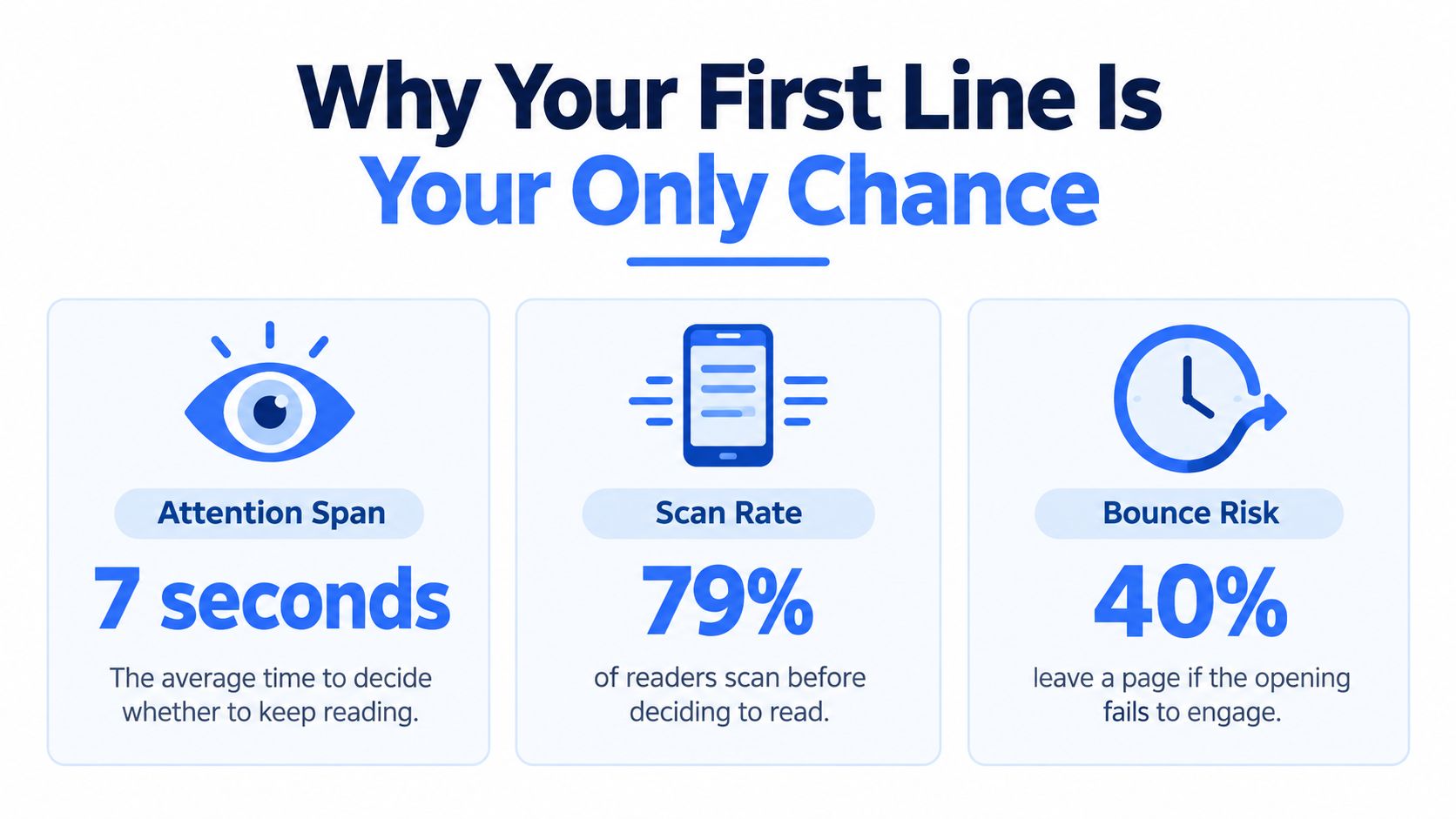
79 percent of test users scanned each new page, while only 16 percent read word by word, according to Nielsen Norman Group's study on how users read on the web. That is the editorial constraint. Readers do not grant full attention up front, so the first line has to survive scanning before it earns reading.
Weak openings fail for a simple reason. They spend the highest-value space on ceremony instead of meaning. “In today's busy business environment” says nothing. “I want to share some thoughts” tells the reader the draft has not found its point yet.
Treat the hook as information design. The job is to name the subject, show why it matters, and leave one useful question unanswered. That is a promise, not a flourish. If the line creates curiosity without clarifying relevance, it gets a glance and loses the click. If it explains everything, it removes the reason to continue. Good openings handle that trade-off in a few words.
News editors learned this early. The inverted pyramid put the central fact near the top because readers often stopped early, and editors still needed the core point to land. The history of the inverted pyramid is useful here for one reason. It shows why front-loading mattered. The structure respected reader behavior instead of arguing with it.
Edit the first words, not just the whole sentence
Scanning is brutal at the front of a line. Nielsen Norman Group's research on the first words readers notice found that readers often focus on the first two words. Their testing also makes the first 11 characters worth inspecting. If those characters are “I wanted to,” “Here's why,” or another warm-up, cut them. Start with the problem, audience, result, or tension.
This matters even more in social posts. The LinkedIn character limit 2026 does not save a vague opening. It makes wasted characters more expensive.
Practical rule: If someone sees only your first line, they should understand the topic, the stake, and the reason to keep going.
The Psychology Behind the Pause
A strong hook creates an information gap. The reader understands enough to see why the subject matters, but not enough to feel finished. That gap produces curiosity without requiring a cheap trick.
The balance matters. A vague line such as “This changed everything” creates uncertainty but gives the reader no useful reason to care. A complete line such as “The answer is to reduce response time” gives away the payoff before the body starts. One withholds too much. The other withholds nothing.
A 2025 meta-analysis of 8,977 headline experiments found a curvilinear relationship between concreteness and click-through rate. More specificity helped when competing headlines were vague. It hurt when the headline already revealed too much. The dataset reported an average click-through rate of 1.33% and a median of 1.04%, which makes matched comparisons more useful than treating either figure as a universal target. The meta-analysis of headline experiments supports a simple editorial rule: disclose the problem and the consequence, then hold back one meaningful detail.
Give the gap a shape
Good curiosity has a subject. It points toward a problem, tension, surprise, or decision.
Weak:
“You won't believe what happened next.”
Better:
“Our sales pipeline looked healthy until we measured time to first response.”
The second version names the setting and signals a conflict. The reader wants to know what the measurement exposed. The first version asks for trust before offering evidence. That's a poor bargain.
Your hook should match the promised payoff. An insight hook must deliver an insight. A warning must explain the risk. A story must move somewhere. If the body gives the reader a predictable lesson after a dramatic opening, the hook has done its job badly. It attracted attention from the wrong people, then charged them with disappointment.
For a practical framework on interrupting predictable openings without turning them into empty stunts, see this guide to pattern interrupt copywriting. The useful test is not whether the line feels unusual to you. It's whether the reader can infer its relevance and still has a sensible reason to continue.
Three Types of Hooks That Actually Work
Most hooks fit three useful jobs. They can connect through a shared feeling, open a specific information gap, or establish a concrete fact. The category matters less than the promise behind it.
| Hook Type | Best For | Key Mechanism |
|---|---|---|
| Emotional | Personal stories and founder lessons | Shared experience |
| Curiosity | Educational posts and problem solving | A specific unresolved gap |
| Data | B2B analysis and expert commentary | Immediate evidence of relevance |
Emotional hooks create recognition
An emotional hook works when the reader recognizes the situation before they know the lesson.
“We celebrated the new leads before checking whether sales could follow up.”
That line creates tension through a familiar business failure. It doesn't pretend the event was more dramatic than it was. It gives the reader a human problem and leaves room for the explanation.
Use this form for founder stories, team mistakes, customer moments, and lessons where feeling carries the meaning. Don't open with emotion alone. “I was frustrated” has no shape. Name what caused the frustration.
Curiosity hooks create a useful gap
A curiosity hook introduces a question the body can answer. The question needs stakes, not fog.
A 2024 study of news consumption found that headlines containing question marks were read 3.4% more often, consistent with information gap theory. The study on question based headlines supports question framing when the missing answer feels important, surprising, and relevant.
Weak:
“Are you scaling correctly?”
Stronger:
“Why does adding sales capacity sometimes reduce growth?”
The stronger version identifies a causal tension. It tells the reader what kind of answer is coming. Then pay it off quickly. Name the observation, method, or counterintuitive detail within the next few lines. Curiosity without delivery is just clickbait wearing office clothes.
Data hooks establish authority fast
A data hook starts with a verified number, a measured change, or a concrete observation. The figure must earn its place. If it doesn't change how the reader sees the problem, remove it.
The opening of this article uses scanning behavior because that evidence changes the writing task. A random percentage would only decorate the paragraph. Data should sharpen the decision, not make the writer look busy.
Choose the type based on reader state. A cold audience may need a clear problem. A warm audience may respond to proof or a story. A technical reader may want the observation first. The best hook is the one that makes the right reader expect a payoff you can provide.
Hooks for LinkedIn, Blogs, and Tweets
The same idea needs different packaging on different platforms. LinkedIn readers usually need a professional problem with a human edge. Blog readers need immediate subject clarity because search and scanning punish vague openings. Tweets need compression, so every word must carry either context or tension.

LinkedIn needs a decision problem
Weak:
“I've been thinking about leadership lately.”
Stronger:
“Our team didn't need another meeting. It needed a decision owner.”
The second line gives the reader a workplace problem and a point of tension. It also filters the audience. People who manage teams may continue. People looking for general inspiration can keep scrolling, which is fine.
A LinkedIn hook can use a question when the question names the problem:
“Why does a healthy pipeline still produce a weak quarter?”
That's more useful than “Is your pipeline working?” The first suggests a mismatch worth investigating. The second sounds like a survey written by a bored spreadsheet.
Blogs need subject clarity first
Weak:
“There are many things writers should consider.”
Stronger:
“A hook in writing gives readers a reason to read the next sentence.”
The blog opening should establish the topic before adding style. Search readers may arrive with a specific need. Don't make them decode your cleverness before you answer it.
Tweets demand a tighter version:
“Your hook failed before the second sentence. The problem wasn't creativity. It was missing context.”
That line states the subject, creates friction, and leaves the explanation open. It doesn't need a grand setup.
These formats reward different levels of context, but the promise stays stable. Name the audience or problem, show the consequence, then reserve one useful detail for the body.
This video offers another visual way to think about opening lines and social posts.
A format can improve distribution, but it can't rescue a dishonest opening. A carousel with a vague first slide remains vague. A short post with a strong first line can work because the reader understands the bargain immediately.
Templates You Can Use Today
Templates help when they preserve the mechanism, not when they replace judgment. Fill the blanks with a specific audience, problem, observation, or consequence. If the result could apply to every business on earth, the variables are still too soft.
LinkedIn templates
Problem and consequence
“[Audience] keeps doing [common action], but the real cost appears in [specific consequence].”
Counterintuitive question
“Why does [apparently helpful action] sometimes create [unexpected problem]?”
Story opening
“We thought [assumption]. Then [specific event] showed us [unresolved lesson].”
Use one variable at a time when testing. Keep the story, audience, and promise stable while changing the opening angle.
Blog templates
Direct definition
“A hook in writing [clear function], so readers can decide whether [next action].”
Evidence led opening
“[Verified observation] changes how you should write [topic].”
Diagnostic opening
“If your [content type] gets attention but no [desired behavior], inspect the first [relevant element].”
A blog hook should orient the reader before it tries to surprise them. That doesn't mean writing dull prose. It means putting the subject where the reader can see it.
Tweet templates
Sharp contrast
“[Expected result] looked fine. [Specific signal] said otherwise.”
Compressed lesson
“Your [content asset] doesn't need more [common fix]. It needs [specific correction].”
Open loop
“We fixed [visible problem] and found [unexpected issue]. The second problem mattered more.”
For more examples of how content structures change across formats, review these content creation examples. Then rewrite each template in your own language. A template should disappear inside the final sentence. If readers can see the mould, the writing feels manufactured.
Stop Guessing, Start Testing
Benchmarks help with context. They do not pick your hook for you. Format results shift by audience, account strength, topic, and what the post is asking the reader to do, which is why The LinkedIn format analysis is more useful as a reminder about sample limits than as a rulebook.
Test the promise instead.
Keep the topic, format, author, publishing window, and call to action as steady as you can. Change the opening only. Then check what the reader did: clicks, dwell time, completion, qualified comments, profile visits, or conversions. A strong hook creates the right kind of pause and leads into the next line without breaking the promise.
That trade-off matters. A line can attract attention and still hurt performance if it pulls in the wrong reader, frames the piece badly, or creates curiosity your draft does not satisfy. I see this constantly in social drafts that chase punch over clarity. The first line gets reactions. The body cannot cash the cheque.
Research on online news engagement found a low overall click rate across tested links, which is a useful warning against trusting instinct over behavior. The practical lesson is simple: small gains matter, and confidence is a poor metric.
For paid social teams, this guide to a good hook rate for Facebook ads can help frame platform specific measurement. Use your own baseline first. Then test one variable at a time. A hook works when it attracts the right reader and carries them into the material you promised, not when it collects empty reactions.
ViralBrain helps founders, marketers, and creators study high performing LinkedIn patterns, generate opening lines in different styles, and refine drafts with analytics.
Grow your LinkedIn to the next level.
Use ViralBrain to analyze top creators and create posts that perform.
Try ViralBrain free