

How to Find Your Voice for LinkedIn Content
Learn how to find your voice for professional content with practical exercises, tone frameworks, and testing methods that actually work
Grow your LinkedIn to the next level.
Use ViralBrain to analyze top creators and create posts that perform.
Try ViralBrain freeMost advice on finding your voice is too vague to use. “Be authentic” sounds pleasant, but it doesn't tell you whether to write shorter sentences, take a firmer position, share a story, or stop using words you'd never say aloud.
For LinkedIn, your voice is a set of repeated choices. It shows up in your opinions, sentence rhythm, examples, level of detail, source handling, and willingness to say something that may not please everyone. You build it through practice, feedback, editing, and exposure. You don't wait for a magical sentence to reveal it.
Why Finding Your Voice Is Not a Single Breakthrough Moment
Finding your voice rarely feels like a dramatic breakthrough. It looks more like writing a rough post, deleting half of it, noticing one sentence that sounds like you, then doing that again until the pattern becomes visible.
Public speaking anxiety makes this harder. A large 2025 survey ranked fear of public speaking as the 46th most common fear out of more than 65 measured fears, with 33.7% of Americans saying they were afraid or very afraid of it, according to public speaking statistics compiled by VoxBooster. Broader estimates in the same source describe fear at roughly 75% worldwide, with around 40 million U.S. adults affected by public speaking related anxiety. The exact estimates vary, but the practical point holds: hesitation is common. It isn't proof that you lack ideas.
The same source describes a research arc spanning 30 years, with estimates that about 63% of the general population report some level of public speaking anxiety. Fear suppresses practice, yet practice gives you the material needed to hear, test, and refine your voice. That loop explains why waiting to feel confident is a poor content strategy.
Practical rule: Treat confidence as a result of publishing and reviewing work, not as a requirement for starting.
Exposure builds what talent cannot
Age and experience show why voice develops. A 2026 consumer survey reported that 69% of people aged 45 and over felt quite or very confident speaking publicly, compared with 25% of people aged 16 to 24, a 44 point gap reported in fear of public speaking statistics from Crown Counseling. The difference doesn't prove age alone creates confidence. It does show that repeated exposure, feedback, and accumulated communication experience matter.
Education showed a similar pattern in that survey. Twenty four percent of people with a college degree were fearful, compared with 52% of those with a high school diploma or less. More writing, presentations, meetings, and professional conversations can give people more chances to practise deliberate expression.
A UK survey summarized by the same source found that 59% of respondents would avoid public speaking if there were no repercussions, while 21% said they actively hate and avoid it. Silence often comes from avoidance, not from an empty mind.
Your LinkedIn voice starts with lower stakes. Write a private draft. Record a short voice note. Share an opinion with a trusted colleague. Use practical professional content creation tips when you need ideas, but don't borrow another creator's personality. For the difference between voice and tone, keep this guide to voice and tone in writing nearby.
Stop trying to sound profound
A founder who writes “I learned a valuable lesson about leadership” gives readers nothing to hold. A founder who writes, “I stopped asking candidates whether they were ambitious. Everyone said yes. I started asking what they had quit recently,” has made a voice choice. The sentence has a position, a rhythm, and a useful point of tension.
That kind of clarity comes from accumulation. Publish enough to notice what you repeat. Review enough to see what feels forced. Edit enough to remove the phrases you picked up from other people.
You don't find your voice by staring at a blank document until it blesses you. You find it by making choices, then keeping the ones that sound true.
Self Assessment Exercises to Map Your Natural Voice
Before refining your voice, collect evidence about how you already communicate. Your natural style leaves clues in emails, sales calls, meeting notes, posts, and messages to people you trust. The job is to spot those clues without turning yourself into a walking tone chart.
Start with a short freewrite. Set a simple prompt such as, “What do buyers misunderstand about my category?” Write without editing. Then repeat the exercise with, “What would I change if I had to run this company again?” Don't polish the result. The awkward bits are useful because they reveal your ordinary vocabulary.
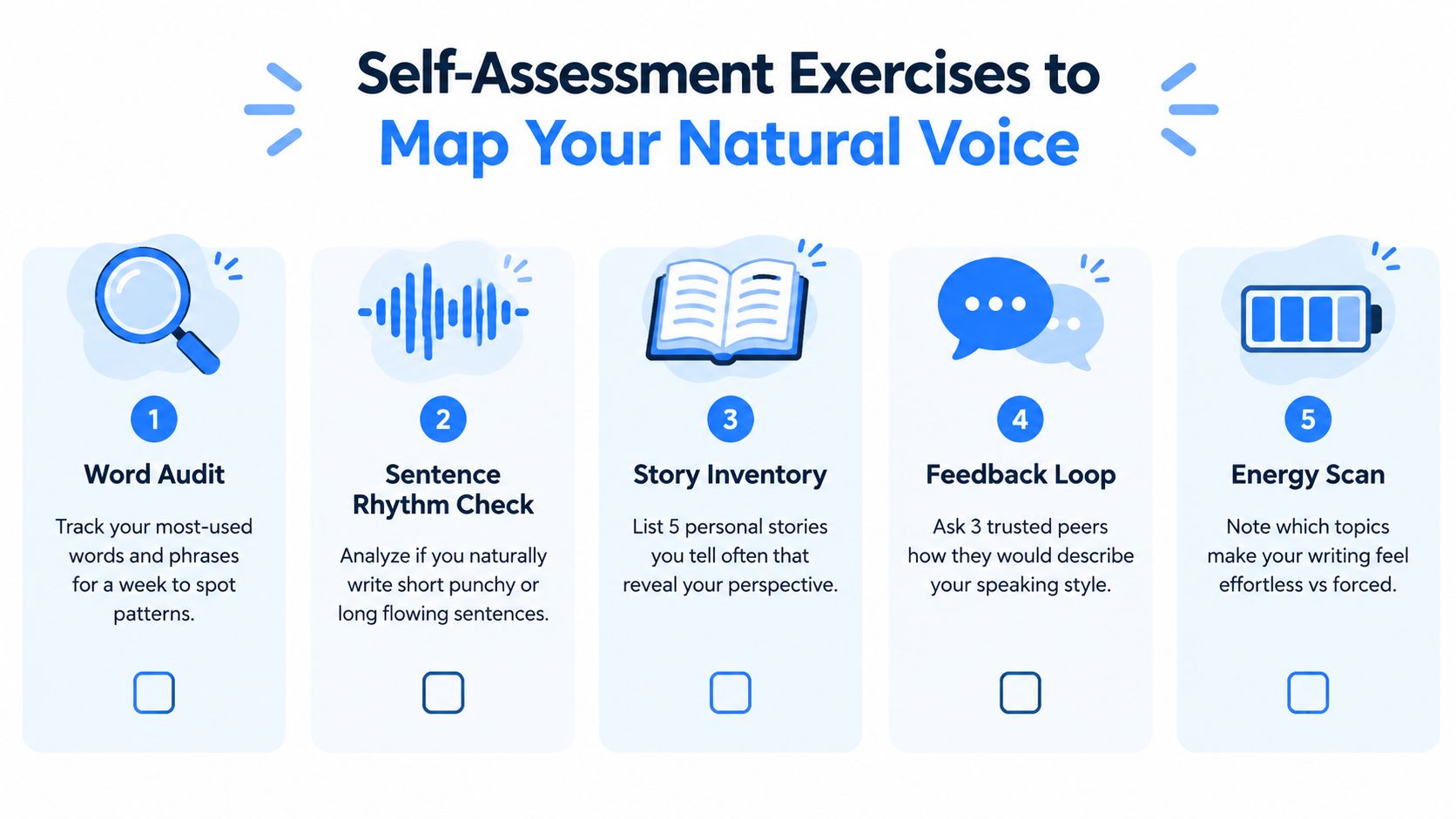
Use the following visual as a working checklist.
Find the patterns you keep producing
A practical voice audit should examine five areas.
-
Word choices: Mark words and phrases that appear often. Look for verbs, transitions, level of formality, and phrases you'd never say in conversation. Repeated wording can become a strength, but unconscious repetition makes posts sound mechanical.
-
Sentence rhythm: Read three pieces aloud. Do you prefer short, blunt sentences? Do you build long explanations? Do you vary both? Rhythm affects how readers experience authority, warmth, urgency, and doubt.
-
Stories: Write down personal stories you tell more than once. Include the problem, the decision, and what changed your view. Recurring stories usually contain your strongest perspective because you've already tested them in conversation.
-
Outside feedback: Ask three trusted peers to describe your speaking style without giving them suggested adjectives. Their answers may reveal traits you miss, such as calm, sceptical, precise, dry, patient, or direct.
-
Energy: Compare topics that make drafting easy with topics that make you sound stiff. The gap can show where your knowledge is deep enough to support a real opinion.
The brand voice guide from ViralBrain can help you turn those observations into usable writing decisions. Keep the final inventory short. A page of notes is enough.
Your voice inventory should describe behaviour, not identity. “Uses short sentences and challenges weak assumptions” is useful. “Is an authentic leader” is wallpaper.
Turn observations into rules
Convert patterns into rules you can apply while drafting. For example, “I explain complex ideas through blunt comparisons,” “I use one personal detail before the lesson,” or “I avoid corporate phrases.” These rules create consistency without forcing you into a costume.
Then test the rules against a new post. If the writing feels unnatural, adjust the rule. A voice guide should make writing easier, not turn every sentence into a committee meeting.
Tone Frameworks and Archetypes That Actually Work
“Be authentic” fails because it gives you no editing decision. A useful tone framework connects a specific stance to a specific reader need. It tells you what to emphasise, what to avoid, and how the post should move.
A 2024 literature review on authorial voice argues that readers interpret voice as a mix of deliberate techniques rather than one isolated trait, as described in the PubMed review of authorial voice. That matches what readers notice on LinkedIn. They respond to your position, your sentence rhythm, your examples, and how you handle evidence.
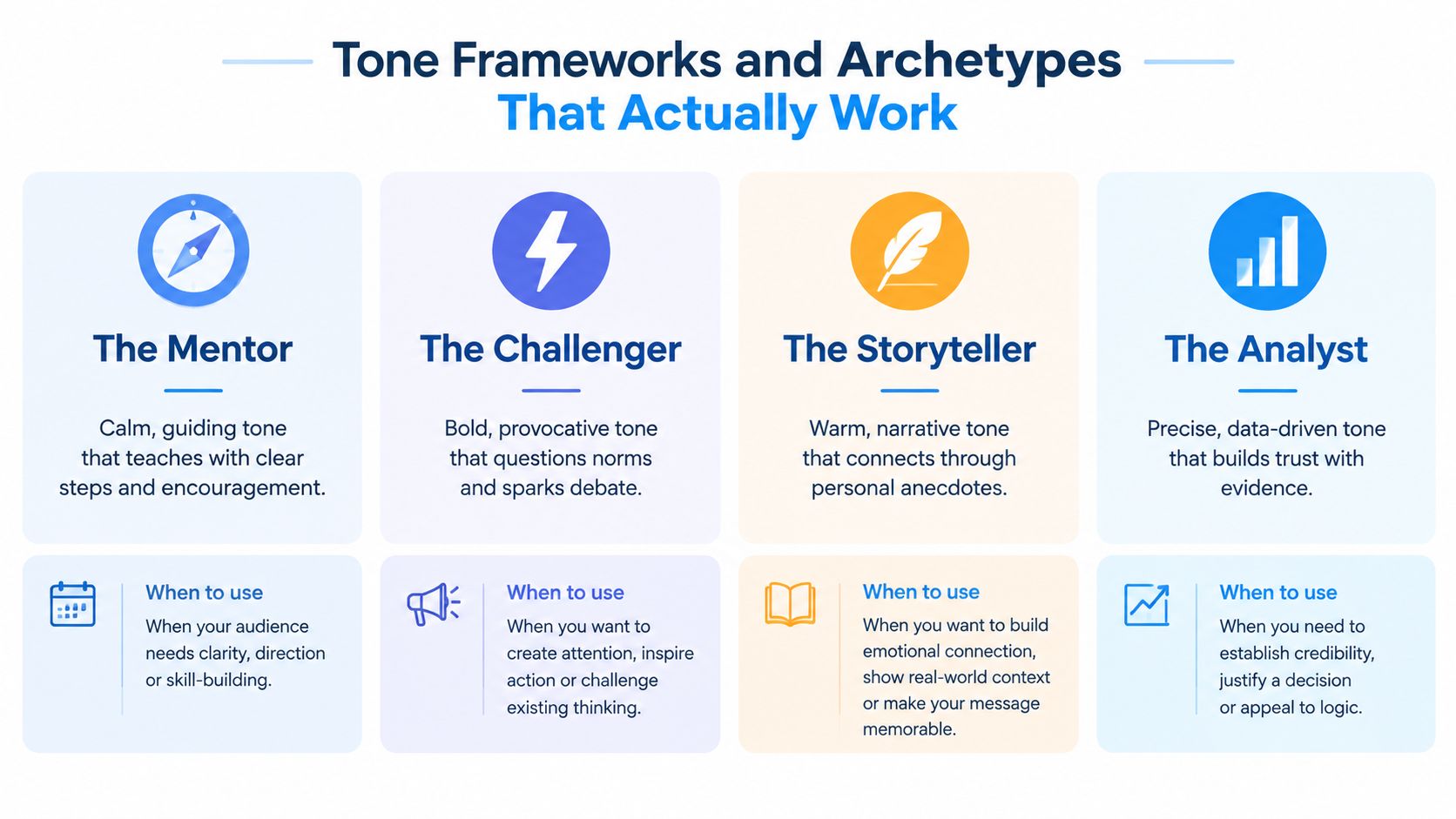
Four practical choices
The Mentor teaches through clear steps. Use it for onboarding, process advice, and lessons from repeated work. The tone is calm, but it shouldn't become soft or vague. “Start with the customer interview, not the homepage copy” is more useful than “Put the customer first.”
The Challenger questions accepted practice. Use it when you have a defensible disagreement. A challenger post needs a reason, not just a loud opinion. “More content won't fix unclear positioning” gives readers a claim they can assess.
The Storyteller uses a personal event to carry a business lesson. The story needs a decision, consequence, or changed belief. A long account of your morning routine is not a business insight just because coffee appears in it.
The Analyst uses comparisons, evidence, and careful distinctions. It works well for research, product strategy, pricing logic, and category education. The risk is sounding like a spreadsheet with a profile photo.
A post can use one primary archetype with a secondary trait. A mentor can challenge a bad habit. An analyst can tell a short story. Don't mix every style in one post. That produces tonal soup.
Choose techniques, not costumes
The University of Melbourne separates authorial voice into macro, middle, and micro levels in its guide to developing an authorial voice. At the macro level, you justify choices and findings. At the middle level, you connect sources through your own analysis. At the micro level, word choice and reporting verbs signal attitude.
That structure works for LinkedIn too. Your macro voice is the position you take. Your middle voice is how you explain the evidence. Your micro voice is the wording, rhythm, and verbs that make the post sound like you.
For practical ideas on preserving a recognisable tone across channels, review these Xholic AI voice scaling tips. Then create a small style sheet with your preferred sentence length, recurring topics, banned phrases, typical level of disagreement, and evidence standard.
Writing Prompts and Templates for Daily Practice
Voice gets stronger when writing becomes ordinary. You don't need inspiration every morning. You need a repeatable way to turn an observation into a draft before your inner editor starts demanding a board presentation.
Use a timed freewrite first. Write the raw answer to one prompt without fixing grammar.

Try prompts such as:
• What advice in my industry sounds sensible but fails in practice?
• What did a customer teach me that changed our process?
• What decision would I make faster if I had to repeat it?
• What do smart operators keep getting wrong about this problem?
• What sentence would I say to a client who asked for the shortcut?
The point is not to publish each answer. The point is to produce raw material in your own language.
Use a four pass drafting routine
A practical method from an academic writing source recommends freewriting, reading broadly, writing daily, talking through arguments, sharing drafts early, and trusting your instincts. A complementary Harvard communication workshop recommends dumping uncensored thoughts, condensing them into an executive summary, testing extreme pro and con positions, then reshaping the argument for its target format, as described in this research source on writing voice and communication practice.
Turn that into a LinkedIn routine.
-
Dump: Write everything you think about the topic. Include objections, examples, and half formed ideas.
-
Condense: Reduce the draft to one sentence. If you can't state the point plainly, the post has more thinking to do.
-
Stress test: Write the strongest argument against your position. Then answer it without pretending the objection is foolish.
-
Shape: Choose a format. Use a story for a changed belief, a short sequence for a process, or a direct argument for a disputed idea.
A simple template can keep the writing lean.
Opening: State the tension or surprising observation.
Context: Give the specific situation that created your view.
Point: Explain what you now believe.
Application: Tell readers what to do differently.
Close: Invite a useful response, not applause.
Write the first draft in your natural voice. Edit structure second. Grammar comes last. Starting with polish is how people end up with immaculate posts that say nothing.
Use the video below as another prompt for observing delivery, pacing, and spoken phrasing. Don't copy its voice. Notice what your own version would sound like.
Read the final post aloud. Any phrase that makes you wince deserves a rewrite. Your mouth is a better detector of borrowed language than your eyes.
Preserving Your Voice When Using AI Tools
AI can help you produce more drafts. It can't decide which experience changed your mind, which opinion you're willing to defend, or which phrase belongs to you. If you hand over the core thinking, the output may be clean while your identity exits through the side door.
Recent 2026 commentary describes automated drafting as capable of producing “shallow fakes” and raises the risk that AI assistance can weaken authenticity rather than clarify it, as discussed in this LinkedIn guidance on finding your voice with AI. That concern is especially relevant for founders and B2B marketers who publish across profiles, teams, and platforms.
Start with your own raw material. Give the tool a voice note, a rough paragraph, a customer story, or a sharp opinion. Don't ask it to invent your point of view from an empty prompt. Empty prompts tend to produce content that is tidy, agreeable, and forgettable.
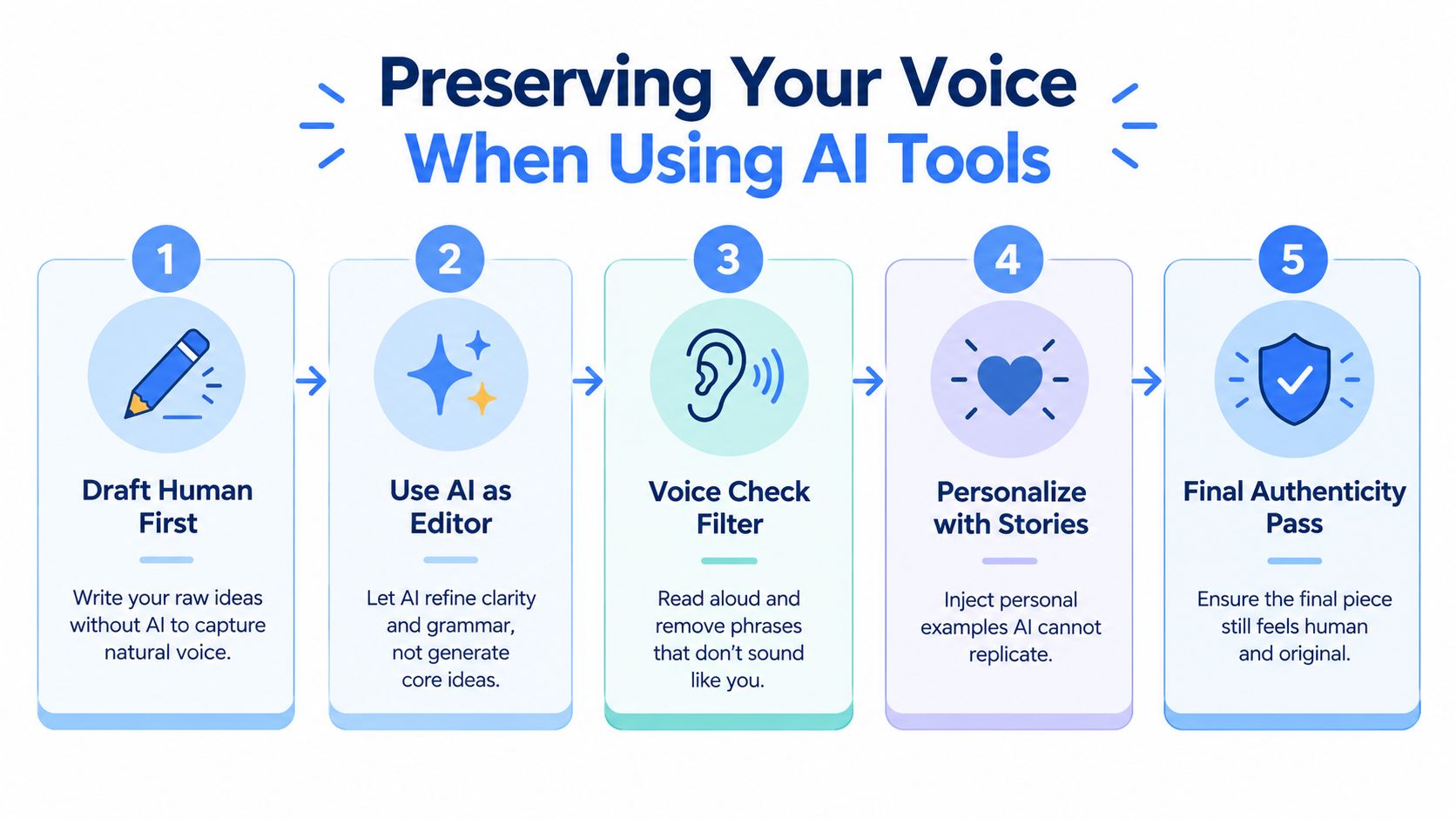
Keep the human decisions visible
Use AI as an editor for clarity, structure, grammar, and alternative openings. Keep the main claim, personal evidence, emotional temperature, and final wording under human control.
A useful review asks:
• Did I believe this before the tool drafted it?
• Would I say this sentence to a customer?
• Does the post include a detail only I could provide?
• Did the edit remove the friction that made the idea interesting?
• Is the conclusion mine, or did the tool choose the safest ending?
Read the draft aloud. Remove smooth phrases that sound like generic professional content. Add a concrete detail, a sharp qualification, or a sentence that shows the cost of getting the issue wrong.
A family friendly AI resource hub from 1chat can help teams compare general AI uses, but tool choice doesn't solve voice drift. Your process does. For a more focused approach to human sounding LinkedIn drafts, use this guide to making AI LinkedIn posts sound human.
ViralBrain can analyse your writing, draft LinkedIn posts in a voice matched to your examples, surface creators and posts in a niche, then help repurpose topics or voice notes into drafts. Treat that output as a starting point. The final post still needs your judgement, your facts, and your willingness to remove anything you wouldn't say.
Testing Methods and Metrics to Track Progress
You can test voice without turning your profile into a laboratory. The goal is to identify patterns that make your writing clearer and more recognisable, then keep adjusting.
Start with recordings. Read the same short post aloud before editing and after editing. Compare your pace, pauses, emphasis, and vocal effort. A pre and post study of trainee teachers found that training samples showed slower speech and reduced vocal effort regardless of intended motivation, supporting the value of deliberate awareness and feedback in changing delivery, as reported in this voice training study.
Track signals that show recognition
Keep a simple review log for each published post.
• Recognition: Note whether people mention your recurring themes, phrasing, examples, or point of view. Recognition is stronger evidence of voice than a single burst of attention.
• Response quality: Separate thoughtful replies from empty reactions. A useful comment often shows that readers understood the claim well enough to extend or challenge it.
• Clarity: Record the questions people ask after reading. Repeated confusion may point to weak structure rather than a weak idea.
• Consistency: Compare your posts over time. Look for stable sentence rhythm, topic preference, level of directness, and use of stories.
• Delivery: Record yourself reading drafts. Notice where you rush, flatten emphasis, or use words that don't sound natural aloud.
Don't chase every fluctuation. A post can perform well and still sharpen your positioning. A popular post can attract attention because of timing or controversy while teaching you little about your actual voice.
Run controlled edits
Change one feature at a time. Try a shorter opening, a firmer stance, a personal example, or a different closing. Keep the topic and core point similar so you can judge the writing choice rather than the entire subject.
Review results with a human reader who knows your work. Ask whether the post sounds like you, what sentence feels strongest, and where the voice becomes generic. Specific feedback beats praise because “good post” tells you almost nothing.
Your target isn't a fixed persona. It's a recognisable pattern that still leaves room for growth. Keep the elements readers identify, change the habits that weaken clarity, and let repeated work do the unglamorous part.
ViralBrain helps founders and marketers turn their own writing, ideas, and voice notes into voice matched LinkedIn drafts, with tools for pattern analysis, repurposing, editing, and analytics. Visit ViralBrain, upload a few real examples, then use the drafts as material to edit into something you'd actually say.
Grow your LinkedIn to the next level.
Use ViralBrain to analyze top creators and create posts that perform.
Try ViralBrain free