
How to Maintain Brand Consistency Across Every Channel
Learn how to maintain brand consistency with a step-by-step playbook covering guidelines, governance, templates, review workflows, and measurement.
Grow your LinkedIn to the next level.
Use ViralBrain to analyze top creators and create posts that perform.
Try ViralBrain freeA widely cited benchmark links consistent brand presentation across every customer touchpoint to a 23% revenue increase. The figure comes from research first reported by Lucidpress and Demand Metric, and it points to a problem many teams still treat as a design issue. Brand consistency is a business system. If your website sounds calm, your LinkedIn posts sound frantic, and your sales deck uses a logo from three rebrands ago, buyers notice the disorder.
Most companies don't lack brand rules. They lack a way to make those rules survive contact with busy people, rushed launches, agencies, founders, and editable templates. A PDF can't stop someone from stretching a logo at 5:47 p.m. on a Friday.
Why Brand Consistency Actually Pays
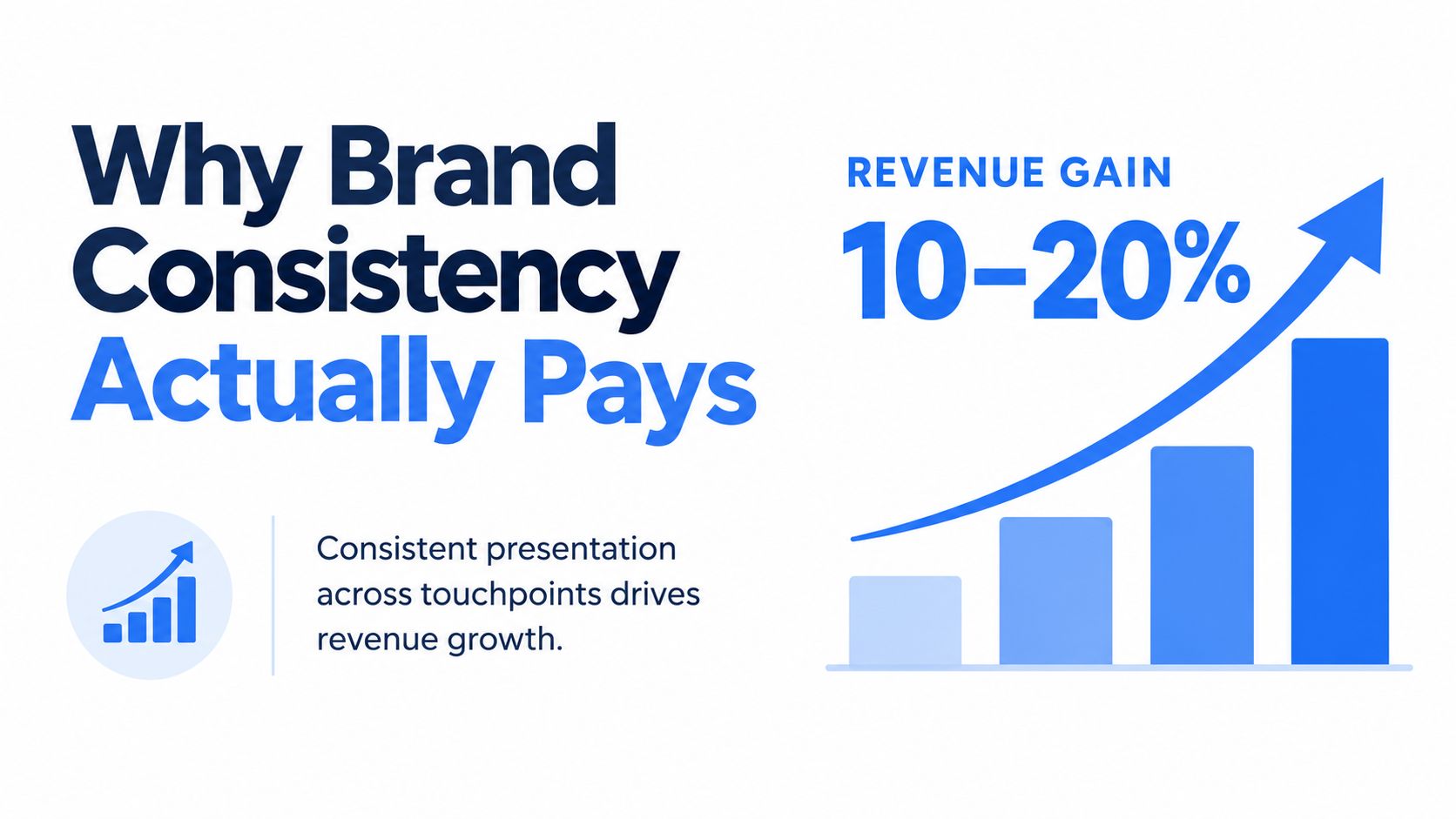
The commercial case starts with revenue. The Lucidpress research summary connects consistent brand presentation across channels with a 10% to 20% revenue increase, while some later updates cite gains as high as 33%. These figures are summarized by Omnibound's review of brand consistency research. They don't mean a new color palette prints money. They mean a company that presents itself reliably makes it easier for people to recognize, understand, and trust what they see.
Consistent brands also perform better on measures such as awareness, favorability, and action intent. Research summarized by System1 and the Institute of Practitioners in Advertising found 27% more significant uplifts for consistent brands across those measures. The same report estimated that inconsistent branding could cost studied brands £3.5 billion over five years. That is a costly way to discover that nobody checked the deck template.
Consistency reduces mental work
People process repeated cues faster. A familiar color, type treatment, phrase pattern, or visual rhythm helps someone identify the source before they read every word. That matters in a crowded LinkedIn feed, a busy inbox, a sales call, or a partner page where your logo has to compete with several others.
This doesn't mean every channel should look identical. A founder post can sound more personal than a product page. A webinar deck can use more context than an advertisement. The useful rule is narrower. The same company should remain recognizable across those changes.
That includes the verbal system. Your opening lines, level of directness, proof style, and calls to action should belong to the same brand. Teams that need a clearer distinction between stable voice and flexible tone can use this practical resource on adapting your brand voice.
Practical rule: Allow variation by channel, but never leave variation to chance.
The failure usually happens after the strategy meeting. Someone writes a guide. The guide gets stored in a folder. New contributors receive a link they can't find later. Designers make templates from memory. Sales copies an old slide deck. Marketing creates a fresh version of the tagline. Everyone believes they are following the brand, which is how five slightly different brands appear in public.
Documentation is not enforcement
A brand guide can describe the correct logo, color, typography, message hierarchy, and tone. It can't enforce any of those rules by itself. Enforcement requires ownership, controlled assets, usable templates, review gates, and checks on live content.
The distinction matters because the economic benefit comes from what customers see, not what the brand team approved in a document. A perfect guide that nobody uses has the commercial value of a locked filing cabinet.
Treat consistency as an operating system. The guide defines the rules. Governance decides who can change them. Templates make the right action easier. Reviews catch exceptions. Metrics show where the system breaks. That is the playbook for how to maintain brand consistency across every channel without turning the brand team into a full-time correction desk.
Building One Source of Truth for Your Brand
Start with one living source of truth. Not a sprawling PDF. Not a folder called “Final Brand Assets” containing six files with “final” in their names. Use a searchable workspace where the current rule sits beside the approved asset and a clear example.
The guide needs enough detail to make decisions without becoming a museum of design theory. Lock down the parts that affect recognition and interpretation.
Define the rules people use every week
Begin with the visual basics. Show approved logo versions, minimum clear space, incorrect treatments, core colors, supporting colors, typography, image direction, and accessibility requirements. Place an approved example next to a bad example. Contrast teaches faster than a paragraph saying “do not use the logo incorrectly.”
Then add the verbal system. Define the audience, promise, proof style, tone, vocabulary, sentence length, forbidden phrases, message hierarchy, and CTA conventions. A brand that says “book a demo” on one channel and “start your transformation journey” on another may have a voice problem, not a creativity problem. For a useful perspective on why brand messaging drives growth, focus on how a message connects the brand promise to a clear business action.
A LinkedIn first brand needs more than a logo section. It needs rules for the content itself.
- Hook style should define whether posts open with a claim, a mistake, a short story, or a useful contrast.
- Post structure should show how the brand moves from problem to explanation to action.
- Proof standards should state when to use a customer example, a process detail, or a personal observation.
- CTA language should make clear whether the brand invites discussion, asks for a reply, or points to a resource.
Don't prescribe every sentence. Define the boundaries that make a post recognizable.
Keep the guide alive
Give the source a version number, an owner, a change log, and a review date. Use plain naming such as Brand Voice v3 or LinkedIn Post Template Current. Archive old versions instead of leaving them beside current files. When people see four “approved” logos, they choose the one that loads first.
Link the rules directly to templates, image libraries, presentation files, and copy examples. The person creating a post shouldn't have to search through a separate system to find the correct type scale. The person building a sales deck shouldn't need a brand designer to confirm which logo is current.
The brand voice guidelines template from ViralBrain can help structure the verbal part of the system. Adapt the format to your team. A template is a starting point, not a substitute for decisions.
The best guide is the one a contributor opens while doing the work, not the one the brand lead praises during the rebrand presentation.
Use side by side examples for common tasks. Show an on brand LinkedIn post beside an off brand version. Show a current sales slide beside an outdated one. Explain the specific difference in one sentence. New team members learn what “good” means when they can compare real work, not when they read another page of adjectives.
The source of truth should answer practical questions quickly. Which logo goes on a partner page. How much personality can a founder use. Which CTA belongs at the end of a product post. What happens when a campaign needs a color outside the core palette. If the guide can't answer those questions, it isn't ready for daily use.
Setting Up Governance That Does Not Fall Apart
Governance is where most brand programs become uncomfortable. Someone has to decide who owns the rules, who can edit the assets, who approves exceptions, and who gets the final word when a product lead wants a louder design.
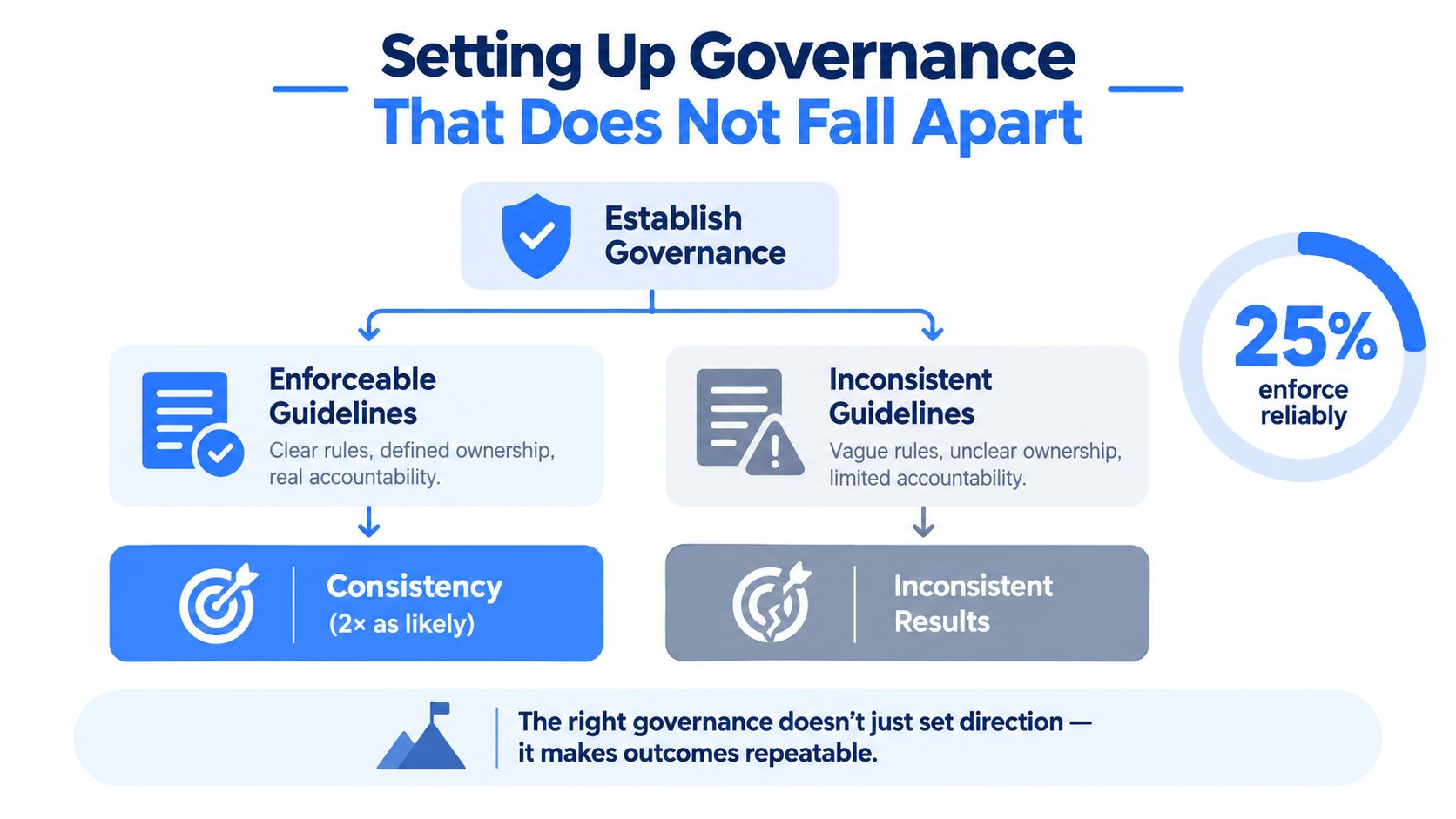
Companies with enforceable guidelines are 2x more likely to maintain consistency, yet only about 25% of organizations enforce their guidelines reliably, according to the data summarized by Wifitalents. The gap is not mysterious. Teams document standards, then leave every contributor to interpret them alone.
Give decisions a named owner
A small team may need one brand owner and one backup. A larger company needs clear ownership for visual identity, voice, product messaging, channel publishing, and partner materials. The owner doesn't need to approve every social post. They do need authority over the rule itself.
Write down who can make each decision. A marketing manager may approve a routine campaign asset. A designer may maintain approved templates. A brand lead may approve a new visual treatment. A founder may have input on personal posts, but personal preference shouldn't rewrite the company voice.
The approval path must include an escalation route. If two teams disagree, the content shouldn't sit in limbo while twelve people add comments. One person makes the final call, and the reason gets recorded when the decision changes an existing rule.
Limit editing without blocking work
Role based access solves a practical problem. Contributors need freedom to adapt approved content, but they don't need permission to alter master logos, type settings, or core colors. Lock those components in templates. Allow editing where the context changes, such as headline, image, example, or local offer.
Use a shared asset library with clear status labels. Mark files as current, approved for adaptation, restricted, or archived. Remove old versions from ordinary search results. People rarely choose the wrong asset out of rebellion. They choose it because the wrong asset is easier to find.
The enforcement model should work for non designers. A sales representative should be able to create a current one pager without opening a design ticket. A regional marketer should be able to adapt a campaign without copying the master file into an untracked folder. A partner should receive only the assets they need.
Extend the system beyond design
Industry data summarized by Wifitalents reports that about 82% of organizations use templates, but only 16% extend those templates across all teams. That difference explains why consistency often looks fine in marketing and falls apart in sales, recruiting, customer success, or partner content.
Move templates to the places where work happens. Give sales a controlled deck. Give recruiting approved job post formats. Give customer success current email language. Give founders a post framework that protects the brand while leaving room for personality.
Do not confuse central control with a single person checking everything. Centralize the rules, not every keystroke. The brand team should maintain the system and review sensitive work. Other teams should publish routine material through approved paths.
Governance test: If people must ask the brand team for every ordinary asset, the system is too restrictive. If anyone can alter the core assets, it is too loose.
Creating a Review Workflow That Keeps Pace
Review should happen early enough to prevent expensive rework and lightly enough that people don't avoid it. A single approval queue for every tweet, deck, landing page, and launch asset will become a traffic jam. Then people will publish without using it. The workflow failed before the first missed deadline.

Use three review levels. Routine content made from approved templates can move through a trained channel owner. A new campaign asset needs one brand aware reviewer. A launch, major positioning change, founder announcement, or partner campaign needs the brand lead.
The point isn't bureaucracy. It is risk matching. A routine LinkedIn post built in a locked template doesn't deserve the same path as a product launch with new claims, new visuals, and several teams involved.
Put the gate before production
At the brief stage, check the audience, message, proof, CTA, channel, and required brand treatment. A five minute check can prevent a designer from building the wrong idea beautifully. Ask whether the request fits an existing template. If it doesn't, identify the exception before production begins.
At the draft stage, the reviewer checks the work against the actual guide. The review should focus on visible issues, not personal taste. Comments such as “make it pop” create another round of confusion. Comments such as “use the approved headline style and remove the unsupported superlative” give the contributor something to fix.
At the pre launch stage, confirm the final asset, link, logo, disclaimer, and publishing owner. Keep the approved version in one place. Email threads are poor records and excellent hiding places for old files.
A social media manager can approve a LinkedIn post made inside a locked template. A new product launch should go to the brand lead because it may introduce a new message, visual treatment, or claim. A founder post can move quickly, but it still needs a short check when it discusses the company, product, or customer promise.
The content creation workflow from ViralBrain offers a useful reference for structuring repeatable creation and review steps. Adapt the workflow to your approval capacity rather than copying it whole.
Set service rules for reviewers
Define who reviews each content type, where requests go, what information must be included, and how urgent work is handled. Don't promise instant approval if nobody is assigned to provide it. Set a normal review window and a separate path for genuine launches. An urgent request should require a reason, not merely a red label.
Escalate only when the content changes a core rule, carries material reputation risk, or introduces a new interpretation. Record approved exceptions with an expiry or reuse decision. Otherwise, every exception becomes a precedent and the guide slowly turns into decorative wallpaper.
The reviewer's job is to protect recognition and clarity, not to make every contributor write like the reviewer. Good governance leaves room for distinct people while keeping the company identifiable.
Choosing Tools and Templates for Your Team Size
Tool choice should follow the failure you need to fix. A solo consultant with one content channel doesn't need a dedicated brand management platform. A company with several teams, agencies, regions, and partner assets may outgrow a shared folder quickly.
Judge every option on three points. Can people find the current asset. Can they adapt it without damaging the brand. Can someone see what was approved and by whom. A tool that stores files but leaves every logo editable is an archive, not an enforcement system.
| Approach | Best For | Enforcement Strength | Trade off |
|---|---|---|---|
| Lightweight guide with approved files | Solopreneurs and small teams | Low to moderate, depending on discipline | Cheap and quick, but relies heavily on memory |
| Shared library with templates | Growing marketing teams | Moderate to strong when components are locked | Uses familiar tools, but permissions and versions need care |
| Dedicated brand management platform | Multi team companies with agencies or regions | Strong when it includes roles, approvals, and asset status | More setup and administration than a small team needs |
| Channel specific workspace | Teams with one dominant channel | Moderate for that channel | Fast for focused work, but weak across the wider company |
A shared library works when someone owns it. Create folders by use, not by internal department. “Current social templates” is more useful than “Marketing assets.” Add searchable names, dates, channel labels, and approval status. Archive old files instead of relying on everyone to spot a tiny filename difference.
Check the enforcement features
Look for locked logo placement, fixed type styles, approved colors, role permissions, reusable components, version history, review records, and access for every team that creates customer facing work. A template that lets users change the brand foundation isn't a template. It is a suggestion with nice formatting.
Cross team access matters because template adoption often stops at the department that created the system. The data on template use shows the problem. Many organizations use templates, but only a small share extends them across every team. If sales, recruiting, and partners can't reach the same approved system, they will build local substitutes.
Dedicated platforms can be overkill when the company has few contributors and low asset volume. They become sensible when the same problems repeat, such as outdated files, unclear approvals, partner drift, or brand leads spending their week correcting routine work.
For visual campaigns that need consistent people or product presentation, a guide to AI generated on model campaigns can help teams think through repeatable image production. The same governance question still applies. Who approves the source style, which elements can change, and where does the current version live.
Choose the smallest system that enforces the rules you truly need. Spending on software won't repair unclear ownership. It may just give the confusion a cleaner interface.
Measuring Adherence and Training Your Team
Brand consistency becomes manageable when you inspect the work instead of arguing about taste. Sample live assets across the website, social profiles, email, sales materials, partner pages, and presentations. Check whether people used current assets, followed the message hierarchy, kept the expected tone, and used the correct CTA.
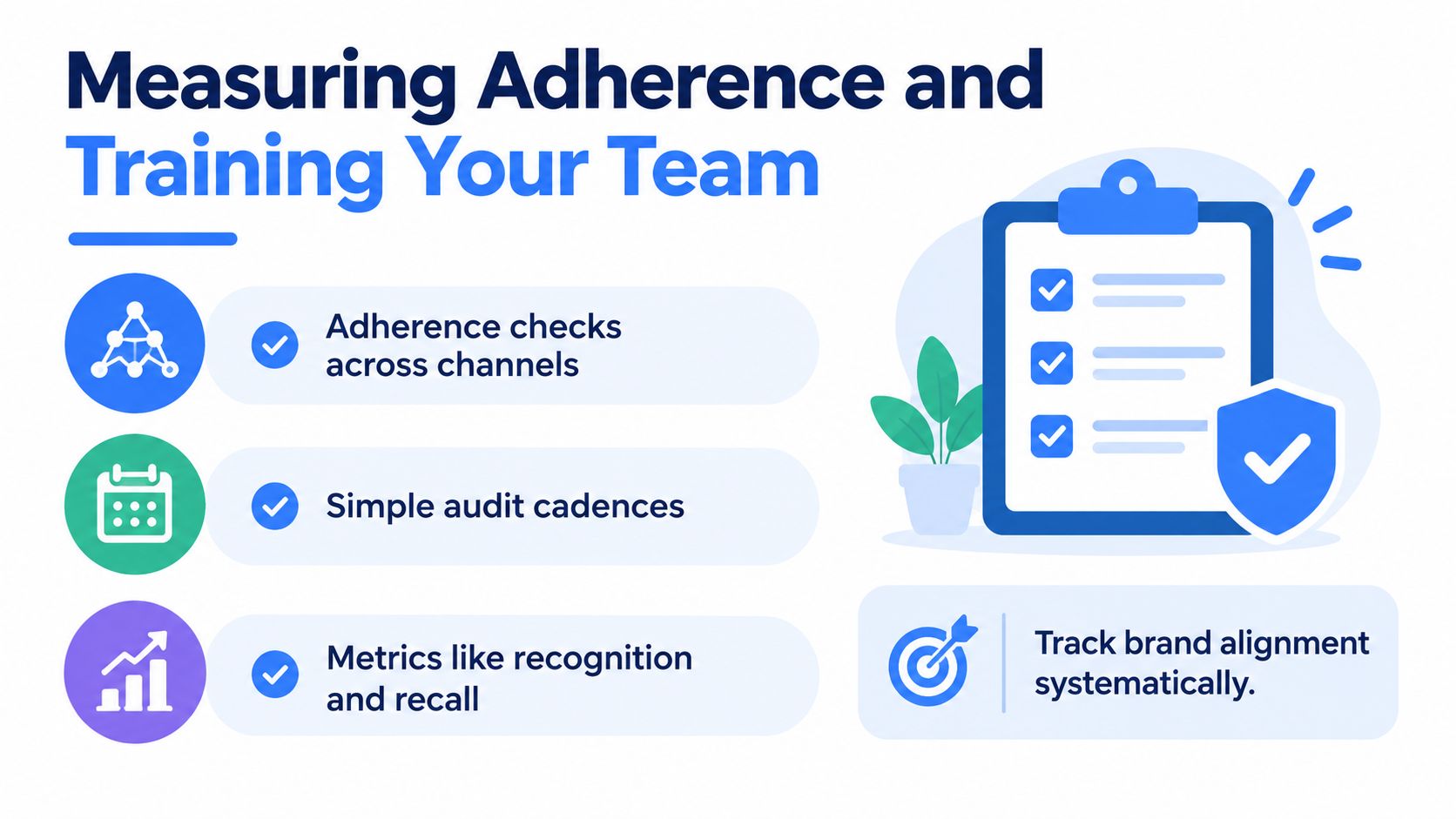
Track findings by cause. A wrong logo may indicate poor search. A weak CTA may indicate an incomplete guide. A repeated tone problem may indicate that training examples don't match the work people create. Fixing the visible error without fixing the cause guarantees another version later.
Measure what the audience can feel
Recognition and recall matter because consistency gives people repeated cues. The research summarized by Tenet says consistent branding can make companies 3.5 times more visible. That figure is useful as a reason to protect repeated signals, but internal adherence checks tell you whether your team is doing the work.
Trust is another useful outcome. Sources summarized by Worldmetrics report that 68% of consumers trust a company more when its brand voice stays consistent. Use that finding as a business case for stable voice rules, then monitor the practical inputs your team can control.
A simple measurement routine can include the following.
- Channel sampling checks a small selection of recent assets across each active channel.
- Template usage shows whether contributors use approved starting points or create local versions.
- Revision reasons reveals whether reviewers keep correcting the same logo, tone, message, or CTA problem.
- Exception records show which one off requests deserve a new rule and which should remain exceptions.
- Guideline activity indicates whether people can find and use the source of truth when they need it.
The content performance measurement guide from ViralBrain can support a broader view of content results. Keep performance data separate from adherence data. A post can perform well while weakening the brand, and a compliant post can perform poorly because the idea needs work. Don't use engagement as a permission slip for random brand behavior.
Train through examples, not lectures
During onboarding, give contributors the guide, the asset library, the templates, and a short exercise. Ask them to identify the correct logo, rewrite an off brand opening, choose the right CTA, and find the approved file. Training works when people practice the decisions they will make later.
Refresh the team when the brand changes. Show what changed, why it changed, and which old assets need replacement. Agencies, freelancers, partners, and new hires need the same practical brief. A shared link without context is not training.
Handle rule breaking as a system signal first. If three people make the same mistake, improve the template or example before blaming the people. If someone ignores a clear approval path after training, address the behavior directly. A review process should feel accountable, not like a brand police department with an unfortunate stationery budget.
Use a 90 day rollout
Start with an audit of the highest visibility channels. Pick the assets that create the most confusion and fix the source files before producing more content. Assign owners, remove outdated files, and publish the living guide.
Next, convert the most common formats into controlled templates. Train the people who create them. Introduce the review levels and record recurring corrections. Don't try to rebuild every asset at once. That creates a large project and no operating habit.
Then run another sample audit. Compare the repeated failures with the first audit. Update the guide, templates, permissions, or training based on what people did. The system is working when routine content needs fewer corrections and contributors can find the right asset without special help.
A useful final check: Can a new contributor find the current rule, use an approved template, submit the right review request, and publish without guessing?
If the answer is no, the problem isn't commitment. The system still asks people to remember too much. Fix the path, then measure adherence again.
ViralBrain helps teams study high performing LinkedIn patterns, create drafts in their own voice, refine hooks, and review posts before publishing. Visit ViralBrain to build a repeatable LinkedIn content workflow that supports a consistent brand voice.
Grow your LinkedIn to the next level.
Use ViralBrain to analyze top creators and create posts that perform.
Try ViralBrain free