

How to Stand Out Online Without Burning Out
Learn how to stand out online with a simple framework, real examples, and weekly habits for founders, marketers, and creators tired of the noise.
Grow your LinkedIn to the next level.
Use ViralBrain to analyze top creators and create posts that perform.
Try ViralBrain freeMost advice on how to stand out online is backwards. It tells you to publish more, sound louder, polish every sentence, then pray the feed notices. That recipe creates a large pile of tidy content that looks like everyone else's.
The better approach is less comfortable. Use specific experience, show how you think, and leave enough rough edges for people to believe a person made it. A polished post can earn a glance. Traceable thinking earns trust.
Online attention is spread across many platforms. DataReportal reported 5.66 billion social media user identities worldwide in October 2025, equal to 68.7% of the global population and 93.8% of internet users. The typical social media user actively uses or visits 6.5 platforms each month and spends about 18 hours and 36 minutes per week on social media, according to DataReportal's Digital 2026 report. Your audience is busy. Your content needs a reason to be remembered.
The Attention Economy Is Lying to You
The feed does not reward volume for its own sake. It rewards a point of view that can survive comparison. Publishing louder, adding polish, and chasing every format will not rescue a claim that could have come from any founder, consultant, or content assistant. High production value can make weak thinking look expensive, but it cannot make it useful.
The market is getting harder to ignore. DataReportal recorded 259 million more social media identities in the preceding 12 months, with annual growth of 4.8%. Its worldwide total had grown by close to 3.4 billion users since earlier measurement, averaging more than 28 million additional users per month, according to DataReportal's worldwide social media analysis. More people publish, more brands distribute, and more software can produce a clean-sounding opinion before breakfast. Production polish is cheap. Traceable thinking is scarce.
Specificity beats volume
Compare two founders writing about customer retention.
The first writes, “Retention improves when you listen to customers and keep delivering value.” The sentence sounds sensible and contributes almost nothing. A competitor can copy it without changing a word.
The second describes removing a dashboard feature after three customer calls exposed the same confusion. The post identifies the original assumption, explains the failed test, shows what changed, and connects the decision to a broader lesson: the team had a communication problem, not a feature shortage. Its authority comes from a decision, a constraint, and a consequence.
That is earned specificity. Strong content includes an observable event, a non-obvious interpretation, a concrete consequence, and a conclusion that generic industry knowledge could not produce. It also leaves a trail. Readers should be able to see what happened, what you believed, what changed your mind, and what you did next.
Practical rule: If ten competitors could publish your post without changing a word, the post has no defensible edge.
Use IndieTool's guide to brand visibility for its focus on clear positioning and consistent visibility. Then make consistency operational. At the start of each week, choose one real decision or customer signal. Draft the event and your interpretation. Publish the useful conclusion, then collect replies and objections as evidence for the next post.
That workflow beats a content calendar fantasy. Build a body of evidence around a narrow subject, explain your decisions, show what changed your mind, and keep enough roughness for the work to sound lived rather than manufactured.
Pick a Niche Narrow Enough to Own
A niche is useful when it filters ideas. “Marketing” is not a niche. “Marketing for bootstrapped SaaS founders who need a reliable pipeline without a large ad budget” gives you a reader, a problem, and a boundary.
Start with a blunt test. If ten other accounts could write the same post in their sleep, your topic is too broad. You don't need a tiny audience. You need a clear reason for the right audience to recognize your work.
Layer the position
Build your niche from three parts.
The first part is the audience. Name the person who has the problem. A B2B founder, a sales leader, a freelance designer, and a social media manager don't need the same advice.
The second part is the problem. Choose a recurring decision, not a vague ambition. “Get more leads” is soft. “Turn founder expertise into sales conversations” gives you something to examine.
The third part is your angle. You might focus on low budget experiments, plain language, customer research, or content systems that one person can maintain. The angle stops your work from becoming a collection of recycled tips.
Your voice should be easy to recognize without a profile photo. Decide how long your sentences tend to be, how directly you state disagreement, and which themes you return to. One voice might say, “Your homepage has a copy problem. Stop adding sections and interview five buyers.” Another might say, “A homepage can lose a buyer before the first scroll. Start with the words customers use when they describe the problem.” Both are clear. They create different expectations.
Write the sentence you can test
Use this positioning statement
I help [specific audience] do [specific outcome] through [specific lens].
For example, “I help bootstrapped SaaS founders create demand through small, evidence led content experiments.” Keep that sentence visible while you draft. If a post doesn't serve the audience, outcome, or lens, cut it or save it for another channel.
Stress test the statement in plain language. Can a stranger identify the reader? Can the reader name the problem? Does the lens reflect lived experience rather than a fashionable label? Can you produce ideas from it without forcing every topic into the same mould?
A narrow position gives you more freedom, not less. You stop competing with every account that mentions growth. You start building recognition among people who care about the problem you chose.
The Anatomy of a Post That Stops the Scroll
A strong post has three working parts, the hook, the structure, and the call to action. They don't carry equal weight.
The hook earns the first moment of attention. The structure earns continued reading. The call to action gives the reader a sensible next move. Many people spend too much time polishing the hook and too little time making the body worth finishing.
The hook makes a promise
A vague opener says, “Success starts with believing in yourself.” That could introduce a post about sales, exercise, hiring, or a motivational mug. It creates no useful tension.
A stronger opener says, “We removed the feature customers requested most often.” The reader now has a decision to inspect. Another option is a specific claim such as, “Our best sales calls started after we stopped presenting the product.” If you have a verified number from your own work, use it with the source, date, and scope. A number without context is decoration wearing glasses.
First person stakes work because they put a real actor behind the claim. “I spent a month fixing the wrong conversion problem” gives the reader a reason to continue. The post needs to explain what was wrong, what evidence exposed it, and what action followed.
For more examples of opening patterns, SupaBird's guide on how to write hooks on X is a useful reference. Use patterns as scaffolding. Don't borrow someone else's personality with the hook.
Structure carries the argument
The body should move. A simple tension and resolution pattern works well. State the common assumption, show where it failed, then explain the decision that replaced it.
A list can work when each item advances the argument. Put the sharpest or least expected point last, not the easiest point first. Short lines help on mobile, but line breaks can't rescue empty thinking. Each paragraph should earn its space.
Use a real example. A post about pricing might open with a founder who stopped selling hourly work. The middle can explain how hourly billing rewarded activity while the client needed an outcome. The final section can describe the new offer, its limits, and the type of buyer it excluded. That structure gives the reader a decision to consider instead of a slogan to applaud.
The pattern interrupt copywriting article can help when your drafts all begin with the same rhythm. Variety matters, but a strange opening still needs a useful point beneath it.
Match the CTA to the payoff
“Agree?” is a lazy request. It asks the reader to perform approval without giving them a subject worth discussing.
A better CTA asks for a relevant experience. “What part of your pricing creates the most client confusion?” invites a specific reply. “Save this before your next positioning review” matches a practical post. “Reply with your current headline and I'll point out the vague phrase” creates a defined exchange, provided you can honour it.
The ranking is straightforward. Structure carries the most weight. The hook earns entry. The CTA directs useful action. Spend editing time in that order. A sharp hook attached to a thin argument is bait, and readers notice.
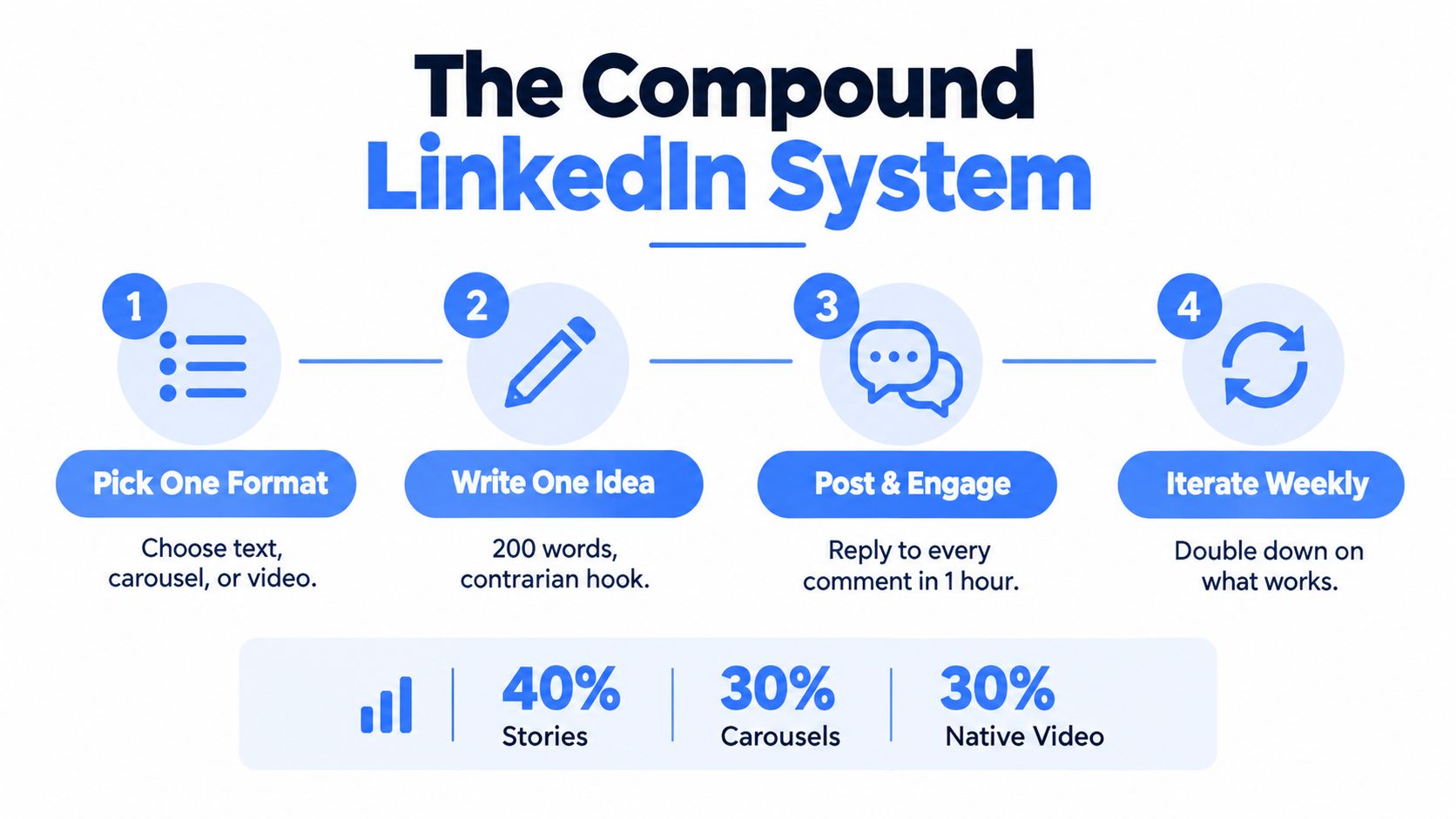
A LinkedIn System That Compounds
LinkedIn rewards useful participation, not a daily sacrifice to the posting gods. HubSpot's 2025 survey found that 64% of marketers posted less than daily, while 30.9% posted multiple times per week and 19.7% posted multiple times per day, as reported in HubSpot's publishing frequency guidance. A sustainable schedule beats frantic output that leaves no time for replies.
Start with a baseline of 10 to 20 comparable LinkedIn posts. Then test one variable at a time, such as format, opening hook, visual treatment, or call to action. A benchmark analysis of 1 million posts from 9,000 active business pages reported average engagement of 5.00% by impressions. Multi image posts led at 6.60%, followed by native documents at 5.85% and video at 5.60%, according to the LinkedIn benchmark analysis. Treat those figures as reference points, not promises.
Use a repeatable weekly rhythm
Pick a few publishing days that fit your audience. The specific hour matters less than keeping the topic, audience, and cadence stable long enough to compare results. Test text, native documents, multi image posts, and video. Don't assume the fanciest format wins.
HubSpot reported that LinkedIn found image posts received 98% more comments than posts without images in the research cited by HubSpot's social media strategy statistics. Use an image when it explains the idea. A real workspace photo or a cropped quote can support a point. A random stock photo adds the visual equivalent of a tiny business hat.
Track reach, comments per 1,000 impressions, qualified profile visits, replies, demos, or attributable pipeline. Likes are easy to collect and easy to misunderstand. A poll may earn attention while a document post earns more useful interaction.
A simple operating table
| Publishing slot | Format | Opening | Useful CTA |
|---|---|---|---|
| Early week | Text post | A decision that failed | Ask for a comparable experience |
| Midweek | Native document | One framework from real work | Invite a save |
| Later week | Short personal take | A belief you changed | Ask what changed the reader's mind |
| Flexible slot | Poll | A narrow business choice | Ask for the reason behind the vote |
The 20 posts per month benchmark reported by HubSpot can reach about 60% of a page's unique audience, but it is not a guarantee. Audience size, topic, quality, and distribution still matter. Use the benchmark to plan a test, not to justify flooding a feed.
Profile views, comment quality, and messages from relevant strangers tell you more than a vanity score. If views rise while nobody starts a useful conversation, your profile may be attracting curiosity without a clear offer. Fix the promise in your headline and profile before blaming reach.
The video below can provide another practical reference for building a LinkedIn publishing habit.
Repurpose One Idea Into a Week of Content
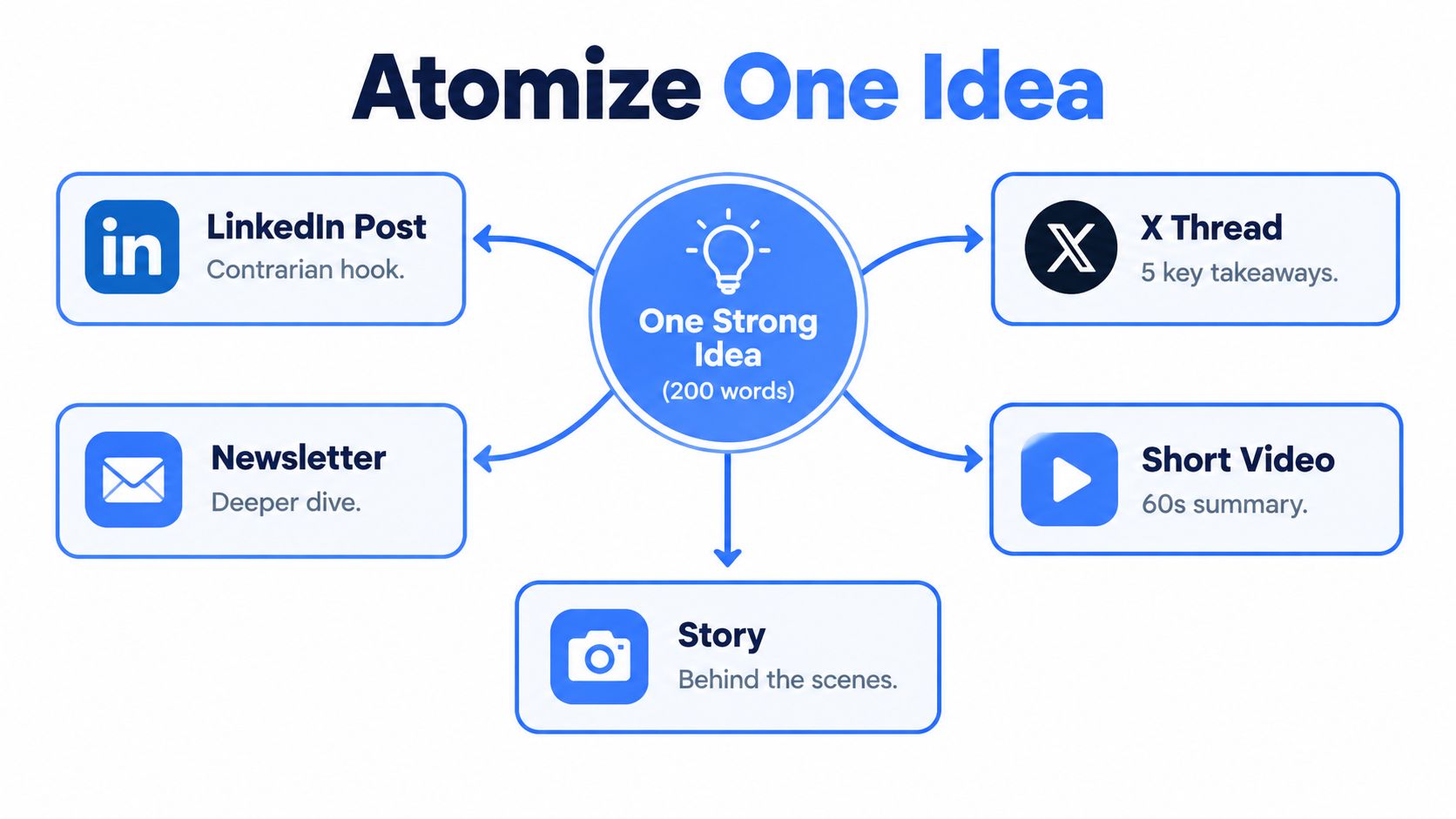
Don't write seven unrelated posts. Write one strong idea, then change its shape for each channel.
Begin with a short LinkedIn post. Give it one contrarian claim, one useful example, and one takeaway. Turn the argument into a native document where each slide carries one beat. Reduce the same idea to a short X post with one sentence that can stand alone. Record a brief video in which you read the idea, then add a live example. Expand the argument in a newsletter introduction with more context.
Keep the spine intact
Suppose a founder believes retainers create better incentives than hourly billing. The LinkedIn post can open with, “Hourly billing makes the clock the product.” The body can explain how the client started asking for more activity instead of a clearer result.
The document version can show the old incentive, the client problem, the pricing decision, the trade off, and the new buying conversation. The X version can compress the idea into one sharp sentence. The short video can show a sample scope review. The newsletter can explain when hourly work still makes sense and where retainers create risk.
Each format keeps the same position. It doesn't invent a softer message for one platform or a louder claim for another. Your audience should recognize the idea wherever they find it.
Editing test: Remove every sentence that introduces a new claim. Repurposing should change the container, not the evidence.
A short repurposing session should have a clear order. Copy the original argument into a working document. Mark the claim, example, proof, limitation, and takeaway. Turn each marked part into a native format. Read every version aloud. If the point sounds different, fix the derivative rather than weakening the original.
This process helps you build recognition without repeating the exact same post. It also exposes weak ideas early. If an argument can't survive a document, a short post, and a spoken explanation, it may need more evidence before publication.
Trust Is the New Follower Count
An audience can generate attention without generating confidence. In a feed full of competent sounding AI content, readers need a way to inspect the person behind the claim.
A small account with receipts can beat a large account that paraphrases popular advice. Receipts include a named customer with permission, a linked dashboard, a dated case study, a screenshot with context, or a public correction of your own earlier advice. The point isn't to expose private information. The point is to make the reasoning checkable.
Edelman and LinkedIn found that 91% of hidden buyers said strong thought leadership made them more receptive to a company's sales and marketing outreach. The report also found that 71% of hidden buyers viewed thought leadership as more effective than traditional sales and marketing materials for demonstrating potential, compared with 64% of target buyers. In addition, 79% of hidden buyers said they were more likely to advocate internally for a company that consistently produced high quality thought leadership, according to the 2025 Edelman LinkedIn B2B Thought Leadership Impact Report.
Apply the trust test
Before publishing, inspect the claim.
Can a reader verify it quickly? Does it name a real constraint? Does it show the failed assumption before the result? Would you still publish it if your largest client read it?
A named source helps. Google's guidance prioritizes helpful, reliable, people first content and points to experience, expertise, authoritativeness, and trustworthiness as useful assessment factors in its guidance on creating helpful content. That standard applies beyond search. People trust advice more when the author explains who did the work, what was tested, when it happened, and where the result may not transfer.
Nielsen found that 88% of respondents trusted recommendations from people they knew more than any other measured advertising channel, while recommendations were trusted 50% more than lower ranked channels such as online banner ads, mobile ads, SMS messages, and search ads. Those findings are reported in Nielsen's global Trust in Advertising research. A recommendation is useful because someone else has put their name near the claim.
| Signal | Trust Built Profile | Decorative Profile |
|---|---|---|
| Evidence | Names the situation, method, date, and limit | Uses broad claims with no trail |
| Experience | Shows a decision that had a cost | Repeats popular advice |
| Mistakes | Pins a post about a failed assumption | Displays only polished wins |
| Replies | Answers criticism with specific evidence | Replies with generic thanks |
| Profile | States who the person helps and how | Uses impressive labels with no proof |
A public mistakes post can build more confidence than another polished success story. A public dashboard can help when sensitive details are removed. A reply that addresses the criticism directly does more for credibility than a string of heart emojis.
For practical guidance on using visuals without turning them into decoration, Bulk Image Generation's social media engagement guide offers useful context. Visuals support trust when they show the work. They don't replace it.
Your 30 Day Plan and What to Stop Doing
Use the next month to build a system, not a fantasy content calendar.
Week one
Lock the niche. Write the positioning statement. Rewrite your profile so the audience, problem, and angle appear in plain language. Publish a few posts that test different examples of the same position. Watch which subjects bring thoughtful replies from the people you want to reach.
Week two
Test signature formats on LinkedIn. Keep the topic stable while changing the structure or visual treatment. Compare text with native documents, multi image posts, and video. Measure engagement by impressions, comments, qualified profile visits, and replies from relevant accounts. The benchmark analysis cited earlier gives you a reference point, but your own audience decides what works.
Week three
Repurpose the strongest idea across X, a newsletter, and short video. Keep the original claim intact. Remove platform specific filler. Record the video from notes rather than reading a script that sounds like it was assembled by committee.
Week four
Review the evidence. Check hook saves, comment depth, messages from strangers, profile to follow conversion, and the quality of conversations created. A post with fewer impressions may still be more valuable if it attracts a serious buyer or useful peer.
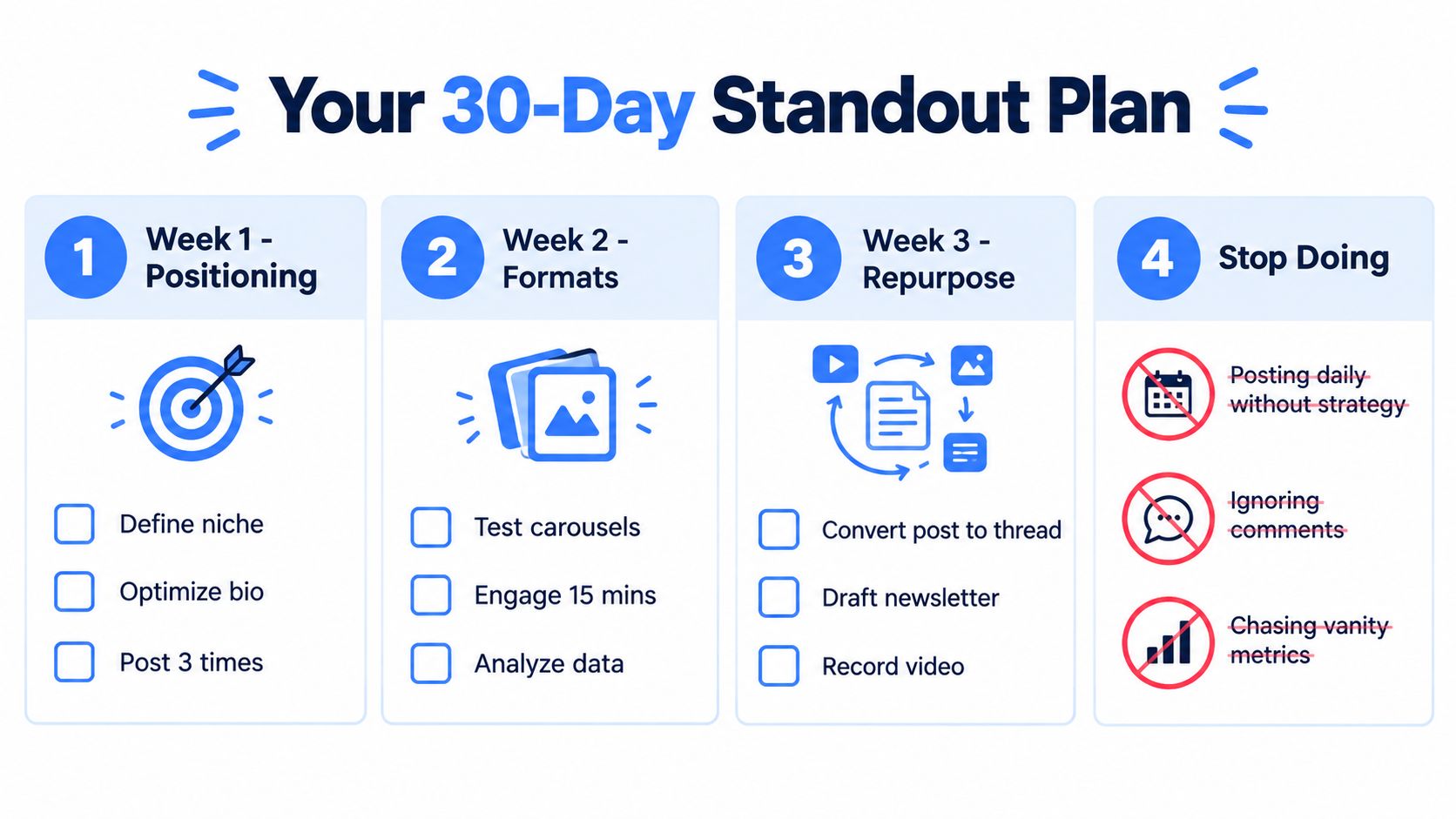
Stop posting three times a day without a reason. Stop copying generic carousels from larger accounts. Stop measuring success through likes alone. Stop waiting until every sentence has a fresh coat of varnish. Stop ignoring comments after publication, because the reply section often contains better market research than the original post.
The next ten minutes are enough to start. Write one sentence naming the audience you help, the problem you solve, and the experience that gives you a distinct angle. Then turn that sentence into a post with one real decision behind it.
ViralBrain analyzes high performing LinkedIn posts to help you study hooks, structures, calls to action, and writing patterns in your niche, then creates drafts in your own voice for testing and repurposing. Visit ViralBrain to turn one specific idea into a repeatable publishing workflow without adding more noise to your week.
Grow your LinkedIn to the next level.
Use ViralBrain to analyze top creators and create posts that perform.
Try ViralBrain free