

How to Stay Competitive in 2026 Without Burning Out
Learn how to stay competitive in 2026 with practical playbooks for founders, marketers, and creators. Real tactics, real data, no fluff.
Grow your LinkedIn to the next level.
Use ViralBrain to analyze top creators and create posts that perform.
Try ViralBrain freeYour competitors aren't beating you with better tools. They're beating you because they picked fewer things, measured them properly, and kept doing the human work you tried to automate away. That's the blunt version of how to stay competitive in 2026. Many teams do the reverse. They buy more software. They post more content. They call that progress because the dashboard looks busy.
I've shipped enough to know busy is a terrible metric. Busy hides waste. It lets everyone feel productive while margin, quality, and customer trust leak out slowly. You don't need another stack of apps. You need two workflows that work, one clear signal routine, and skills your rivals can't rent from the same model you use.
The Real Reason Most Teams Lose Ground
93% of organizations now claim enterprise level generative AI adoption, up from 61% the prior year, yet only 2% report measurable returns, according to KPMG generative AI adoption index findings. Read that twice. Almost everyone has the tools. Almost nobody can show the money. That gap tells you the problem.
Your team probably doesn't have a tool shortage. You have a measurement shortage. People count prompts, posts, drafts, and tasks closed. Nobody owns cycle time, error rate, conversion, or revenue per workflow. So output goes up and quality slides. Customers notice before your weekly report does.

Activity feels safe
Adoption is easy to announce. Redesign is annoying work. It forces hard calls about who does what, what gets cut, and what standard counts as good. Buying seats avoids those fights. That's why companies buy seats.
The same pattern shows up in McKinsey State of AI 2025 results. 88% of respondents said their organizations regularly used AI in at least one business function. A separate result said more than 80% of respondents using generative AI saw no tangible effect on enterprise level EBIT. More use. No profit signal. That's an execution problem wearing a tech costume.
If nobody can point to a baseline and a result, you didn't improve a workflow. You decorated it.
The fix starts with fewer bets
Pick work with real cost. Sales follow up. Content production. Support triage. Reporting. Research. Document review. Write down what it costs now in time and errors. Then test one change. Keep human review where mistakes hit trust or money.
You also need standards people can repeat when you're not in the room. Acheloa Wellness on competitive excellence is useful reading on that wider discipline because excellence breaks when it lives only in one person's head. Your team needs written quality bars, clear owners, and a stop rule for tools that don't pay.
Here's my test. Ask each lead to name one workflow improved this quarter and show the before and after numbers. If they give you tool names instead, you've found the failure mode. You're funding activity. Your competitor is funding outcomes. Fix that first or the rest of this article won't save you.
A Weekly Market Scanning Routine That Actually Works
Most market research dies in a doc nobody reads. Founders save fifty tabs, feel informed, and change nothing. That's entertainment with extra guilt. You need a short Monday routine that ends in a decision, even if the decision is to do nothing.
Keep it to about ninety minutes. Use the same sources each week so changes stand out. Track what competitors did, not what they claimed on a podcast. Pricing pages, job posts, product changelogs, sales pages, and top performing content tell the truth faster.
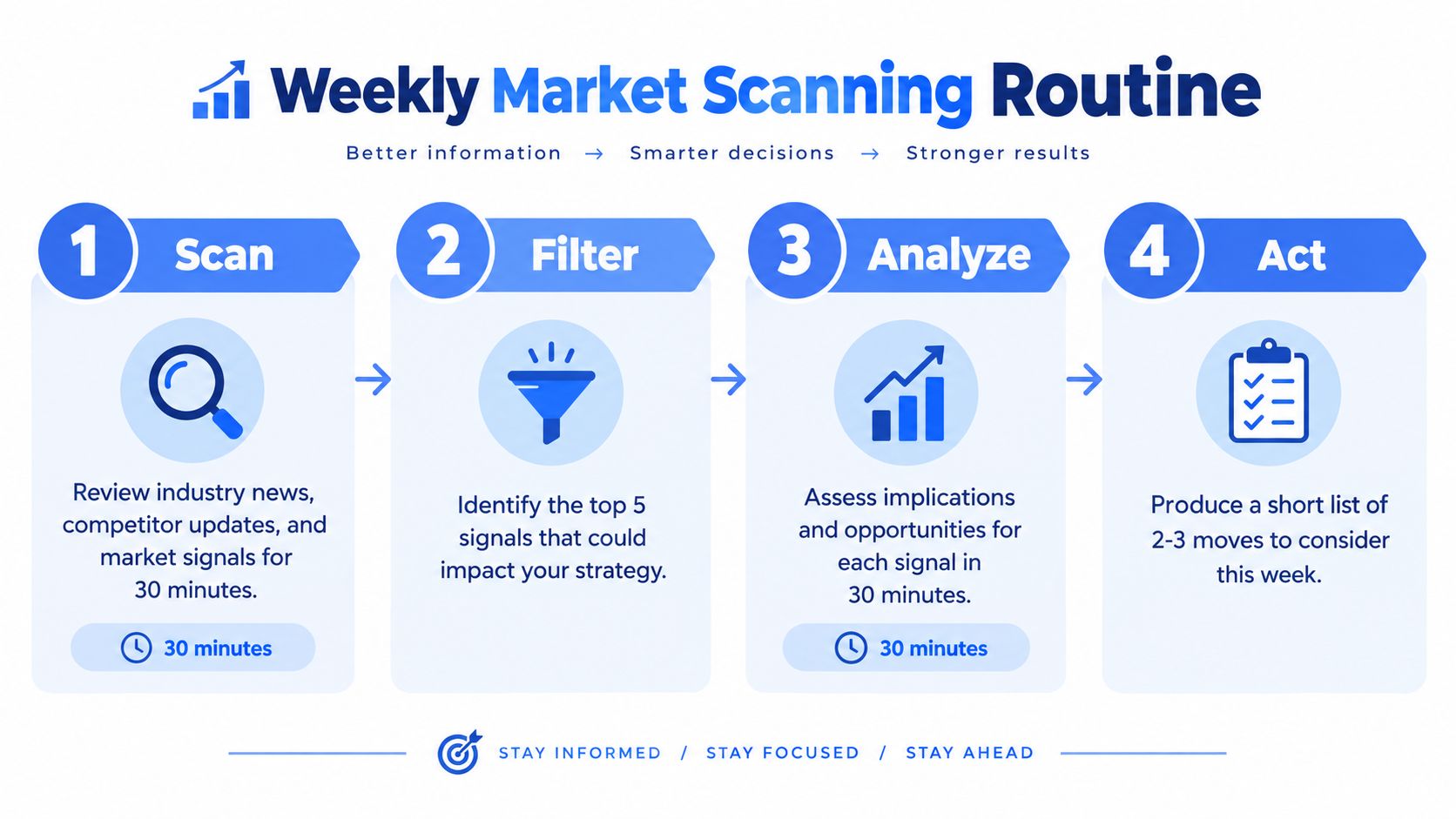
Run the same four steps
- Scan. Spend thirty minutes reviewing ten to fifteen competitor moves. Note price changes, new offers, hiring shifts, product releases, and content that got real response.
- Filter. Cut the list to five signals that could affect revenue, cost, or customer choice. Ignore vanity launches and vague partnership posts.
- Analyze. Write one threat and one opportunity in plain words. Name who is affected and what could happen if you ignore it.
- Act. Pick one small move to test, assign an owner, and set a review date. Or write no action and stop researching.
That last step matters. Endless scanning is procrastination in a blazer. A good signal log fits on one page. Date. Signal. Evidence. Likely impact. Decision. Owner. If a signal appears three weeks in a row, treat it as real until proven otherwise.
For search led teams, a rank tracker helps you spot keyword movement before traffic reports scream at you. Pair that with direct evidence from competitor pages. Ranking shifts without page changes mean one thing. Ranking shifts after a pricing or content push mean another.
Know what counts as signal
A rival hiring three enterprise sales reps is signal. A founder posting big opinions with no product change is noise. A changelog that cuts onboarding steps is signal. A rebrand with the same weak offer is mostly paint. Job posts are underrated because they reveal budget before press releases do.
If you want the broader method behind spotting shifts early, read this guide on what trend forecasting means in practice. Use it to sharpen judgment, then bring everything back to your one page log. Big frameworks don't help if Monday ends with no owner.
The video below gives a useful outside view on watching rivals without copying them blindly.
Creators should track hooks and topics gaining repeat engagement in their niche. Marketers should watch offer changes and landing page tests. Founders should watch hiring, pricing, and product scope. Same routine. Different evidence. Do it weekly or don't pretend market awareness is part of your strategy.
Pick Two Workflows Worth Redesigning This Quarter
Teams love a transformation plan with ten workstreams. It looks serious in a deck. It usually ships nothing. Pick two workflows. Finish them. Bank the gain. Then pick the next two. Boring advice. It works because focus survives contact with real calendars.
The pressure is real. In the World Economic Forum Future of Jobs Report 2025, 86% of employers expect AI and information processing technologies to transform their business by 2030. 60% expect broadening digital access to do the same. That doesn't mean you redesign everything at once. It means you can't keep every process frozen while the market moves.
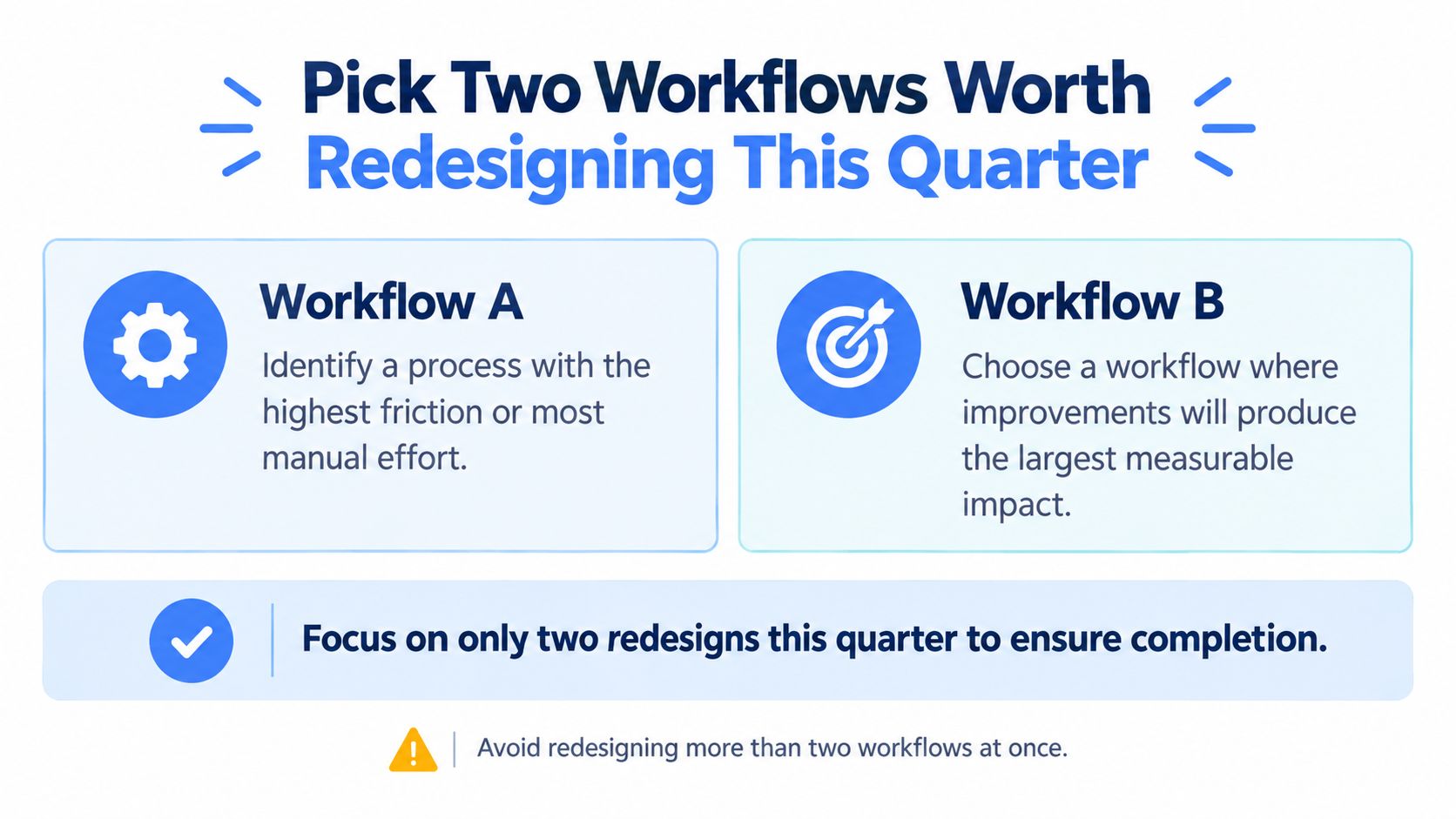
Use a hard selection filter
A good candidate eats real staff time every week. It has a baseline you can measure this week, not after a data project. It touches revenue, cost, speed, or customer experience in a direct way. It has one owner who can change the process without begging five departments.
Skip workflows that are rare, low value, or politically jammed. Skip anything where the only metric is volume. More drafts, more tickets closed, and more reports can all hide worse decisions. You want gains a customer or a profit statement can feel.
- Time cost. Count hours per week across everyone involved, including review and rework.
- Error cost. Track mistakes that reach customers or force another pass.
- Revenue link. Note conversion, response speed, retention, or expansion effects you can observe.
- Change control. Confirm one owner can test, decide, and stop the trial.
Measure before you touch tools
Write the baseline down before anyone opens a new app. Current cycle time. Human review time. Error rate. Cost per output. Conversion or customer response where relevant. Without that, every later claim is just a feeling with better branding.
A founder might pick sales call follow up because slow replies lose deals. A marketer might pick weekly content production because research and approvals eat days. A creator might pick the path from idea to draft because inconsistency kills distribution. Different work. Same rule.
Run a defined trial. Change one workflow design at a time so you know what caused the result. Compare against baseline after enough cycles to see real behavior. If time drops but errors jump, you didn't win. If output rises but conversion falls, stop congratulating the team.
For more operational ideas you can test without a huge program, see these efficiency improvement ideas for lean teams. Steal the ones that fit your two workflows. Ignore the rest. A short list you finish beats a grand plan you present twice and abandon.
Practical rule. If a tool doesn't improve time, quality, cost, or revenue without adding bigger risk, cut it.
A Distribution and Content Engine for LinkedIn-First Teams
If your buyers live on LinkedIn, content is distribution. Not a side hobby. Not something to do when the founder feels inspired. You need a weekly engine that turns proven patterns into posts in your voice, then uses results to pick the next batch.
Many teams fail in two ways. They guess from a blank page and burn out. Or they let AI write generic posts that sound like everyone else selling growth hacks at 7 in the morning. Both waste the channel. The fix is pattern first, voice second, review always.
Build a weekly rhythm you can repeat
Start with research. Study creators your buyers already trust. Save the hooks, structures, proof points, and calls to action that keep working. Don't copy their claims. Borrow the shape and fill it with your own evidence, lessons, and point of view.
Then draft in batches. Turn one strong source into one clear post. A Reddit thread with a real customer complaint can become a post about the hidden cost behind that complaint. A YouTube segment can become a short argument, one example, and one lesson. Keep each post to one idea. LinkedIn punishes muddle.
Human review is where trust gets protected. Check facts. Cut filler. Replace borrowed phrases with words you'd say to a customer. If you use AI drafting support, this guide on how to bypass AI detection on LinkedIn naturally covers the human editing side, which matters more than tricks. Readers smell fake rhythm fast.
Use tools for pattern work, not judgment
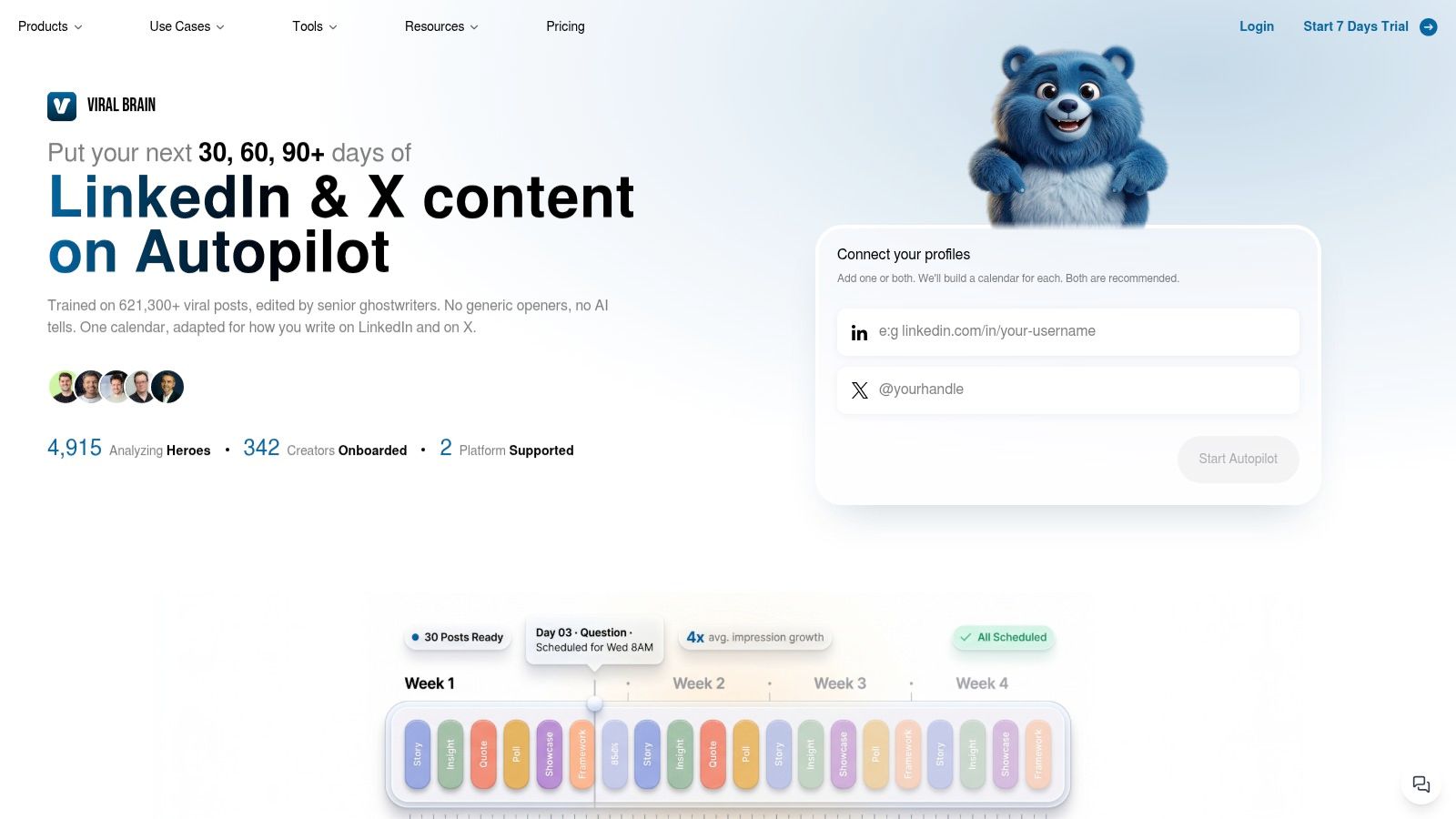
ViralBrain is one option for this workflow because it analyzes high performing LinkedIn posts to surface hooks, structures, and calls to action, then helps users draft in their own voice. Use that kind of tool to find patterns faster. Keep topic choice, claims, and final wording under human control. Tools find shapes. You supply truth.
Schedule posts after review, then read analytics like an operator. Track saves, comments with substance, profile visits, and inbound messages. Impressions alone flatter weak content. A smaller post that starts real sales talks beats a loud post that attracts other creators and no buyers.
- Monday. Collect proven patterns and pick three topics tied to customer pain.
- Tuesday. Draft posts and cut every sentence that adds no proof or tension.
- Wednesday. Review voice, facts, and calls to action with fresh eyes.
- Friday. Compare results, save winning patterns, and kill topics nobody cared about.
Consistency gets easier when the system carries the boring parts. Research once. Draft in batches. Review with standards. Learn in public from the data. That's how a one person team stays visible without living in the app or sounding rented.
Why Retention Compounds More Than Acquisition
New logos feel great in a screenshot. Retained revenue pays salaries. Too many growth teams chase signups while existing customers slip out, then act surprised when growth stalls. Fix the bucket before you buy more water. Yes, that metaphor is old. So is the mistake.
Bain loyalty research on retention economics reports that a 5% increase in customer retention rate can raise profits by roughly 25% to 95%. Treat that range with respect, not as a promise. The math works best where acquisition cost is high, service cost falls with tenure, and loyal customers expand use over time.
Run retention like an investment
Start with cohorts. Split customers by segment, acquisition channel, and tenure so averages stop hiding the truth. Find the earliest behavior signals tied to churn, such as missed use, slower logins, or dropped publishing. Then estimate lifetime value using gross margin, retention probability, expansion revenue, and support cost.
Test interventions on matched at risk cohorts. Set the success threshold before you start. Wait long enough to see renewal behavior, not just a short engagement bump. Reinvest only when incremental retained gross profit beats intervention cost. If it doesn't, your save play is charity with a CRM label.
| Metric | Acquisition Focus | Retention Focus |
|---|---|---|
| Main question | How many new customers arrived | How many stayed and expanded |
| Cost pattern | Pays again for each new customer | Spends to protect existing gross profit |
| Weak signal | Signups and impressions | Short engagement spikes |
| Strong signal | Qualified conversion at sane cost | Repeat use and renewal by cohort |
| Main risk | Filling a leaking bucket | Saving customers who never fit |
For content led products, durable use matters more than first week excitement. Repeated publishing, analytics review, and saved pattern reuse show the product became habit. One viral post followed by silence shows curiosity. Don't price, hire, or raise money on curiosity.
This breakdown of retention revenue gaps from Adam Kitchen fits the same point from the revenue side. Read it, then audit your own reports. Separate new customers from existing ones when you calculate retention. Mixing them inflates the result and helps everyone avoid the underlying problem for another quarter.
The Human Skills You Should Not Outsource to AI
Learn AI tools. Just don't hand over the parts that make you worth listening to. Judgment, customer empathy, original research, domain expertise, persuasion, and accountability are your moat. Models can draft around them. Models can't own the consequences when the call is wrong.
The risk is already visible. EY 2025 global survey findings on AI talent gaps covered 15,000 employees and 1,500 employers across 29 countries. Only 12% of employees were receiving sufficient AI training to realize full productivity benefits. 37% worried overreliance on AI could erode their skills.
Skill erosion is quiet
Nobody notices the first time they skip thinking. The model gives a clean answer and the meeting moves on. Do that for months and junior staff stop building judgment. Senior staff stop checking because speed feels good. Then a hard customer, a messy dataset, or a public claim exposes the gap.
Training depth matters in that same EY data. Employees receiving more than 81 hours of annual AI training reported an average productivity gain of 14 hours per week, compared with a median of eight hours. Access alone didn't do that. Serious training did. Give people role specific practice tied to real work, not a lunch session with prompt tips.
The wider skills shift backs this up. The World Economic Forum estimates 39% of workers core skills will change by 2030 in its Future of Jobs 2025 skills outlook. Analytical thinking remains the most sought after core skill, with about seven in ten companies calling it essential in 2025. Tools change fast. Thinking stays billable.
Protect the human moat on purpose
Write decision standards for work that affects money or trust. Require source checks for public claims. Schedule unaided practice for critical skills like writing, selling, analysis, and customer calls. Yes, it feels slower. That's the point. Strength fades when you never lift without help.
Use AI for pattern discovery, first pass sorting, and rough drafts. Keep humans on final claims, customer emotion, trade offs under uncertainty, and anything with your name on it. Founders and creators win on credibility and point of view. Outsourcing both to a model is a neat way to become interchangeable at scale.
Automate the repeatable parts. Practice the valuable parts until they stay sharp under pressure.
Your 90-Day Operating Cadence
Run this for one quarter before you judge it. Days 1 to 30 are for sensing and baseline capture. Run the weekly scanning routine. Pick two workflows. Write down time, error rate, cost, and customer impact before changes begin. Map which skills on your team are growing, stable, or fading.
That mapping matters because World Economic Forum employer survey coverage shows the shift is already moving through hiring plans. 85% of employers plan to prioritize upskilling and 70% expect to hire people with new skills. Don't wait for the labor market to rescue a team you refused to train.
Days 31 to 60 are for redesign and small tests. Ship one workflow change at a time. Run the cohort retention work. Test the content engine with human review held firm. Days 61 to 90 are for measurement. Compare against baseline. Keep what paid. Kill what didn't. Lock in training and unaided practice for the human skills you chose to protect.
Pick fewer things. Measure harder. Protect the human parts. That's the whole operating system.
If LinkedIn is where your buyers pay attention, ViralBrain can help you turn proven post patterns into drafts in your voice, repurpose source material into posts, and use analytics to repeat what works. Bring your two workflows, your baseline numbers, and your own point of view. Start there and publish like you mean it.
Grow your LinkedIn to the next level.
Use ViralBrain to analyze top creators and create posts that perform.
Try ViralBrain free