
Influencers Social Media Strategy That Works
Stop wasting budget on vanity metrics. This guide breaks down influencers social media strategy with hard data on ROI and platform engagement benchmarks.
Grow your LinkedIn to the next level.
Use ViralBrain to analyze top creators and create posts that perform.
Try ViralBrain freeMost advice about influencer social media starts with audience fit, brand alignment, and authentic storytelling. Useful, but incomplete. A creator can love your product, sound natural, and still produce a post that nobody notices.
The sharper question is mathematical. How many relevant people engage, what format earns that attention, and how much does each useful action cost? Follower counts look impressive in a spreadsheet. Engagement density, qualified clicks, leads, sales, and retention pay the bills.
The Brutal Math of Social Influence
Marketers still treat follower counts like a scoreboard. That's how you end up paying for a large audience that behaves like a waiting room with nobody in it.
A creator with a huge following may deliver reach. Reach matters for some campaigns, but it doesn't prove attention or intent. The useful calculation starts with people who interact, click, sign up, buy, or keep using the product. Everything before that is a rough signal.
LinkedIn makes the problem easy to see. Favikon's benchmark covers 142,728 active creators and reports that nano profiles can exceed 2.4% engagement in the top quartile, while mega creators with more than 500,000 followers reach only about 0.15% or more in the top quartile (Favikon's 2025 engagement benchmark). The gap isn't a minor detail. It changes what you're buying.
Reach is not relevance
A broad audience often contains people who have no reason to care about your offer. A smaller creator may speak to a narrow group with a shared problem, vocabulary, and buying context. That audience can produce fewer impressions while creating more useful actions.
The platform adds another filter. Distribution responds to interaction, retention, and the quality of early reactions. A large account doesn't automatically make a weak post persuasive. If the opening fails, people scroll. If the topic is vague, the right buyers never identify themselves.
Practical rule: Judge creators by relevant actions per dollar, not by follower count.
Set a baseline before you negotiate. Ask for recent performance on comparable posts, audience geography, engagement quality, clicks, and conversion tracking. Comments such as “great post” tell you little. Comments that describe a problem, ask about implementation, or request a demo carry more commercial weight.
Use a simple campaign equation
Start with total campaign cost. Divide it by qualified engagements, tracked visits, leads, or customers. Then compare the result with paid social, search, and other acquisition channels.
Don't use one blended number for every creator. Record performance by creator, topic, format, and audience segment. A creator who performs well for technical buyers may fail with a broad brand message. That failure isn't a mystery. It's a targeting error dressed up as influencer strategy.
Why the Money Keeps Flowing to Creators
Brands aren't putting serious money into creators because every marketing director suddenly became sentimental about personal brands. They're doing it because creator content can combine distribution, explanation, trust, and conversion in one workflow.
The global influencer marketing industry grew from about $1.7 billion in 2016 to $16.4 billion in 2022, then reached roughly $32.55 billion in 2025, according to Sprout Social's influencer marketing statistics. That near 19 fold expansion over a decade tracks the rise of social platforms, mobile first video, and creator led trust. It also shows that brands now treat creator spend as a formal channel, not a small experiment.
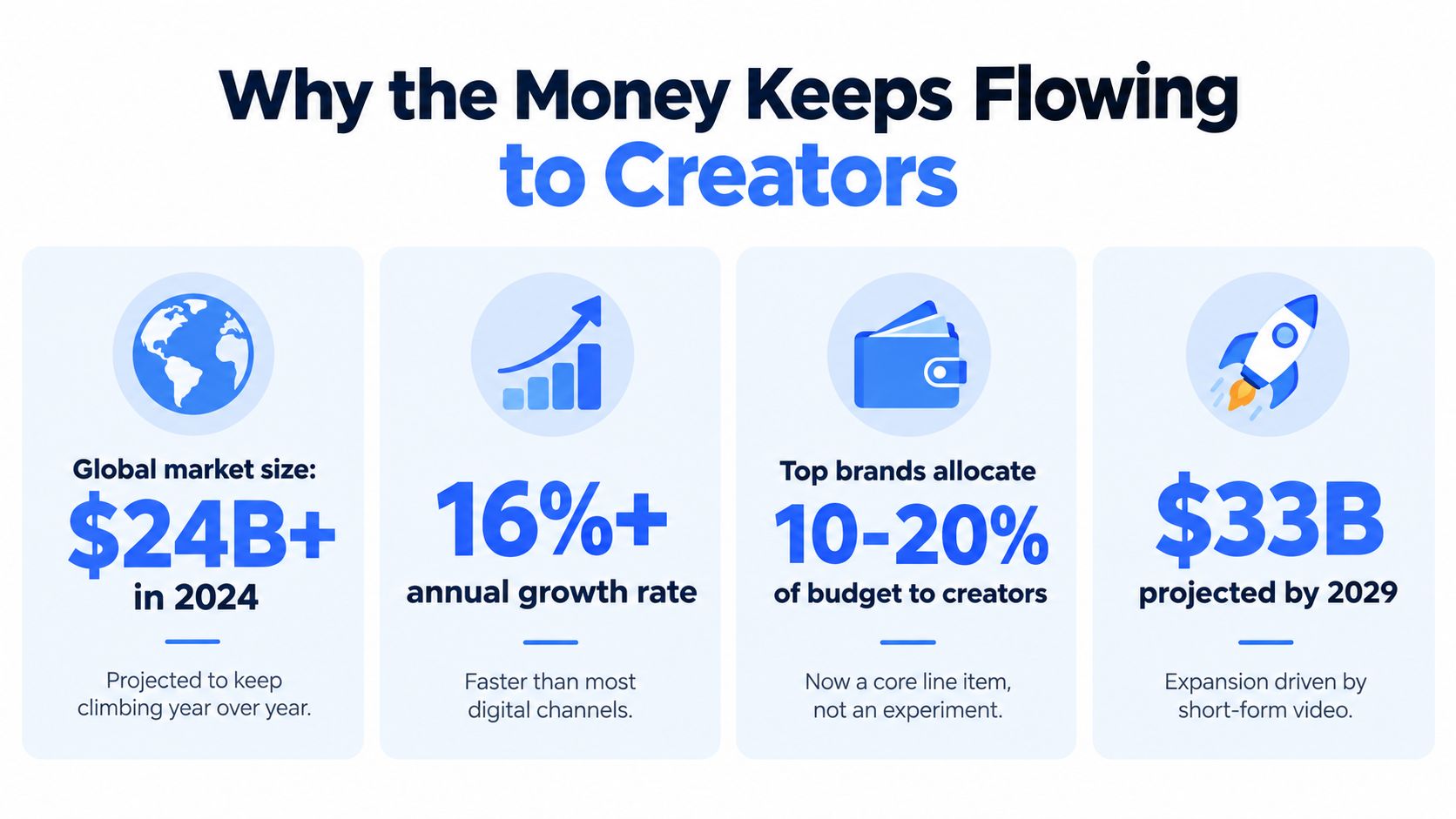
The United States alone is forecast to spend $10.52 billion on influencer marketing in 2025, with spending projected to keep rising in 2026 (Sprout Social). The figure matters because creator activity now sits inside content distribution across Instagram, TikTok, YouTube, LinkedIn, and newer creator channels.
The return explains the budget
One report cites an average return of $5.78 for every $1 invested, while 86% of U.S. marketers plan to partner with influencers in 2026 (Ringly's influencer marketing statistics). Treat that return as a benchmark, not a promise. Averages hide weak campaigns, strong campaigns, different attribution models, and different costs.
The same source projects U.S. creator ad spend at $37 billion in 2025 and $44 billion in 2026 (Ringly). Consumer behavior supports the commercial case. One forecast says 58% of adults have purchased products because of an influencer endorsement, while industry surveys report that roughly 69% trust what influencers say (Ringly).
That trust doesn't mean followers accept every sponsored claim. It means a credible creator can reduce the distance between awareness and action. They can show a workflow, explain a product, answer objections, and give the audience a reason to act.
Spend on a system, not a post
Use creator content in a repeatable process. Brief creators around a real customer problem. Give them room to explain the product in their own voice. Track each asset with unique links, landing pages, or codes. Repurpose strong material into paid ads, sales enablement, email, and organic posts.
A single sponsored post gives you a moment. A measured creator program gives you evidence. The second option is less glamorous, which is why it usually survives budget reviews.
Sizing Up the Creator Tiers
The celebrity creator is often the first name on the shortlist and the last name you should approve. Large audiences can help with broad awareness, but they frequently dilute interaction. Smaller creators often give you a tighter connection between topic, audience, and response.
On LinkedIn, the benchmark is unusually clear. Nano profiles can exceed 2.4% top quartile engagement, while mega creators above 500,000 followers reach about 0.15% or more in the top quartile (Favikon's 2025 benchmark). The report's sample includes 142,728 active creators, so this isn't a conclusion drawn from a handful of famous accounts.
A practical comparison
| Creator Tier | Audience Size | Top Quartile Engagement | Best Use Case |
|---|---|---|---|
| Nano | Small, specialist audience | Above 2.4% on LinkedIn | Focused B2B education and niche trust |
| Micro | Focused professional audience | Often stronger interaction density than large accounts | Product explanation and qualified conversations |
| Mid tier | Established niche audience | Compare recent post performance before buying | Repeated campaigns and broader category reach |
| Mega | More than 500,000 followers | About 0.15% or more on LinkedIn | Broad awareness and major launches |
The table isn't a rate card. It's a warning against buying scale without checking response. A nano creator may lack mass reach, but they can make a technical topic feel specific. For B2B software, that specificity often matters more than a polished celebrity endorsement.
Match the tier to the job
Use larger creators when the campaign needs broad recognition and the offer can survive a light level of explanation. Use smaller creators when the buyer needs context, proof, or a credible reason to change behavior.
Ask each candidate for evidence from comparable content. Look at the audience, not just the account. A creator with fewer followers but strong comments from your target buyers may be more useful than a famous account whose audience has no purchase path.
The expensive mistake: paying for an audience that can't identify the problem you solve.
Build a mixed roster only when each tier has a defined role. A larger creator can create awareness. Smaller creators can explain use cases, answer objections, and generate conversations. Don't add tiers because the campaign deck looks empty. Add them when the buyer journey requires different types of influence.
Formats That Actually Beat the Algorithm
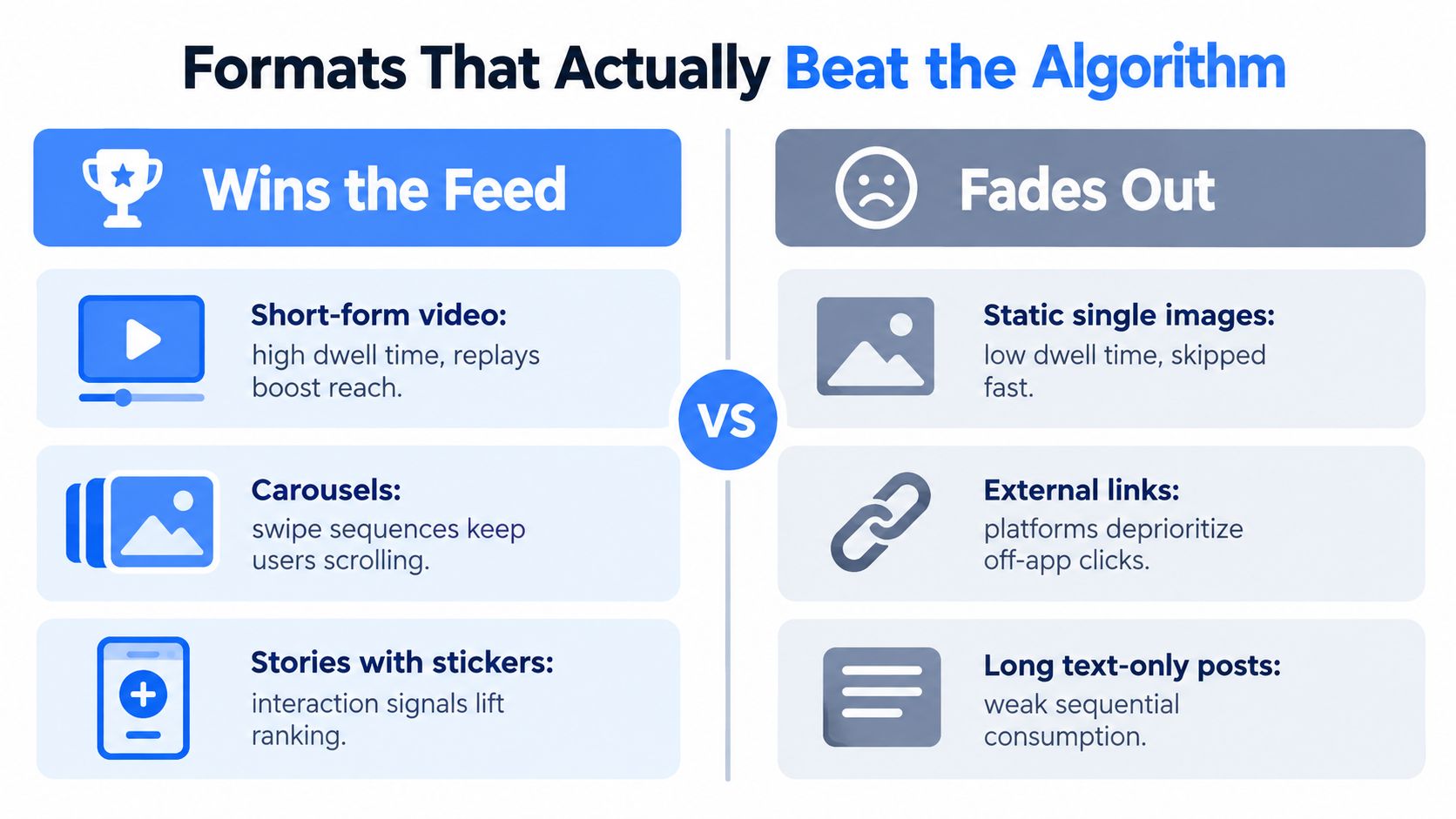
The right creator can still lose with the wrong format. A static image gives the audience one frame and one chance to care. A structured carousel creates several points where attention can continue.
A 2026 benchmark summary reports a median engagement rate of 21.77% for LinkedIn carousel and PDF posts, roughly three times higher than LinkedIn video and images (PostPlanify's engagement benchmarks). The reason is practical. Multi slide documents create sequential consumption, increase time spent with the post, and give the reader several hooks before the final action.
Build the post around retention
Start with a problem the audience already recognizes. Don't open with a company description. Nobody opened LinkedIn hoping to read your corporate origin story before breakfast.
Use a simple sequence:
- Open with tension: State the costly mistake or awkward problem.
- Add a clear progression: Give each slide one idea.
- Show the mechanism: Explain why the problem happens.
- Offer a useful fix: Make the advice specific enough to use.
- Close with one action: Ask for a reply, click, save, or conversation.
Carousels work best when each slide earns the next one. A vague first slide creates weak retention. A crowded slide makes the reader work too hard. A final slide with five calls to action sends the post straight into the swamp.
For practical examples, review LinkedIn post examples and inspect the structure, not just the design. Pay attention to the opening line, slide order, proof, and closing request.
Use video with a job to do
Video isn't automatically weak. It fails when the creator uses it as a moving brochure. Give the video a tight point, visible proof, or a useful demonstration. Remove slow introductions. Put the idea in the opening moments.
Here's a short visual reference for how format choices affect social performance.
Test one format against another with the same creator, topic, offer, and tracking setup. Change one major variable at a time. Otherwise, you won't know whether the result came from the creator, the idea, the format, or pure feed luck.
Navigating the New Deal Structures
The single sponsored post is a poor operating model. It gives the creator little reason to build knowledge and gives the brand little evidence about repeatable performance. Audiences notice repetitive sponsorships, too. Trust gets thinner when every post sounds like the same invoice wearing a different shirt.
The current market supports a more selective approach. Global spend is reported at $32.55 billion in 2025, 80% of brands maintained or increased budgets, 73% prefer micro and mid tier creators, and 92% are already using or open to AI in influencer workflows (PR Newswire's 2025 industry data).
Replace one off posts with useful commitments
A better agreement defines a testing period, content rights, tracking method, review process, and payment structure. Pay for the work and usage rights. Tie bonuses to outcomes only when the outcome can be measured fairly.
Give the creator a narrow problem to solve, not a script packed with approved adjectives. Your legal team can protect factual claims. It shouldn't flatten every sentence until the post sounds like a printer manual.
AI can help with discovery, briefs, transcription, repurposing, and performance analysis. It can't manufacture credibility. Use it to reduce repetitive work, then let the creator add judgment, experience, and a real point of view.
Good deal design: Give creators enough time to understand the offer, then judge the work by audience response and business actions.
Creator access may become more fragmented as people diversify revenue. The verified data reports that creator participation in brand deals fell from 94% in 2024 to 78% in 2025 (PR Newswire). That makes relationships, clear briefs, and reliable payment terms more useful than cold outreach at scale.
If you need outside help, compare top agencies for brand strategy alongside creator discovery tools and internal expertise. Choose an agency for a defined operating gap, not because its presentation contains tasteful gradients.
Setting Realistic Benchmarks by Industry
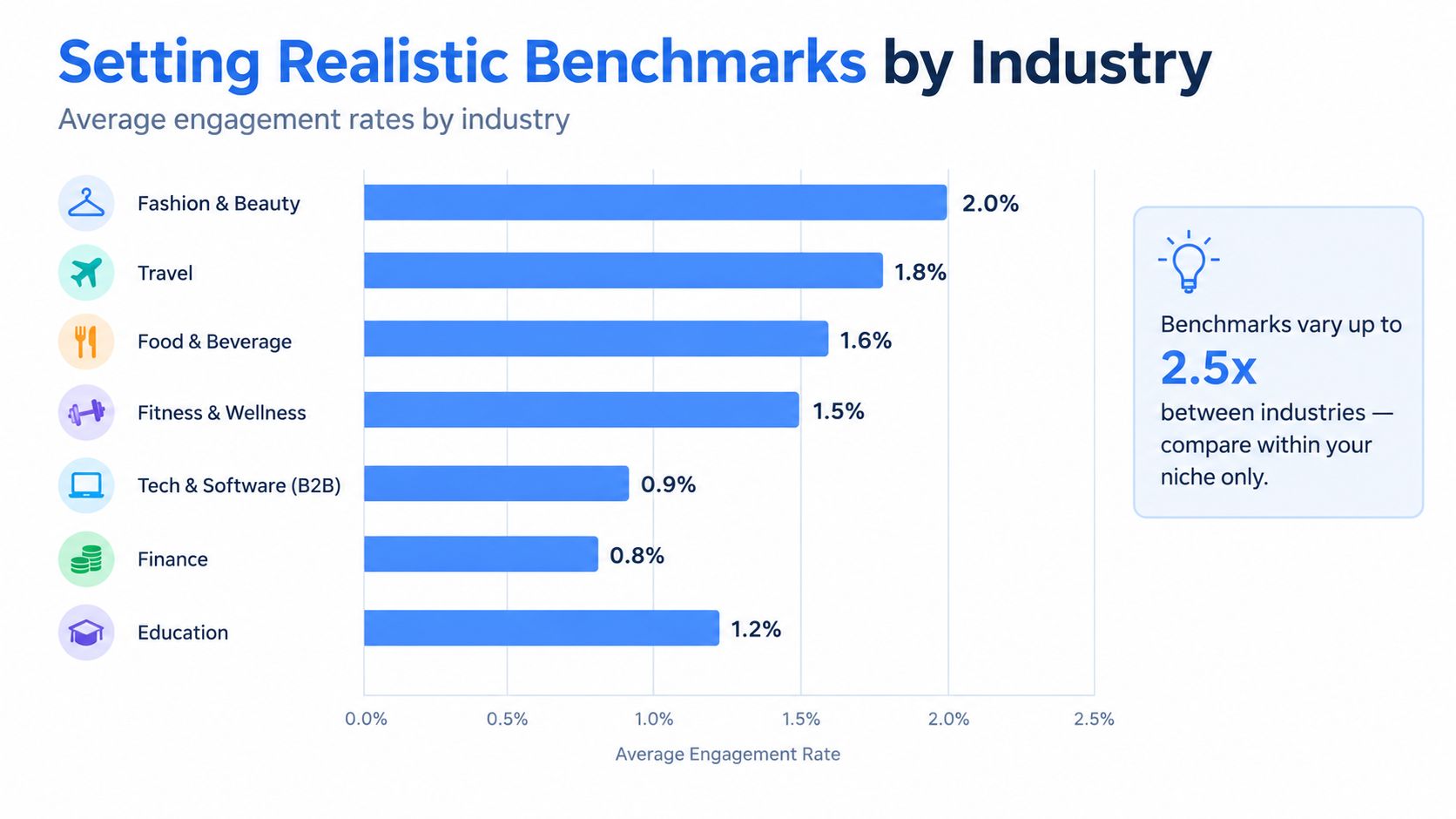
A travel creator and a B2B software creator don't share a useful performance baseline. Their audiences have different habits, content expectations, and reasons to interact. Comparing them directly is a reliable way to frighten leadership with irrelevant data.
Worldwide benchmarks reported by SocialPilot put average engagement at about 2.4% for travel, 1.95% for beauty, 1.6% for sports and fitness, and 1.53% for fashion (SocialPilot's influencer marketing statistics). Those figures show why category context belongs in every campaign report.
Build a fair baseline
Start with the creator's own recent content in the same format. Then compare posts with similar topics and audience intent. A product tutorial should sit beside other tutorials. Don't compare it with a personal story that attracted unusually strong emotion.
For a B2B campaign, engagement may show up as detailed comments, profile visits, direct messages, sales conversations, or demo requests. A lower visible rate doesn't automatically mean failure. A small group of serious buyers can be more valuable than a large crowd collecting free tips.
Track these layers separately:
- Attention: Impressions, views, completion, and time spent.
- Interaction: Comments, shares, saves, replies, and profile visits.
- Intent: Clicks, sign ups, messages, and demo requests.
- Revenue: Opportunities, customers, repeat purchases, and acquisition cost.
Don't copy another niche
Travel content can invite quick reactions because the subject is visual and easy to understand. Technical content may demand more thought before someone comments. That doesn't excuse weak creative. It changes the baseline and the evidence you should value.
Set targets from your own account history and creator history first. Use industry data as context, not as a magic pass mark. If a creator beats their normal performance with a relevant audience and produces qualified action, the campaign may be working even when a lifestyle benchmark looks higher.
Measuring What Actually Matters
Likes are feedback, not revenue. They can help you diagnose attention, but they shouldn't carry the campaign report. A post with modest public engagement can create valuable sales conversations. A post with loud applause can create nothing except a screenshot for the quarterly deck.
Start tracking before publication. Give every creator a distinct UTM link, landing page, code, or lead form. Record the content format, topic, audience, cost, publication date, and follow up result. If you can't identify the source of an action, don't pretend the channel earned credit for it.
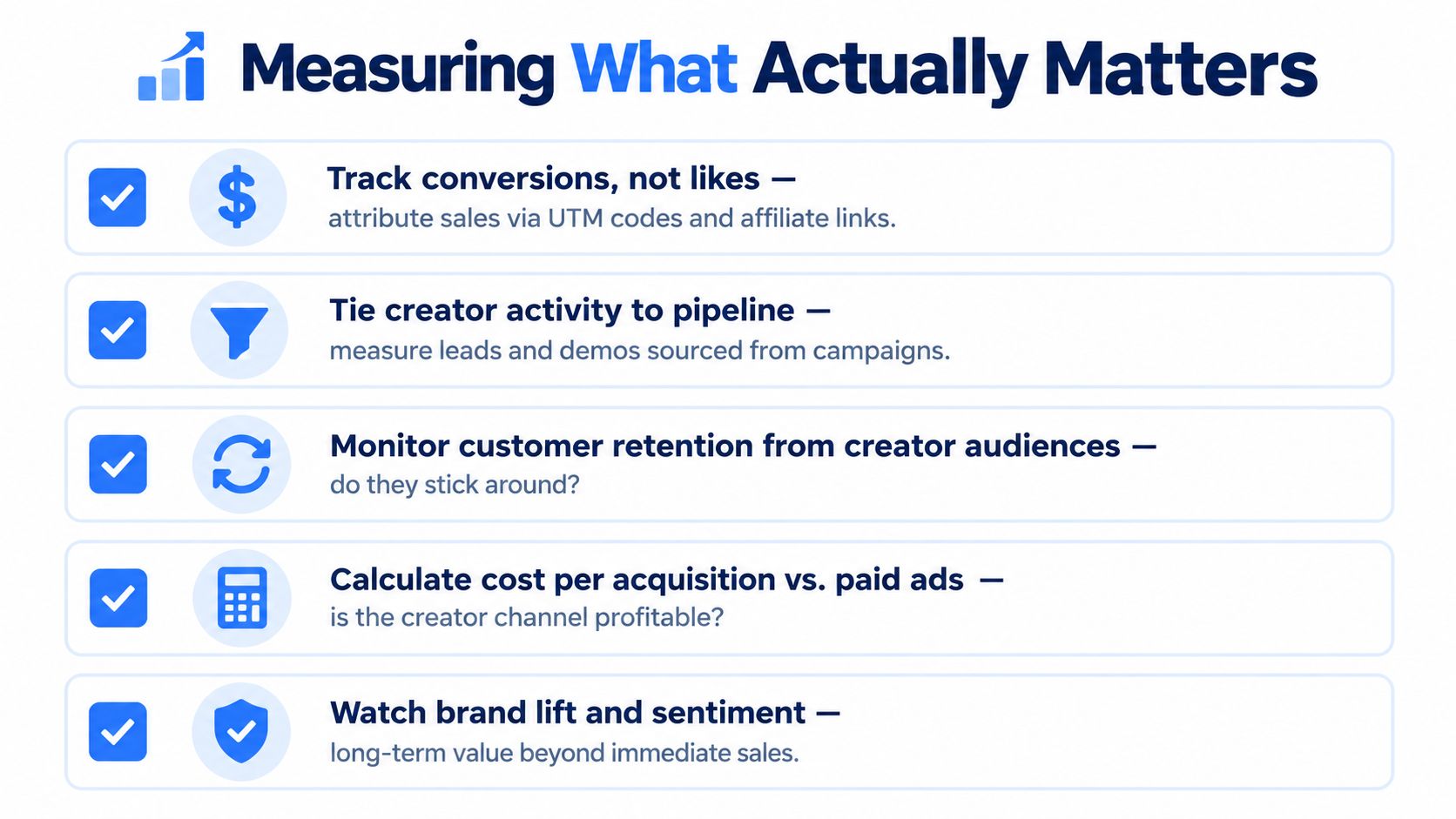
Use a blunt measurement chain
Conversions come first. Track purchases, registrations, qualified applications, or another action that connects to your business model. Likes can sit in a secondary column where they belong.
Pipeline needs source data. Match creator traffic with leads, meetings, demos, and opportunities in your CRM. Ask sales whether those contacts fit the target account profile. A pile of cheap leads can still waste everyone's afternoon.
Retention tells you about trust. Check whether customers acquired through creator content remain active, renew, or buy again. A creator who produces short lived demand may look efficient until customer quality enters the report.
Cost decides whether the channel survives. Compare creator acquisition cost with paid advertising and other channels. Include production, fees, usage rights, agency costs, and internal time. Your spreadsheet should be rude enough to reveal the truth.
Cut vanity reporting
Keep impressions and engagement for diagnosis. Use them to identify strong hooks, useful formats, and creators who attract the right audience. Don't confuse those signals with commercial proof.
Review each partnership after the agreed testing period. Keep creators who deliver qualified action, useful content, or reliable learning. Renegotiate unclear arrangements. Stop funding creators whose only achievement is making your brand appear briefly before the audience scrolls away.
ViralBrain helps teams study high performing LinkedIn posts, analyze creator patterns, generate drafts in a chosen voice, repurpose source material, and review performance data. Use it as one part of a measured workflow, alongside platform analytics and your CRM.
ViralBrain can help you find relevant LinkedIn creators, study the hooks and formats behind strong posts, then turn those patterns into drafts for your own voice. Visit ViralBrain to compare creator performance, build repeatable content, and stop spending budget on influence you can't measure.
Grow your LinkedIn to the next level.
Use ViralBrain to analyze top creators and create posts that perform.
Try ViralBrain free