
LinkedIn Content Strategy for Business: A Step by Step Plan
Build a LinkedIn Content Strategy for Business in six steps, covering audience, content pillars, team roles, weekly testing, KPIs and repurposing for leads.
Grow your LinkedIn to the next level.
Use ViralBrain to analyze top creators and create posts that perform.
Try ViralBrain freeLinkedIn had over 1 billion users across 200 countries and regions, according to 2024 academic research from the University of Texas at Arlington. A large audience sounds useful until you realize how many other businesses want its attention.
A LinkedIn content strategy for business needs a tighter plan than posting whenever someone remembers the company password. Put credible people in front of specific buyers. Give each post a job. Then check whether it did that job, rather than celebrating whatever earned the most likes.
The Six Step Playbook at a Glance
In 2024, 88% of global B2B chief marketing officers surveyed by Ipsos for LinkedIn agreed that relationship building was key to success in the year ahead. That supports treating the channel as ongoing relationship work, not a campaign you abandon after launch week.
Start with ownership. A calendar with no accountable editor is a shared document full of good intentions.
Six Steps, Owners and Review Rhythm
| Step | Owner | Output | Review rhythm |
|---|---|---|---|
| Define audience and pillars | Head of marketing with a founder | Three or four pillars tied to buyer problems | Quarterly |
| Assign roles and contributors | Founder or head of marketing | Named owners and two or three contributors | Quarterly |
| Build the weekly plan | Content lead | Calendar with one test variable per post | Weekly |
| Publish and log each post | Writers and contributors | Live posts tagged by pillar, format, author and call to action | Weekly |
| Measure by funnel goal | Analytics owner | Scorecard grouped by objective | Weekly |
| Repurpose and scale | Content lead | One insight turned into several posts and a newsletter | Monthly |
Set direction and contributors quarterly. Run planning, publishing and measurement weekly. Review repurposing monthly, when you've collected enough material to make useful choices.
People can hold several roles. A founder might supply the insight and approve facts, while a marketer handles drafting and reporting. What matters is that everyone knows who can approve, publish and stop a weak post.
Name the owner before assigning the work. A department can't approve a draft.
Choose formats after choosing the business goal. If video will support qualified traffic, ContentBuck's guide to drive qualified leads with LinkedIn video is a useful resource for connecting creative choices to the next buyer action.
You don't need a finished content operation before publishing. You do need someone responsible for each part.
Define Your Audience and Content Pillars
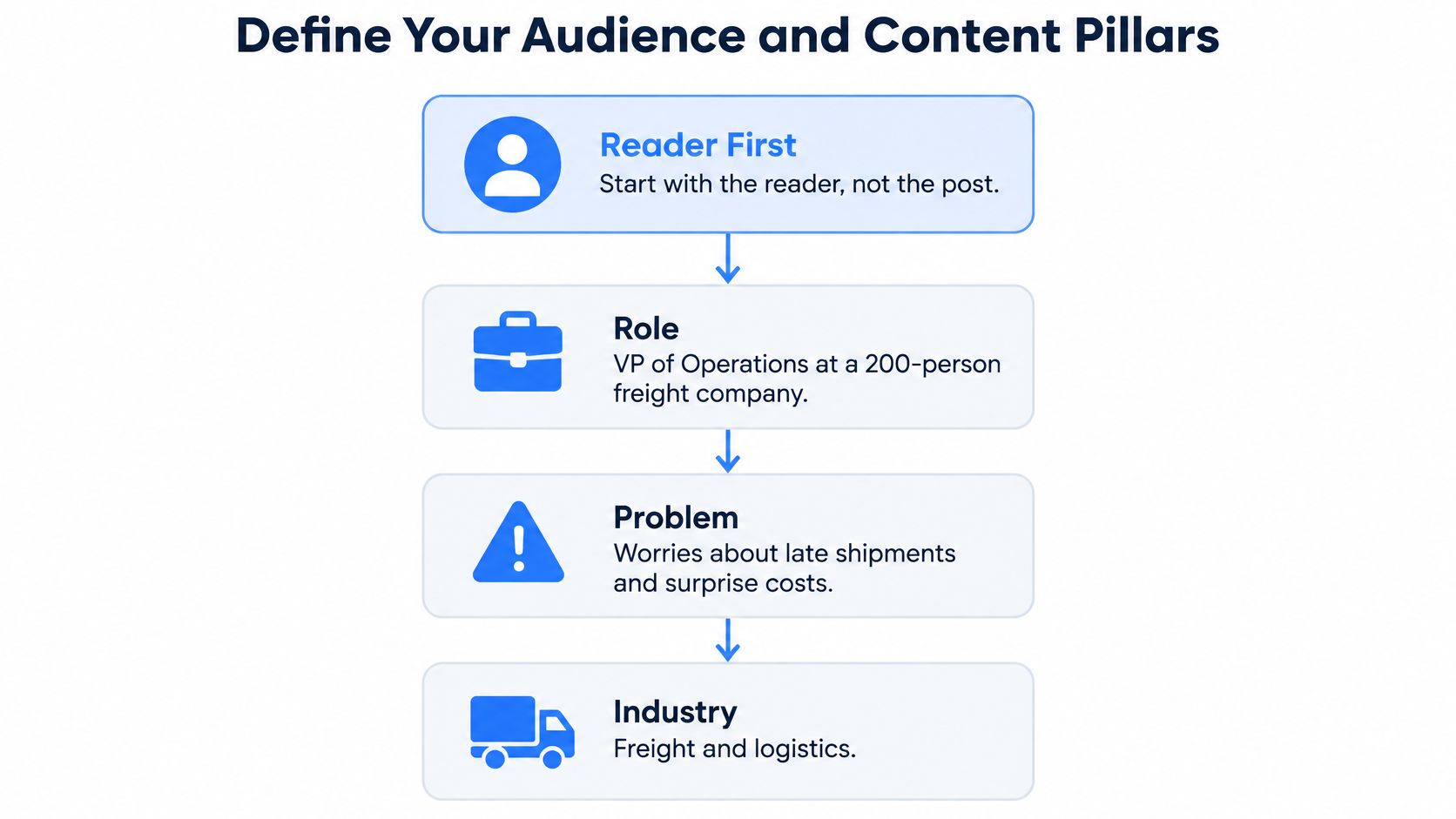
Start with a reader you could recognize in a sales conversation. Say you sell freight software to a VP of operations at a midsize carrier who worries about late shipments and surprise costs.
That's more useful than targeting business leaders. It tells the writer which problems deserve space and which examples will make sense.
LinkedIn's distribution guidance says delivery depends on factors including connection strength, notification settings and user activity. Follower count doesn't guarantee that a particular buyer will see a post, so write for relevance rather than universal appeal.
Use this hierarchy to keep the audience definition concrete.
Turn Buyer Questions Into Pillars
Build pillars around decisions your buyer needs to make. For the freight example, useful pillars could cover shipment visibility, dispatch handoffs, cost diagnosis and software selection.
Give each pillar a buyer question, example topics and a review date. Under dispatch handoffs, topics might include missing job details, unclear escalation rules and incomplete shift notes. Each could become a practical post without mentioning your product.
A content pillar strategy helps separate durable subjects from passing ideas. Keep the pillar broad enough to support fresh angles, but narrow enough that the same buyer cares about them.
Then choose the editorial mix. These are proposed planning shares for a starting month, not performance benchmarks.
Content Role Mix for a Starting Month
| Content role | Goal | Example post | Starting share |
|---|---|---|---|
| Expert how to | Discovery and trust | Fixing the most common onboarding delay in a niche | 50 percent |
| Customer or operator lesson | Credibility | What a client dispatch team changed and what it saved | 20 percent |
| Founder or employee view | Reach and human context | A candid take on a mistake the team made last quarter | 20 percent |
| Direct offer | Conversion | A customer case study with one clear next step | 10 percent |
A pillar describes the subject. A content role describes the job. Shipment visibility can support a teaching post, an operator lesson or an offer, without becoming three unrelated topics.
For a small team, Blu Dragonfly LLC's content planning tips for busy business owners can help turn those choices into a manageable calendar.
Make the opening line prove relevance. Name the operational problem before introducing your opinion. Buyers shouldn't need to read a small autobiography to discover whether a post concerns them.
Assign Team Roles and Contributors
Employee and expert voices deserve more than a request to repost the company announcement.
LinkedIn reports that 77% of surveyed B2B marketing leaders say audiences vet brands through their networks rather than only through company channels. That makes contributor selection a distribution decision, not an internal morale exercise.
A 2023 Journal of Business Research study, examining 788 corporate brand posts and an experiment involving 334 participants, found stronger engagement rankings for informational posts and higher engagement rates for employee created or shared posts than company page posts. Company pages could still produce greater total engagement through their larger distribution base.
Give Each Contributor a Distinct Lane
Start with people who want to participate and can explain real work. A founder can discuss business decisions. An engineer can explain implementation risks. A customer success lead can describe adoption problems.
Keep the company page for official proof, announcements and a stable record of the business. Don't ask it to imitate a person.
Team Roles and Weekly Time for a Small Team
The hours below are planning estimates, not measured benchmarks. Adjust them after tracking the team's actual workload.
| Role | Owns | Typical person | Hours per week |
|---|---|---|---|
| Content lead | Strategy, calendar and pillar balance | Head of marketing or senior operator | 4 to 6 |
| Writer | Drafts, hooks and variants | Marketing associate or freelancer | 6 to 10 |
| Subject expert contributor | Practitioner proof posts | Engineer, account manager or customer success lead | 1 to 2 |
| Voice editor | Fact and tone check | Founder or senior leader | 1 |
| Analytics owner | Weekly scorecard and newsletter ratios | Growth or revenue operations analyst | 1 to 2 |
Use short interviews or voice notes to collect material. Ask contributors what changed, what failed and what a buyer should check before making a decision.
Boocoo's guide to employee generated content for local businesses offers a useful starting point for gathering staff perspectives. Set approval and participation rules using these employee advocacy best practices.
Edit for accuracy. Don't make every employee sound like the person who writes your press releases.
Contributors must approve posts published under their names. Protect customer details, forbid invented results and make participation voluntary. Engagement evidence doesn't prove that employee posts will create pipeline for your business. That's something your team still has to measure.
Build the Weekly Test Cycle
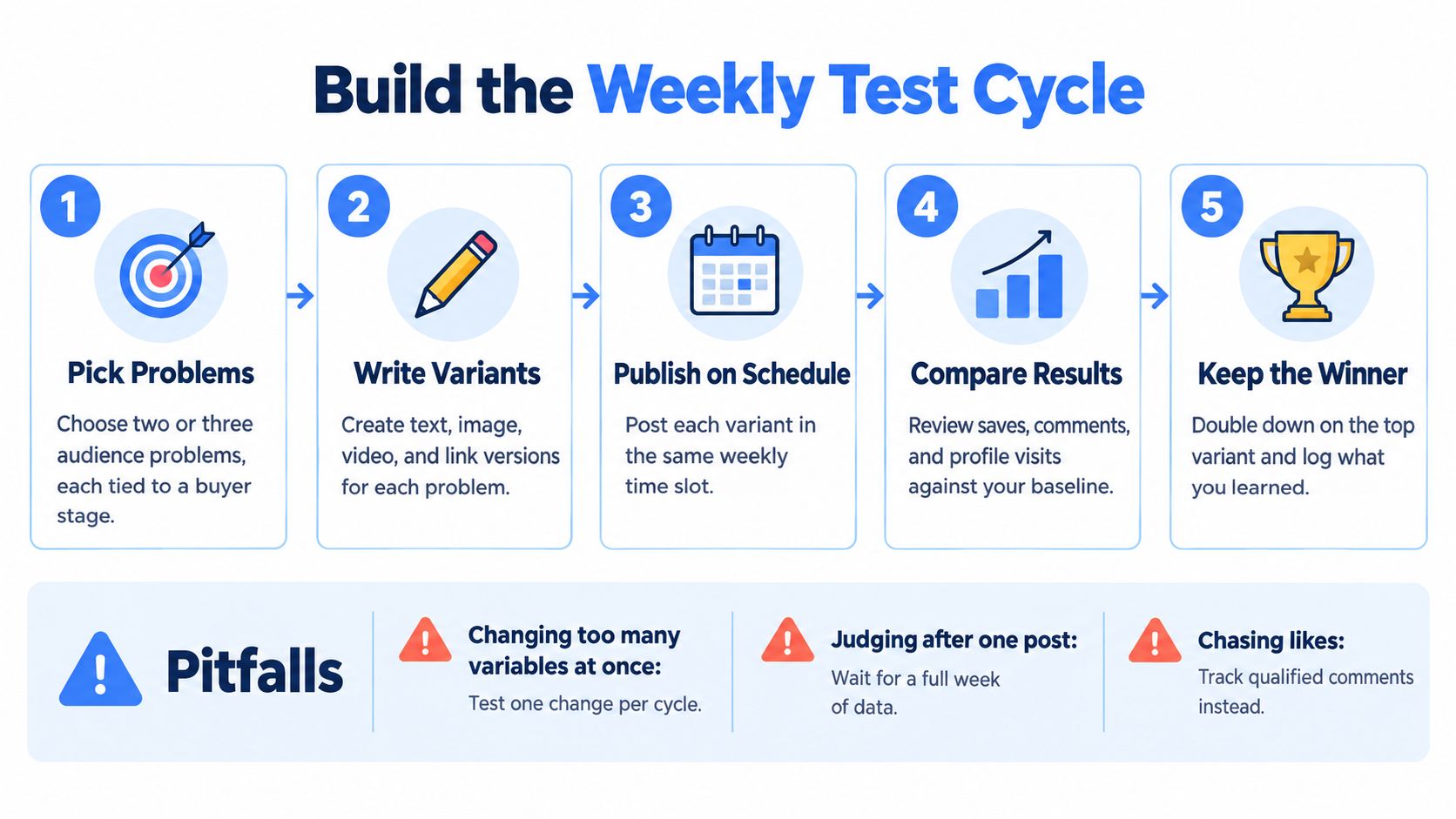
Use a fixed loop so the team learns while publishing. Random changes produce results you can't explain, which makes the next planning meeting mostly an opinion contest.
The visual gives the broad cycle. Keep the written test log more precise than the diagram.
Run a Controlled Weekly Loop
- Pick buyer problems. Choose two or three problems and give each a buyer stage. Someone diagnosing dispatch delays needs different information from someone comparing software.
- Draft useful variants. Prepare text, image, video or link versions where the format suits the explanation. You don't need to publish every version.
- Choose the changed element. Test the hook, proof type, structure or call to action. Write that choice in the log before publishing.
- Keep a publishing rhythm. Reserve slots your contributors can sustain. Leave room for relevant developments without rebuilding the calendar whenever someone has an idea.
- Review against the assigned goal. Check results at a consistent post age. An older post has had more time to collect attention.
- Develop the useful theme. Give the next post a different lesson or application. Repeating the same wording tells you little about the strength of the subject.
LinkedIn's company page guidance reports a twofold engagement lift for companies posting weekly and recommends sharing four relevant pieces of third party content for every self serving post. Treat these as platform guidance, not a promise that a particular schedule or ratio will work for your audience.
Keep the Comparison Readable
Say an expert has a supported finding about incomplete dispatch handoffs. Test an opening that names the mistake against an opening that names its operational consequence across two weeks.
Keep the author, format, underlying proof and next step steady. Timing and audience exposure will still differ, so call the result directional. Repeat the comparison before adopting a permanent rule.
Tags can be another test variable. Tag people who contributed or whose expertise is directly relevant. Don't turn a useful post into a roll call.
For a video walkthrough alongside the written workflow, use this resource.
Three common failures need boring, effective fixes.
- Missed publishing slots. Book the slots before drafts exist and keep approved material ready.
- Too much promotion. Count useful teaching, outside perspectives and direct offers during the weekly review.
- Too many changed variables. Reject a comparison if the log can't name the main difference between versions.
A weekly review is a checkpoint. It doesn't make a small sample conclusive.
Measure What Matters Each Week
Assign a funnel goal before drafting. Reach, trust, qualified traffic and pipeline require different evidence. Comparing every post by reaction count gives the easiest content an unfair advantage.
A longitudinal study using 106 weeks of data from a B2B firm found that followers and website visits were positively associated with sales revenue. That supports tracking downstream activity, but a finding from one firm doesn't establish that follower growth causes sales in every business.
Scorecard by Funnel Goal
| Objective | Metric | Where to find it | What a weak result points to |
|---|---|---|---|
| Reach and follower growth | Impressions and new followers | LinkedIn post analytics | The opening line is not earning attention |
| Engagement and trust | Reactions, comments and reposts | LinkedIn post analytics | The topic lacks resonance or proof |
| Qualified traffic | Tracked link clicks and website sessions | UTM tagged links and web analytics | The post has no clear next step |
| Pipeline | Conversion rate and influenced opportunities | CRM with campaign source | The content draws attention but not buyers |
| Newsletter reading | Article views divided by impressions | LinkedIn newsletter analytics | The headline did not earn the click |
| Newsletter response | Engagements divided by article views | LinkedIn newsletter analytics | Readers finished but had no reason to respond |
Treat the final column as a starting hypothesis, not a diagnosis. Weak reach might reflect audience fit or limited distribution. Low conversion might come from a poor landing page, not a weak post.
Use consistent UTM naming for author, campaign and post. Connect website sessions to forms in your web analytics, then record qualified inquiries and opportunities in your CRM. A LinkedIn business analytics workflow can help keep those records aligned.
Read Newsletter Ratios Carefully
LinkedIn newsletter analytics can report impressions, engagements and article views for editions published within the previous two years. Record those counts for each edition, then calculate article views divided by impressions and engagements divided by article views.
These are diagnostic ratios, not exact reader conversion rates. Article views count clicks, not completed reading. Engagements concern posts containing the edition, so they don't prove someone responded after finishing it.
A busy comment section can reveal interest. It can't tell your finance team what the content earned.
Ask sales to record direct content mentions and which expert a buyer recognized. Employee influence may appear in a conversation before it appears in attribution.
Increase themes that attract relevant visits, qualified conversations or opportunity progress. Keep educational material in the mix so the feed remains useful before a buyer is ready to act.
Repurpose and Scale Without Repeating Yourself
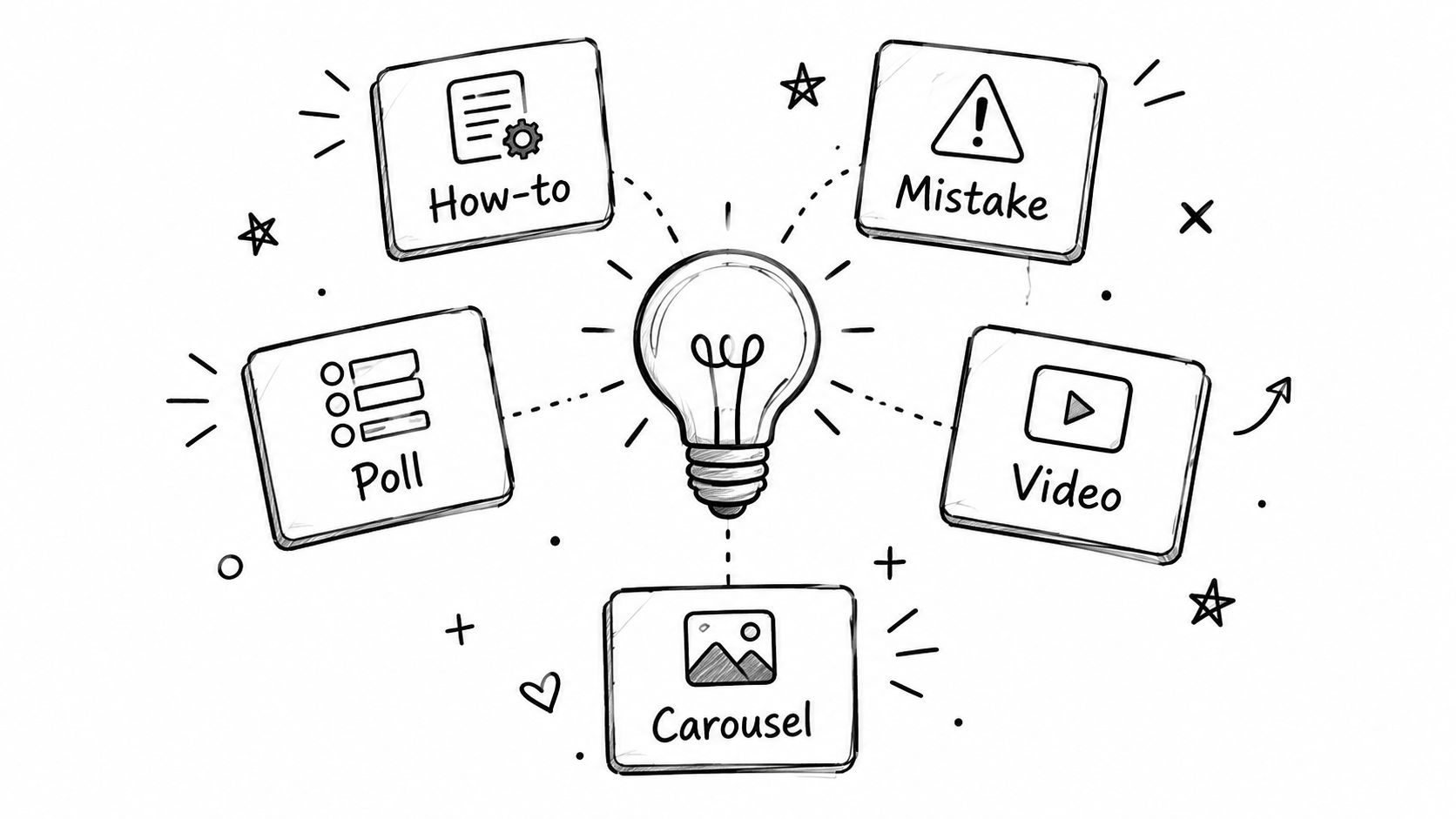
A single supported finding can serve several audience needs without repeating the same post. Suppose a dispatch team finds that unclear ownership leads to missed handoffs. An expert can explain a practical handoff check; a mistake post can show why another dashboard will not solve unclear ownership. A poll can ask operators where handoffs break, a video can demonstrate the workflow, and a newsletter can explain the trade-offs.
Keep the evidence and core lesson consistent, but change the question, format, and contributor's perspective. Use the image as an idea map, not a checklist to fill every format.
Match Each Format to a Useful Test
In 2024, 63% of surveyed B2B buyers in the United States, United Kingdom and India said short-form social video helped inform buying decisions, according to LinkedIn research commissioned from GWI. Treat that as a reason to test video, not proof it will outperform text with your audience.
| Format | Test focus | Useful signals |
|---|---|---|
| Text | Hook wording | Impressions, reactions and comments |
| Documents and images | Visual structure | Shares and available click metrics |
| Video | Opening seconds or length | Impressions and profile visits |
| Polls | Question framing | Comments and reactions |
| Newsletter | Headline or first paragraph | Article views and engagements |
Use LinkedIn post analytics across multiple content types to compare a reasonable sample. Keep the topic and audience steady, and judge signals against the funnel goal: awareness, consideration, or action. One unusually strong post is not enough to name a format winner.
Give Newsletters a Distinct Job
A newsletter can connect ideas that need more explanation than a feed post allows. Set out the decision, supporting evidence, and limits of the advice. Reposting the week's captions in article form adds length, not depth.
LinkedIn notifies followers about new newsletter editions through push, in-app and email notifications, so publish predictably and make each edition useful enough to justify that interruption.
When a pillar produces steady results over several weeks, add either a contributor or a format, not both in the same month. Employees and subject-matter experts extend distribution through their own voices; give each a clear role and preserve time for review. Scale only when the added capacity helps the team serve a funnel goal, rather than merely increasing post volume.
Choose One Pillar and Start the First Four Weeks
Keep the first month small enough to finish. A useful test comes from consistent execution, not a polished launch presentation.
Weeks One and Two
Week one. Choose one pillar and name its audience segment. Draft opening lines for six posts. Check that each promises a specific lesson you can support.
Assign a contributor and an approval owner before developing the drafts. Use material from actual work, with permission where needed. Leave unsupported claims out, even when they make a hook more exciting.
Week two. Publish on the agreed rhythm. Log each draft's pillar, hook, format, call to action and author in Google Sheets or your existing planning tool. Keep the test log alongside that planning sheet so the team can compare what it published with the results.
Weeks Three and Four
Week three. Change only the hook on half the planned posts. Keep the other elements steady enough for a useful comparison, and note changes in timing or distribution.
Week four. Review each post against its assigned funnel goal. Decide which theme deserves another month, which needs stronger proof and which should stop. Likes alone are not a reason to repeat a post if it did not serve its goal.
ViralBrain offers a hook library and analysis of high-performing creator posts to help prepare first drafts. It also lets users save drafts, so the team can keep each hook and call to action in its own test log alongside the planning sheet. Treat suggested patterns as ideas to test, not guaranteed results. Manual posting is supported today, so your team still decides what goes live.
Schedule the weekly review before writing the first draft. ViralBrain can help prepare drafts around buyer problems; a named expert, a clear funnel goal and your own results should guide what gets repeated.
Visit ViralBrain to explore hooks, study creator post patterns and prepare drafts around your buyer problems. Use drafts with a named expert, a clear funnel goal and a test log, then let your own results decide what gets repeated.
Grow your LinkedIn to the next level.
Use ViralBrain to analyze top creators and create posts that perform.
Try ViralBrain free