
8 Reverse Engineering Examples for Creators and Products
Explore 8 reverse engineering examples for content growth, product design, ads, software, and web pages, with practical tactics you can use.
Grow your LinkedIn to the next level.
Use ViralBrain to analyze top creators and create posts that perform.
Try ViralBrain freeThe popular advice about reverse engineering is to find something successful and copy what made it work. That skips the difficult part. You can see the output without knowing what caused the result. A busy comment section, a polished product, or a persistent ad can suggest where to investigate. None proves that you've found the mechanism.
Reverse engineering is a research habit. Study an artifact, separate its parts, form an explanation, then test that explanation with your own material. For creators and marketers, that means treating posts, ads, and pages as evidence rather than templates with better shoes.
Good methods for user research belong beside this work. Competitor analysis can help you decide what to investigate. Conversations with your own customers can help you decide whether that pattern solves their problem.
Copy the research discipline. Treat the visible design as a hypothesis until your own evidence supports it.
These reverse engineering examples span LinkedIn posts, search pages, ads, products, networks, aircraft, malware, and landing pages. The useful question stays the same across them. What can you prove from the evidence, and what are you merely guessing?
A disciplined analyst records both. Otherwise, reverse engineering becomes imitation with a spreadsheet.
1. LinkedIn Post Teardown
A LinkedIn post with a busy comment section gives you an artifact to examine, not a formula for growth. Start by separating the hook, argument, evidence, format, and call to action. Record what the author wrote before deciding why readers responded.
The structure matters more than a memorable opening sentence.

A founder could study a creator whose posts explain mistakes in customer discovery. The useful observation might be that the author names a costly decision, shows what happened, then gives readers a practical correction. That pattern is worth testing with the founder's own experience. Borrowing the mistake would require borrowing the life that produced it.
Use a spreadsheet alongside a LinkedIn post analyzer tool. Record the opening, topic, supporting evidence, visible reactions, and the substance of comments. Keep observations separate from explanations.
Study the Response, Not Just the Hook
Comments deserve their own analysis. A reader asking for implementation details signals something different from a reader applauding a familiar opinion. A lively argument can inflate visible activity while doing little for your actual business goal.
For a structured approach, use LinkedIn competitor analysis to organize comparable posts rather than collecting unrelated hits.
Adapt the argument pattern, then rewrite every sentence around your own topic. A marketer could turn a personal lesson format into a post about a failed software onboarding decision, supported by their own records.
Test enough original posts to avoid judging the pattern from an isolated result. Compare them with your normal content and track the outcomes you care about. Don't declare the hook responsible when the topic, audience, and author changed too. That's a crowded crime scene.
2. The Skyscraper Technique
The Skyscraper Technique starts with an appealing idea. Study a useful search page, build a stronger resource, then approach relevant sites that might value the improvement.
The weak version means adding more words. The stronger version means finding what the existing page prevents readers from doing. A long article can still leave readers stranded at the exact moment they need an example, a download, or a decision rule.
Consider a hypothetical SaaS template library. A competing page may contain attractive previews but little guidance on choosing a template. Your improvement could be an editable resource with clear use cases, filled examples, and explanations of when each template is unsuitable.
Define Better Before You Write
Create a research record for each competing page. Note the reader's task, the available evidence, the missing steps, and any material that requires independent checking.
Then write a precise improvement statement. Your page might help a sales manager choose a handoff template and adapt it to their existing workflow. That's more useful than promising the best guide on the internet. The internet has enough self awarded trophies.
A legacy software case offers a useful measurement analogy. NIST's software reengineering study examined 21,480 COBOL source statements and 4,062 executable statements, illustrating why raw size and recovered function need separate measures.
Apply that distinction to content. Word count measures volume. It doesn't establish whether a reader can complete the task.
Copy the coverage logic, not the competitor's wording or visual identity. Before outreach, test your resource with someone who needs it. Ask them to use it without your narration.
If you contact a site that references a competing page, explain the specific improvement. Name the usable asset or missing instruction you added. Don't send generic praise followed by a request for a link. That's flattery wearing a delivery uniform.
3. Competitor Ad Teardown Using Meta Ad Library
An ad's continued appearance doesn't prove that it makes money. You can't infer conversion quality, acquisition cost, or profit from creative alone.
Use Meta Ad Library as a place to inspect advertising artifacts and form hypotheses. Examine the customer problem, promise, proof, offer, and next step. Treat an apparent pattern as a candidate for testing, not a competitor's financial confession.
A hypothetical B2B software team might notice repeated ads about slow approvals. Rather than copy the layout, the team could test whether its own prospects respond to a specific approval problem. The useful pattern is the problem framing. The competitor's footage, testimonials, and claims stay with the competitor.
Record What You Can Actually Observe
Save dated evidence and distinguish the ad's visible contents from your interpretation. A changed offer might reflect a new strategy, a seasonal campaign, or a different audience. Without supporting information, you don't know which.
Use competitor content analysis to connect ad observations with broader messaging. Keep an Ad Library API for competitive intelligence in mind when planning how to collect and maintain research records.
A persistent ad is a reason to investigate. It isn't permission to write profitable in your notes.
For your own test, preserve a clear comparison. If you change the hook, offer, audience, and destination together, you'll struggle to explain the result.
Copy the testable angle, such as the cost of delayed approvals. Write your own claim and support it with your own evidence. If you can't substantiate the promise, a prettier ad won't repair it.
Set the decision rule before spending. Decide which business outcome would justify another test and which result would make you stop. Competitor research should narrow your uncertainty, not give you confidence on credit.
4. Product Teardowns by iFixit
The appeal of an iFixit style teardown is straightforward. Opening a device lets you investigate decisions that its exterior hides. But the screwdriver is only the entry fee. Traceable observations make the exercise useful.
A teardown record should connect each part to its location and condition.
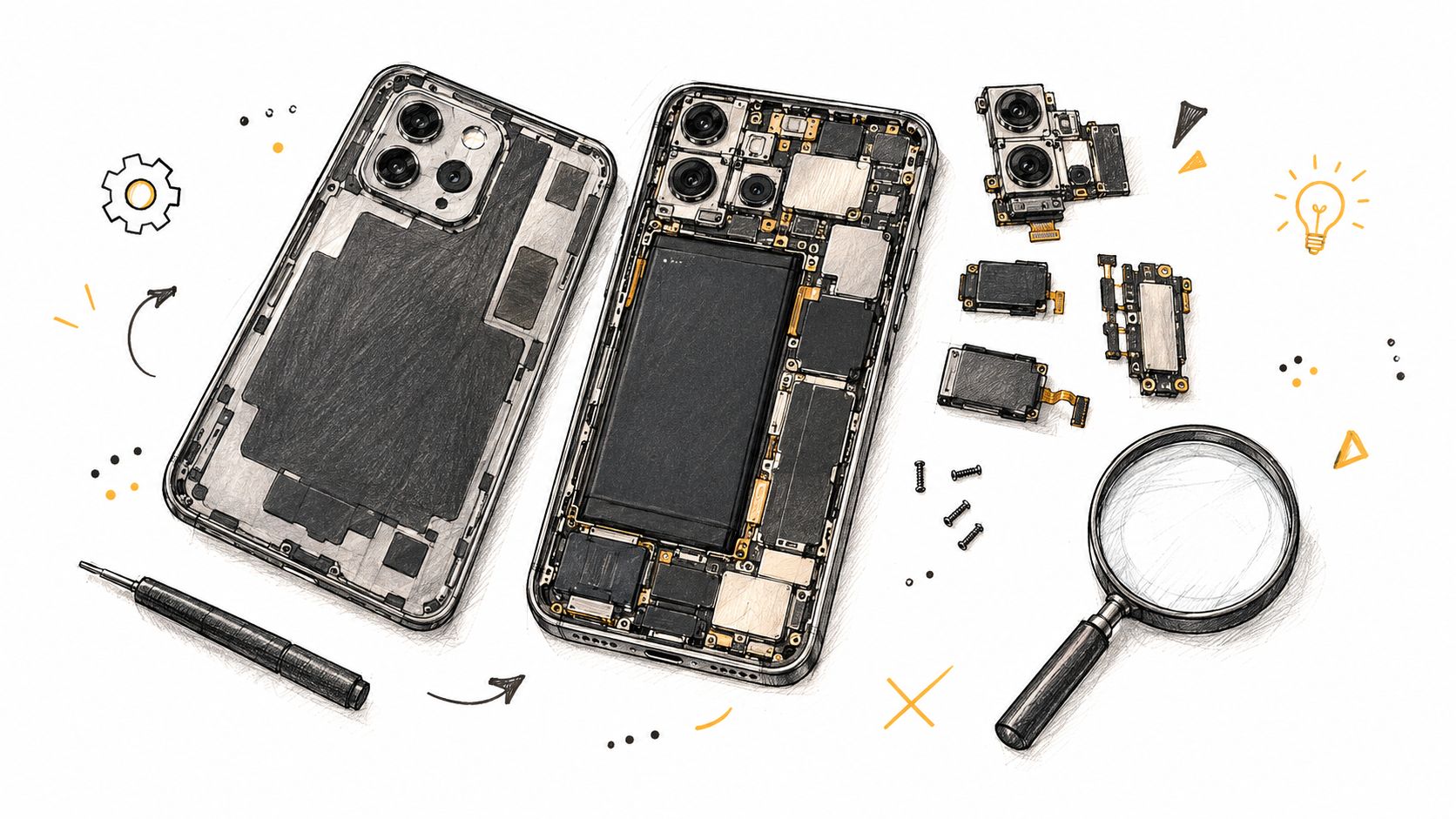
The Berkeley product teardown study describes systematic deconstruction followed by analysis of components, physical principles, technology, and development choices. The practical implication is simple. Document the original state before modifying anything.
A product team examining a repairable device could investigate how someone reaches a replaceable component. Record fasteners, connectors, access steps, and surrounding parts. Don't assume that an awkward assembly proves careless engineering. You may be missing a production or durability constraint.
Preserve the Evidence Before Improving the Design
Photograph assembly order, label removed parts, measure relevant dimensions, and retain samples. A beautiful drawing without a link to the measured object is still a guess.
The teardown footage below provides a visual reference for the examination process.
For more complex geometry, the engine housing reverse engineering case describes repeated laser scans, alignment markers, cleanup of noisy measurements, and conversion into CAD features. Its useful lesson is that raw capture needs validation before production use.
Copy a demonstrated design principle, such as accessible replacement, only after checking that it suits your own requirements. Don't copy a component arrangement merely because it fits inside a successful product.
And don't infer a competitor's purchase price from a part number. A teardown can expose a component. It can't expose the supplier contract tucked away in procurement.
5. Samba and the SMB Protocol
Use Samba and SMB as a reference point for a difficult engineering question. How can an independently built system communicate correctly without reproducing another system's private internals?
The research target should be observable behavior. For an authorized compatibility project, record inputs, outputs, message sequences, errors, and boundary conditions. Your explanation must predict what happens beyond the example that first caught your attention.
A hypothetical storage team could build a test harness around file sharing behavior. The evidence would be captured exchanges and repeatable tests. A diagram of the expected conversation would help, but the actual responses would decide whether the implementation works.
Copy the Contract, Not the Internals
NASA's trajectory reverse engineering work provides a concrete example of this approach. NASA extracted trajectory information from an SPK file and reconstructed it in other analysis tools, using Python scripts for Monte and Copernicus rather than relying on direct source code integration.
The transferable pattern is to choose a stable interchange artifact and validate reconstructed behavior at meaningful checkpoints. For a network project, that means testing message handling and error behavior, not merely producing a plausible packet.
Legal scope belongs in the research record. Cornell's explanation of reverse engineering law describes the conditions attached to DMCA Section 1201(f), including lawful access, an interoperability purpose, unavailable necessary information, and avoidance of copyright infringement.
Document your authorization, technical objective, missing information, and copied materials. Get qualified legal advice before crossing uncertain boundaries.
Don't copy an access bypass under the banner of compatibility. In the BnetD case described by EFF, alternative server work created legal exposure because it bypassed an access control.
A successful exchange proves a technical result. It doesn't settle the legal question. Your packet capture isn't a law degree.
6. Tupolev Tu-4 and the Boeing Superfortress
The Tupolev Tu-4 and Boeing Superfortress comparison presents the most tempting version of reverse engineering. Start with a complete aircraft and try to reproduce it.
For a product analyst, the sharper lesson is about hidden assumptions. Measuring an object gives you dimensions and relationships. It doesn't automatically tell you which choices were essential, which were compromises, or which depended on the original manufacturing process.
Treat a complete system as connected decisions. A hypothetical team rebuilding an obsolete mechanical assembly would need to record material properties, interfaces, tolerances, and expected behavior. Matching the silhouette would be a poor stopping condition.
Reconstruct the Principle Before the Shape
The Wright brothers offer a better documented model for that discipline. They studied earlier gliders, investigated failures, and tested successive designs rather than copying an existing powered aircraft.
Their first successful powered flight occurred near Kitty Hawk on December 17, 1903, and lasted 12 seconds, according to the Wright brothers history reference. The useful research pattern was systematic observation, measurement, failure analysis, and reconstruction of the principles needed for controlled flight.
A faithful shape can reproduce an error faithfully. Test the behavior you actually need.
For a modern product team, connect every proposed adaptation to a requirement. If you change a material because your production line can't use the original, identify which behaviors might change with it. Validate those behaviors rather than assuming the substitution is harmless.
Copy the measured relationship, such as how a control change affects the system. Don't carry over undocumented assumptions merely because they survived inside the original.
Creators can apply the same principle. A recognizable format may depend on an author's expertise or audience trust. Reproducing its appearance doesn't reproduce those conditions. The missing ingredient won't appear when you adjust the font.
7. Stuxnet Analysis and the Release of Ghidra
Stuxnet analysis and Ghidra point toward an essential distinction in software investigation. A readable explanation of code is not yet a verified explanation of behavior.
Treat decompiled output as working evidence. Record what you observed, what you inferred, and what remains untested. A function name you assign can help organize analysis, but it can make a weak interpretation look settled.
For a hypothetical security team examining a suspicious binary, begin with an authorized, isolated environment. Preserve the original artifact. Inspect strings and imports, record relevant addresses, then test narrowly defined explanations without connecting the sample to production systems.
Make Every Interpretation Checkable
Write findings so another analyst can reproduce them. Attach each behavioral claim to the relevant artifact, location, input, and observed result. When evidence conflicts, retain the conflict in your notes instead of editing it out for a cleaner story.
The training problem is real. A software reengineering education needs analysis surveyed 93 professionals and educators. It found that 33.8% strongly agreed and 31.0% somewhat agreed that reverse engineering resources were insufficient, while identifying tool complexity, missing prerequisites, and limited training as barriers.
That supports a practical training choice. Use imperfect but legally distributable projects with maintenance problems, and document uncertainty as part of the exercise. A clean puzzle can teach a technique without teaching how to handle contradictory evidence.
AI assistance needs the same restraint. A review of conversational AI in software engineering education examined 52 papers and reported mixed results, limitations, and a need for more empirical work.
Copy the verification method, not the tool's confident interpretation. Ask an assistant to propose hypotheses, then check them independently in a debugger or test harness.
Generated pseudocode can look tidy while missing behavior. Neat handwriting has never been an accuracy guarantee.
8. Landing Page Teardown With the Wayback Machine
A saved landing page can show what a company published. It can't tell you why the company changed it or whether the new version converted better.
Use Wayback Machine snapshots as evidence of visible decisions. Examine headlines, offers, proof, pricing presentation, and calls to action. Keep the observation separate from the story you're tempted to tell about it.
A timeline helps organize those differences without pretending to reveal performance.
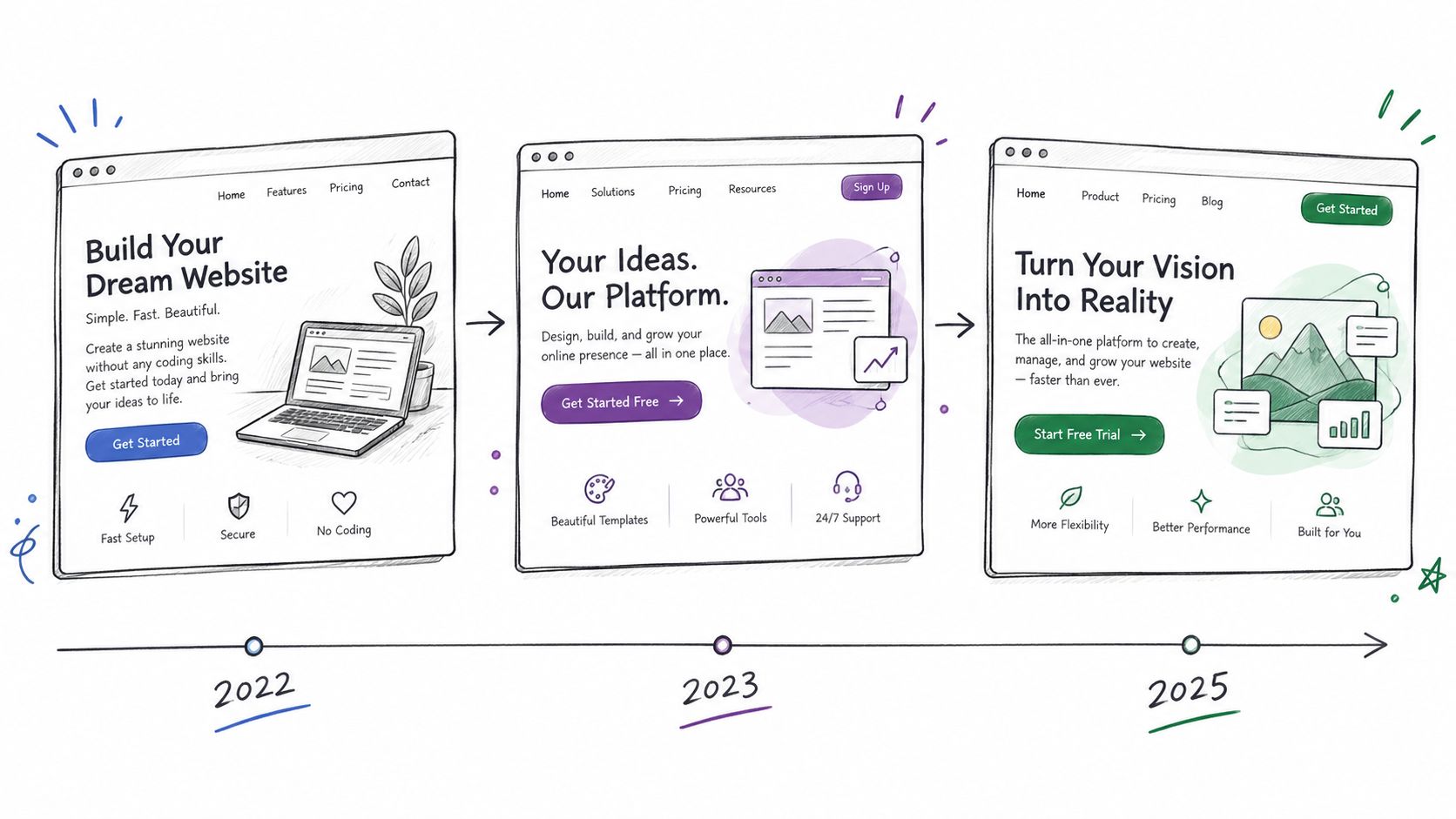
A hypothetical SaaS marketer might compare an archived page built around broad productivity language with a current page focused on a specific buyer's approval process. The defensible finding is a change in positioning. Claiming that the company discovered its best converting headline would require evidence the archive doesn't provide.
Study the Decision Without Inventing the Result
Save each snapshot reference and record exactly what changed. Note incomplete captures or missing assets, since uncertainty about the artifact should remain visible in your analysis.
Use what competitor analysis involves to frame the comparison around a business question. For example, investigate whether competitors describe the category through user tasks, business outcomes, or product features.
The pattern worth testing might be greater specificity. If a page names the buyer, the frustrating task, and the expected outcome, you can test that structure using your own customer language.
Don't copy the competitor's evidence. Their customer logos, testimonials, and performance claims don't become yours because you arranged them in a familiar order.
Pair the research with your own page experiment. Keep a record of what changed and which outcome you measured. If the new version performs poorly, preserve that finding too.
A competitor's current page is its current choice. Treating it as the correct answer saves effort by removing the research. Unfortunately, that removes the useful part.
8 Reverse Engineering Examples: Side-by-Side Comparison
| Example | Complexity and Resources | Expected Outcome | Ideal Use Case | Key Advantage |
|---|---|---|---|---|
| LinkedIn Post Teardown | Low; spreadsheet, post samples, and a few hours | Repeatable post structures to test with your audience | Improving social content using engagement patterns | Inexpensive way to overcome blank-page syndrome |
| The Skyscraper Technique | High; research, content production, backlink tools, and outreach | A more comprehensive page and potential backlinks | Building search visibility for topics with existing demand | Starts with proven topics and link opportunities |
| Competitor Ad Teardown Using Meta Ad Library | Low; free tool and brief research time | Insights into competitors' active creative, offers, and messaging | Informing advertising concepts and campaign tests | Free access to real ads competitors are running |
| Product Teardowns by iFixit | High; physical devices, tools, and technical expertise | Documentation of components, design, and repairability | Comparing hardware design or assessing repair options | Reveals internal construction and component choices |
| Samba and the SMB Protocol | High; protocol analysis, engineering expertise, and compatibility testing | File and printer sharing between Windows and Unix-like systems | Enabling interoperability across mixed operating systems | Provides open-source SMB compatibility |
| Tupolev Tu-4 and the Boeing Superfortress | Very high; intact aircraft, detailed analysis, and major industrial capacity | A bomber modeled on an existing aircraft design | Reproducing or adapting complex hardware designs | Accelerated development by studying a working design |
| Stuxnet Analysis and the Release of Ghidra | High; reverse-engineering expertise, analysis tools, and isolated systems | Understanding malware behavior and supporting defense | Malware analysis and security research | Reveals code behavior using accessible analysis tools |
| Landing Page Teardown With the Wayback Machine | Low; free archive access and comparison time | A timeline of changes to a competitor's messaging or page design | Studying historical positioning and website changes | Provides free access to past page versions |
Build a Better Reverse Engineering Habit
The strongest reverse engineering examples share a discipline. Study the evidence before copying the output. Describe what you can observe, propose an explanation, and test it under conditions you understand.
For creator research, collect a body of posts rather than an isolated hit. Log the hook, structure, format, supporting evidence, and comments. Compare your own results against your normal content before deciding that a borrowed pattern works.
For product and campaign research, compare competing artifacts and preserve dated records. Note which features changed together. A new offer beside a new headline makes it harder to credit either change alone.
Keep a Record That Can Survive Disagreement
Use a research note with separate spaces for observations, hypotheses, tests, and unresolved questions. Someone should be able to challenge your explanation without losing access to the evidence behind it.
Define the stopping condition before starting. A creator might need enough evidence to justify another original post. An engineer may need repeatable behavior across a documented set of tests. These are different standards, and pretending otherwise makes marketing certainty look suspiciously cheap.
Record failure without dressing it up. A rejected hypothesis can prevent wasted effort. A successful test with unclear causes should remain a successful test with unclear causes.
The honest result may be that you understand the visible pattern but haven't established why it works.
AI can help organize artifacts and generate candidate explanations. Keep original materials intact and verify interpretations independently. Faster drafting is useful, but it doesn't remove the need to check whether the draft reflects the evidence.
Translate the Pattern Into Your Own Work
ViralBrain helps teams analyze creator patterns and turn them into LinkedIn drafts matching their own topics and voice. Use that assistance to explore structures, not to inherit someone else's experience or pretend their results will transfer.
Choose a narrow research target. A founder could examine how creators explain difficult decisions. A product team could investigate access to a replaceable component. A marketer could compare how landing pages introduce proof.
Then build something original from the principle you identified. Test it, keep the result, and revise the explanation when the evidence disagrees.
Copy the method, not the surface result. That's how reverse engineering becomes a useful habit instead of a more elaborate way to borrow someone else's homework.
ViralBrain analyzes creator posts to surface hooks, structures, and calls to action, then helps you generate drafts for your own topics and voice. Visit ViralBrain to turn your LinkedIn teardown research into original drafts you can test with your audience.
Grow your LinkedIn to the next level.
Use ViralBrain to analyze top creators and create posts that perform.
Try ViralBrain free