

What Is GTM Strategy and How to Build One
What Is GTM Strategy. Learn what a GTM strategy really is, why it matters, and how to build one for SaaS, founders, and LinkedIn-led personal brands
Grow your LinkedIn to the next level.
Use ViralBrain to analyze top creators and create posts that perform.
Try ViralBrain freeMost advice about what is GTM strategy gets the first thing wrong. It treats go to market as a launch checklist, then adds a few slides about audience, channels, and pricing. That creates a tidy document and a messy business.
A GTM strategy is an internal operating system for revenue execution. It connects the ideal customer profile, message, offer, distribution, sales motion, onboarding, and retention. Product, marketing, sales, RevOps, and customer success need to run from the same logic, with named owners and feedback loops.
The gap between planning and execution is large. 83% of B2B organizations say GTM strategy is very important, while only 38% say execution is very effective, a 45 point gap reported by Demandbase. That gap is where launches go to die.
Why GTM Is an Operating System, Not a Launch Poster
A press release isn't a GTM strategy. Neither is a landing page, a demo video, or a launch deck with attractive gradients and no owner beside the work.
A launch is an event. GTM is the machinery that keeps working after the announcement disappears from the feed. It decides who should buy, why they should care, how they can find you, how sales converts interest, and how customer success turns new revenue into durable usage.
The common failure pattern is predictable. Marketing defines one audience, sales chases another, product hears complaints from a third group, and nobody updates the message when deals close or disappear. Once the launch sprint ends, ownership becomes a group project, which is a polite way of saying nobody owns it.
The three symptoms of launch thinking
Teams treating GTM as a one time event usually show three symptoms.
- Marketing and sales use different ICPs. Marketing targets a broad category. Sales pursues accounts with urgent pain. The funnel reports activity, not agreement.
- Closed deal feedback goes nowhere. Reps hear objections and customer success sees activation friction, yet the positioning document remains frozen in a shared folder.
- Ownership ends on launch day. The team celebrates the release, then stops reviewing whether the motion produces qualified pipeline, activation, retention, or expansion.
A formal GTM discipline matters because execution gets harder as buying becomes more complex. One benchmark set reported that 77% of B2B product launches miss their revenue targets in year one, while 77% of B2B buyers describe their latest purchase as complex or difficult. The same benchmark reported a median enterprise SaaS purchase involving 11 stakeholders. Those figures appear in GTM strategy benchmarks.
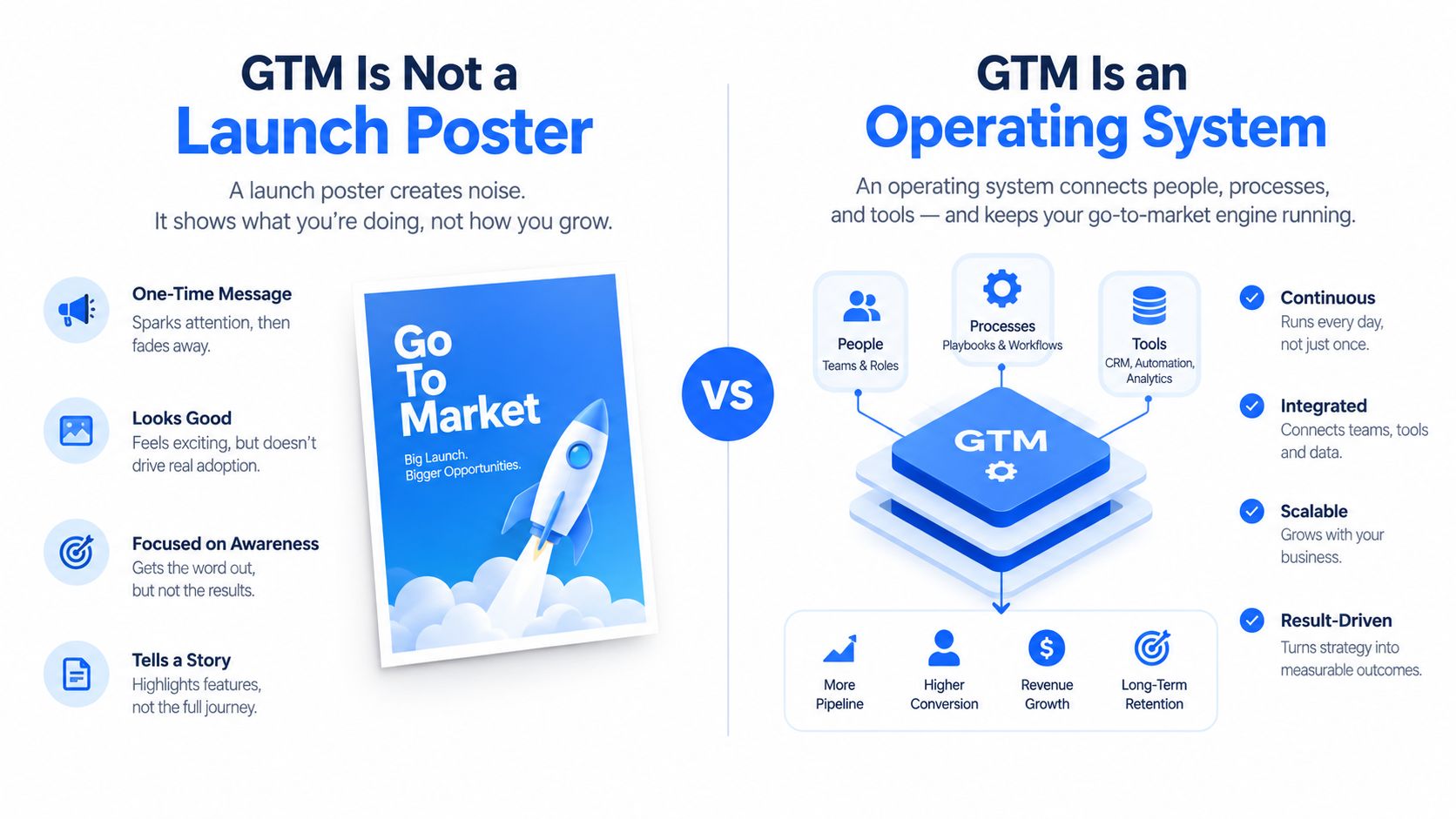
Practical rule: A pretty launch deck is decoration. The strategy lives in the decisions, owners, metrics, and review cadence behind it.
The operating system view is less glamorous and more useful. It turns product truth into pipeline, pipeline into revenue, and revenue into retention signals. It also accepts that the system needs updates as buyer behavior, pricing, channels, and sales evidence change.
The rest of this guide treats GTM as an executable system. You'll define its mechanics, choose a motion, build the plan, measure it, catch drift, and install a working routine.
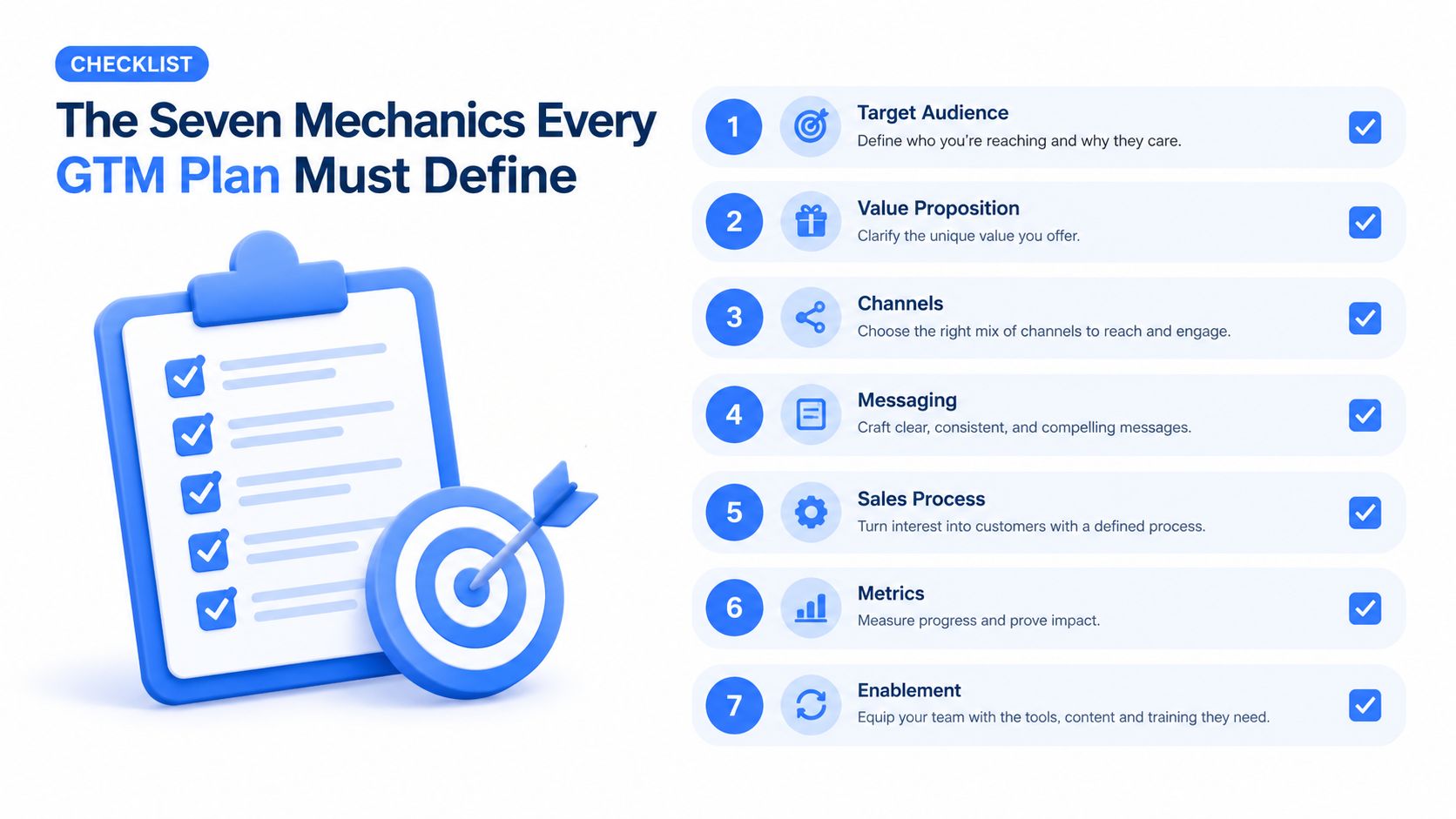
The Seven Mechanics Every GTM Plan Must Define
A GTM plan becomes executable only when seven decisions are documented. Who buys, what problem you solve, how buyers find you, how they purchase, and how revenue continues must be clear enough for another person to act without calling the founder.
Use each mechanic as an audit. Each one needs a named owner, a decision, and one artifact.
1. Target market and ICP
Choose the market, then define the ideal customer profile within it. The artifact is an ICP one pager covering firm type, buyer role, pain, trigger, current alternative, and disqualifiers.
Use this guide to finding your target audience to turn labels such as “startups” or “marketers” into observable buyer traits and a reason to act. Vague targeting fills the funnel with attention sales cannot convert.
2. Value proposition and positioning
State the painful problem, the promised change, and why your approach differs. The artifact is a positioning statement with one core message per buyer persona.
Creator-led content and LinkedIn-first growth need different proof, even when they target the same market. One may build trust through repeated expertise, while the other earns evaluation through practical evidence. Give each motion a message it can deliver consistently.
3. Pricing and packaging
Decide what customers pay for, how access is packaged, and which buyer receives each tier. The artifact is a pricing matrix mapped to personas, usage, value, and buying friction.
Copying a competitor's pricing page is not research. It only proves that you can use a browser. Pricing must support the motion: self-serve offers reduce sales friction, while complex products may justify guided packages.
4. Distribution channels
Pick where qualified buyers discover and evaluate you. The artifact is a channel bet sheet with audience fit, required effort, owner, test, and stop condition.
A channel is a route to a buyer; platforms your team happens to like are not a distribution plan. Assign different jobs to different routes. Creator-led content can create trust and demand, while LinkedIn can support targeted conversation and account-level follow-up.
5. Sales motion
Define how an interested buyer becomes a customer. The artifact is a motion playbook covering qualification, proof, handoffs, objections, and close criteria.
Without it, founders improvise, reps imitate the founder, and every deal follows a different path. A multi-motion plan also needs clear handoffs between content, inbound response, outbound outreach, and sales.
6. Onboarding and activation
Specify the first meaningful value event. The artifact is an activation checklist showing what the customer must do, what the product must provide, and who intervenes when progress stalls.
A sale without activation is rented revenue. Track the first action that proves the customer has reached value, then assign someone to address stalled progress.
7. Retention loop
Show how usage, customer feedback, support, and expansion information return to the team. The artifact is a retention dashboard tracking retention or churn across review windows, including 30, 90, and 365 days. Treat those windows as operating requirements, not reporting decoration.
If your plan lacks more than one mechanic, it is still a hypothesis. The seven parts depend on one another. Pricing shapes the sales motion, the motion sets the required channel quality, onboarding affects retention, and retention changes acquisition economics.
Choosing Your Motion and the Metrics That Prove It Works
The right GTM motion depends on how buyers want to learn, decide, purchase, and expand. Don't choose sales led because enterprise logos look impressive. Don't choose product led because self serve sounds efficient. Choose the motion whose economics your team can support.
| Motion | Primary Driver | Early Stage Metrics | Common Failure Mode |
|---|---|---|---|
| Sales led | Human selling through qualified pipeline | Qualified pipeline, win rate, sales cycle length | CAC inflation when founders skip outbound discipline |
| Product led | Product experience and self serve value | Activation rate, time to value, retention | Activation failure when free users never reach value |
| Partner led | Distribution through trusted partners | Partner sourced ARR, deal velocity, partner conversion | Channel conflict when incentives are misaligned |
| Creator led | Credibility and audience trust | Audience to MQL conversion, reply rate, qualified conversations | Audience mismatch when reach exceeds fit |
Sales led
Sales led works when the problem is expensive, complex, or risky enough to need human guidance. Its proof sits in qualified pipeline and win rate, not call volume. Teams need clean qualification, disciplined outbound, useful proof assets, and a way to connect rep activity with deal outcomes.
If your team relies on outbound, specialist support such as cold callers can help with prospecting capacity, but outsourced activity won't repair weak targeting. More calls to the wrong accounts create more noise, not a sales system.
Product led
Product led reduces the need for a sales conversation before value. That trade off only works when users reach a meaningful outcome quickly and the product makes the next step obvious. Track activation rate and time to value. Free signups are not success if users leave before the product proves its point.
Partner led
Partner led can extend reach through existing trust, but the partner needs a reason to prioritize your offer. Track partner sourced ARR and deal velocity. If partners register deals that stall, or if direct sales fights them for credit, the channel has a governance problem.
Creator led
Creator led fits businesses where expertise, point of view, and trust shape demand. LinkedIn first growth belongs here, especially for founders selling to a defined professional audience. Track audience to MQL conversion and reply rate, then inspect lead quality. An audience can be large, active, and commercially useless.
The trade off is simple. Each motion demands different evidence. Sales led needs pipeline movement, product led needs product behavior, partner led needs channel economics, and creator led needs audience fit. A single dashboard that treats all four as clicks and leads is a spreadsheet pretending to be strategy.
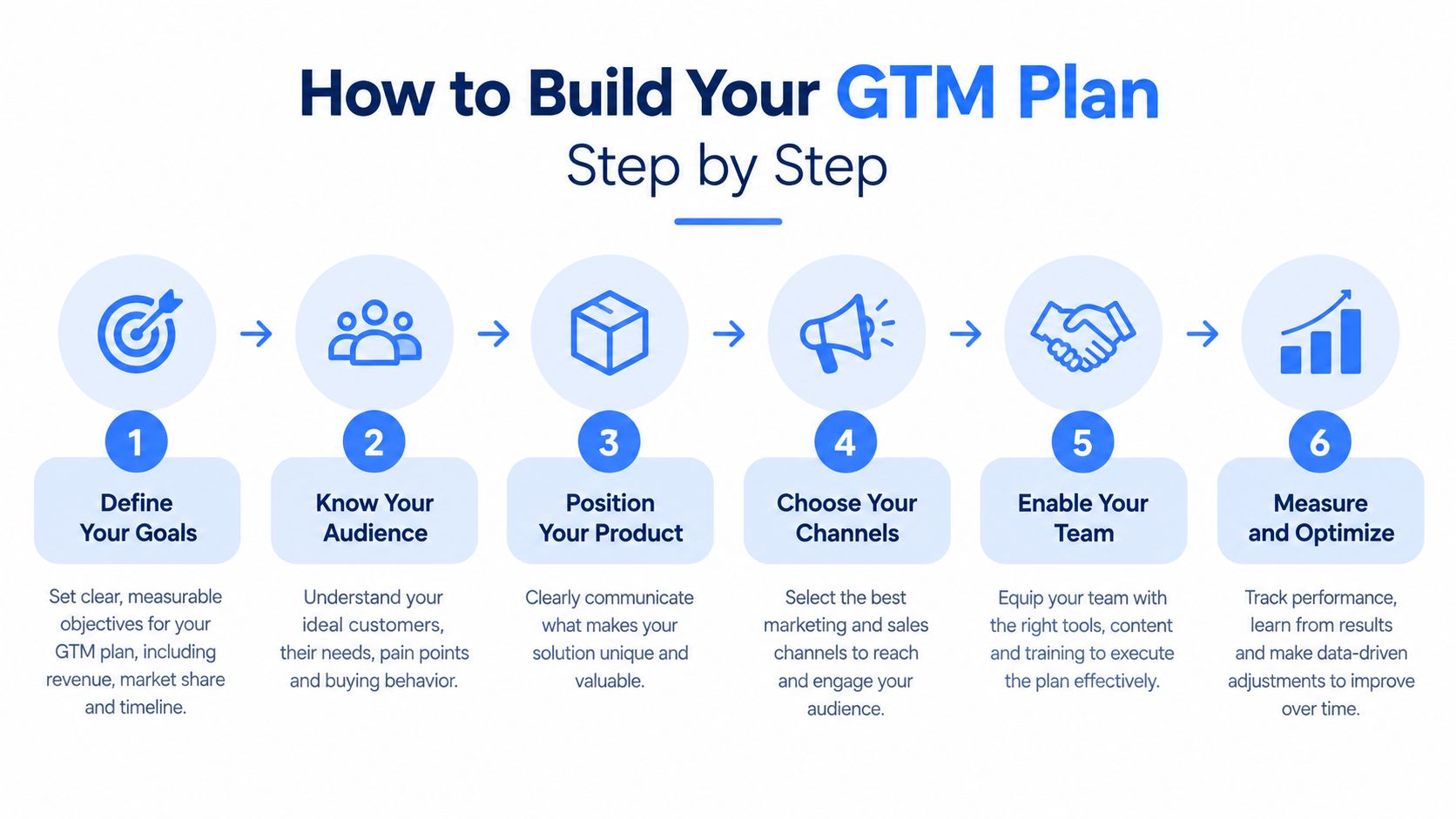
How to Build Your GTM Plan Step by Step
Build the plan in the order decisions depend on one another. Starting with channel selection is backwards. A channel can't save an unclear buyer, weak offer, or broken activation path.
Start with evidence from real buyers
Interview closed lost accounts first. Ask what they tried, what blocked the purchase, who influenced the decision, and what language they used to describe the problem. Compare those answers with closed won customers. Then write the ICP around repeated evidence, not the founder's favorite market.
Sharpen the value proposition against three competitors. Compare the buyer's alternative, the cost of switching, implementation effort, proof required, and the reason your product deserves attention. The output should be a positioning statement that a salesperson can say without sounding like a brochure.
Make fewer motion bets
Choose one primary motion and one supporting motion. A sales led primary motion might use LinkedIn content as support. A creator led primary motion might use a product demo or founder call for high intent buyers. More motions can come later. Early teams rarely have enough people, data, or patience to run five properly.
Lock pricing tiers to buyer personas. Show what changes between tiers, why the change matters, and which path moves a buyer from entry to expansion. The pricing matrix should guide marketing language, sales qualification, and onboarding expectations.
Put owners beside the work
Map the funnel from first touch to activation. Name the event at each stage, the system recording it, and the person responsible for fixing it when it breaks. A GTM plan without ownership becomes a shared document that everyone can edit and nobody must operate.
Set a 90 day milestone ladder. Use early milestones for message tests, qualified conversations, product activation, or partner movement. Don't use impressions as the main launch goal. They tell you that content was seen, not that the market wants the offer.
For teams planning a GTM strategy in 2026, the useful question isn't which tactic is fashionable. It's whether the chosen motion has an owner, a test, a metric, and a stop rule.
Wire in instrumentation before week one ends. The market development strategy guide is useful when the plan involves a new segment, because a new market changes the buyer evidence, message, channel, and proof required.
Three GTM Plans Filled In for Real Scenarios
Templates feel safe because empty boxes don't argue with you. Filled plans expose the trade offs. These three scenarios show how the same mechanics change with the customer, price, and motion.
Scenario A, horizontal product led SaaS
The product serves operations leads at startups with 50 to 200 seats. The ICP is narrow enough to guide acquisition. The primary motion is product led, with content support that explains the operational problem and points users toward self serve signup.
Freemium access reduces initial friction. The paid plan reaches $99 per seat, so activation matters more than demo volume. The team should define the first value event, watch how many users reach it, then improve the path before adding acquisition spend.
Scenario B, vertical sales led SaaS
This product sells into mid market healthcare. The buyer is the COO, while other stakeholders influence security, workflow, and budget decisions. The primary motion is AE driven, with partner referrals supporting account access.
Pricing is $24k ACV. The main proof point is SQL to close, because the business needs to know whether qualified opportunities become customers. A partner that introduces accounts but creates no deal movement isn't a channel. It's an email forwarding service with better branding.
Scenario C, LinkedIn personal brand
A solo founder turns a built in LinkedIn audience into a cohort course. The ICP follows the audience already gathered around the founder's expertise, but the founder still needs to separate readers from likely buyers.
The motion is audience led. Content creates demand, a waitlist captures intent, and the launch offer tests whether attention becomes paid participation. The success metric is waitlist to launch conversion, with cohort completion as a useful quality check.
| Mechanic | Horizontal PLG SaaS | Vertical Sales led SaaS | LinkedIn Personal Brand |
|---|---|---|---|
| ICP | Operations leads at startups with 50 to 200 seats | COOs in mid market healthcare | Existing audience with a clear learning need |
| Positioning | Faster operational workflow without a heavy buying process | A focused solution for a complex healthcare operating problem | Practical expertise packaged into a guided cohort |
| Pricing | Freemium to $99 per seat | $24k ACV | Paid cohort offer |
| Primary motion | Product led | AE led | Audience led |
| Supporting motion | Content | Partner referrals | LinkedIn content and direct conversations |
| Success metric | Activation rate | SQL to close | Waitlist to launch conversion |
These are not interchangeable plans. The horizontal product needs a strong first use. The healthcare product needs coordinated human selling. The founder needs an audience that matches the offer, not merely an audience that likes posts.
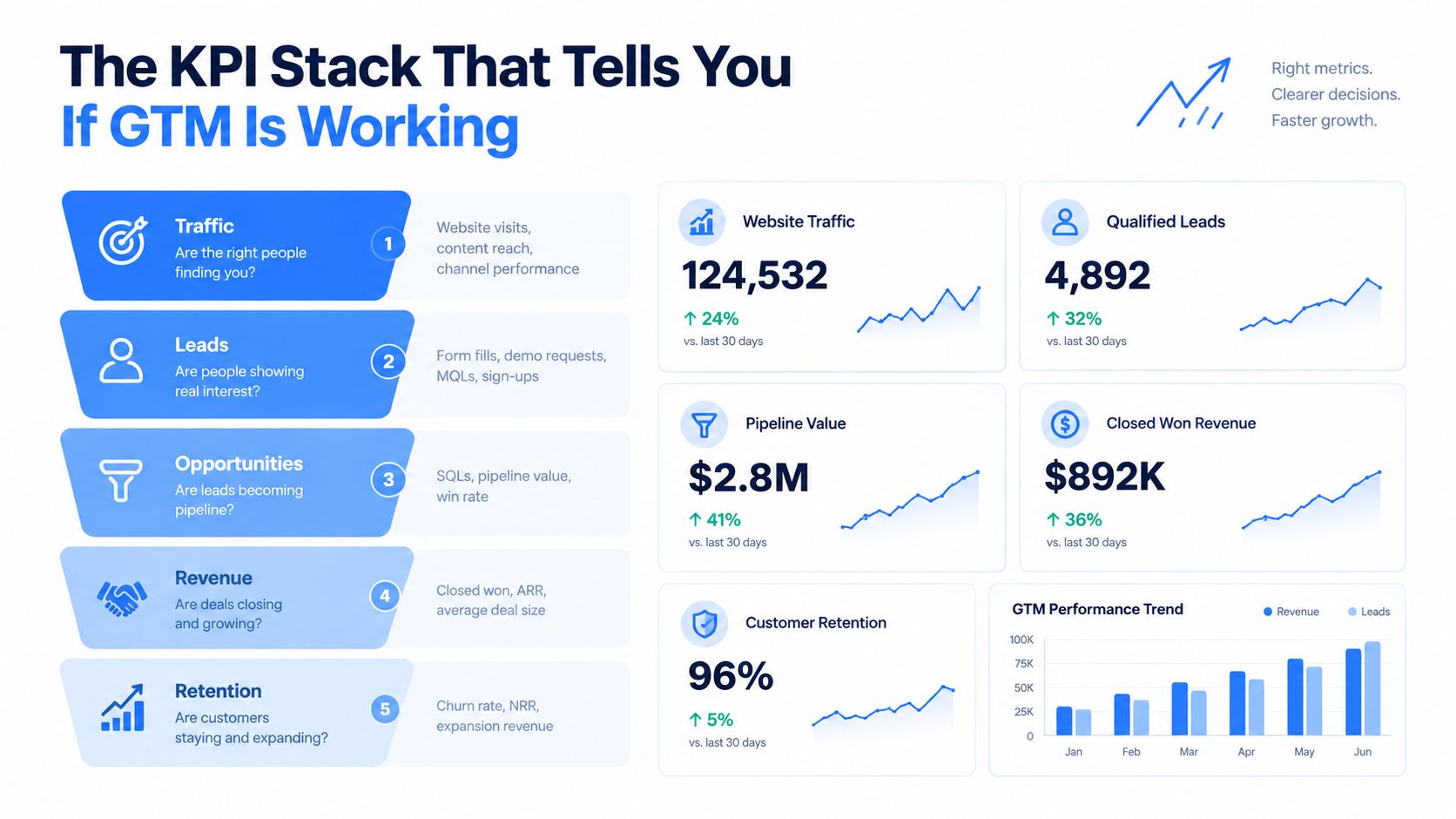
The KPI Stack That Tells You If GTM Is Working
A KPI stack should expose whether the revenue system is gaining strength. Leading indicators show near-term movement. Lagging indicators confirm durable revenue. Unit economics decide whether additional spending makes financial sense.
Choose leading indicators by motion. Product-led teams track activation and time to value. Sales-led teams track demo quality, qualified pipeline, and stage conversion. Creator-led teams track audience-to-offer conversion, reply rate, and cohort completion. Partner-led teams track partner-sourced opportunities and deal velocity.
Lagging indicators include ARR, retention, expansion, and churn. Track stage conversion, sales cycle length, CAC, LTV, and retention or churn across 30, 90, and 365-day windows. A dashboard earns its place only when it connects early behavior to durable revenue.
The number each motion must defend
Every motion needs one outcome it cannot explain away. A sales-led team must defend qualified pipeline moving to closed revenue. A product-led team must defend activation leading to retention. A partner-led team must defend partner-sourced ARR moving at a workable pace. A creator-led team must defend audience-to-qualified offer conversion.
For SaaS, common planning benchmarks include CAC payback under 18 months and LTV to CAC above 3x, as described in the GTM framework source from Zoomforth. Treat these as decision rules, not promises. If your business cannot calculate them, stop increasing spend until the measurement system works.
Two metrics often conceal a weak motion. Lead volume can rise while fit declines. Engagement can look healthy while buyers ignore the offer. For a creator-led or LinkedIn-first motion, an influencer ROI strategy must connect attention to qualified action, not applause.
Use attribution modeling to track sources and assign credit. Attribution cannot repair poor positioning or a weak channel, but it can give sales and marketing one structure for examining contribution instead of arguing over spreadsheets.
The Mistakes That Kill GTM Before Launch Day
The most expensive GTM error is treating the plan as a launch deck. The other mistakes are symptoms of the same problem, teams make decisions once, then stop operating the system.
The benchmark evidence is uncomfortable. Only 37% of B2B professionals define GTM as an integrated, cross functional revenue framework, while about 21% say their organization lacks a formal GTM strategy or clear ownership, according to GTM strategy statistics. Confusion about the definition becomes confusion about the work.
| Mistake | Symptom | Quick Diagnostic |
|---|---|---|
| ICP written by committee | Marketing and sales pursue different accounts | Compare the last closed won and closed lost accounts against the ICP |
| Pricing copied from competitors | Buyers question value or deals stall around price | Review objections and lost deals by buyer persona |
| Channel sprawl before fit | Several channels produce activity, few produce qualified action | Pause every channel without a named test owner |
| Sales motion chosen for prestige | Large targets appear in the CRM, but pipeline stays thin | Review qualification quality and stage movement |
| Onboarding ignored | New customers buy, then fail to reach first value | Inspect activation steps and early support requests |
| No GTM owner | Meetings produce updates, not decisions | Ask one person who can change the plan this week |
The pre mortem
For the committee built ICP, interview recent wins and losses before rewriting the profile. For copied pricing, run a pricing conversation with real buyers and document the value they recognize. For channel sprawl, keep one primary test and stop the rest until evidence earns more budget.
For a prestige driven sales motion, inspect whether the buyer needs human help. If not, a self serve path may be cheaper. If yes, assign the sales process and proof assets required. Do not force a product led experience onto a complex purchase, or a sales led process onto a simple one.
Onboarding deserves the same attention as acquisition. Define activation before launch, then give customer success a clear intervention path. A customer who never reaches value is not a retention mystery. The team skipped a mechanic.
No owner means no operating system. Assign one person to maintain the plan, run the review cadence, update decisions, and surface trade offs. Mistakes are usually drift, not bad luck. The pre mortem catches drift while it is still cheap.
Your 30 Day GTM Adoption Checklist
A founder can install the operating system without turning the company into a meeting factory. The first month should create decisions, ownership, evidence, and a review habit.
Week one
Audit the ICP and value proposition against closed won, closed lost, and recent buyer language. Write the seven mechanics in one working document. Put a named owner beside each one, including the mechanics founders usually leave floating between product, sales, and customer success.
Week two
Choose one primary motion and one supporting motion. Run a single channel test that fits the ICP. Review pricing with the buyer personas in mind, then document the reason each tier exists. If nobody can explain the difference between tiers in plain language, the packaging isn't ready.
Week three
Instrument the KPI stack. Define CAC, payback period, stage conversion, activation, and one retention window that matches the motion. Use the measurement definitions from the 2026 state of B2B GTM study, which surveyed 511 B2B professionals in the United States and the United Kingdom.
Week four
Run a launch dry run. Check the message, handoffs, product path, support readiness, reporting, and owner decisions. Set a review cadence and a kill criterion before the team gets emotionally attached to a weak channel.
A GTM operating system is alive when the team can connect acquisition cost, activation, retention, and payback without heroic spreadsheet work. The final checklist calls for a payback period under 12 months paired with a steady activation rate. That is a useful internal standard for repeatable revenue, but don't declare victory from one promising week. Review the pattern and keep the owner accountable.
ViralBrain helps founders and GTM teams turn proven LinkedIn post patterns into drafts for their topic and voice, then refine them with hooks, suggestions, repurposing tools, and analytics. If LinkedIn is part of your creator led or sales supported GTM motion, visit ViralBrain and use it to build a repeatable content and feedback loop.
Grow your LinkedIn to the next level.
Use ViralBrain to analyze top creators and create posts that perform.
Try ViralBrain free