
Authentic Content Creation That Earns Trust on LinkedIn
Learn authentic content creation that builds trust and engagement on LinkedIn with voice, hooks, formats and data backed iteration using ViralBrain.
Grow your LinkedIn to the next level.
Use ViralBrain to analyze top creators and create posts that perform.
Try ViralBrain free90% of consumers say authenticity matters when choosing brands, while user generated content is perceived as 2.4 times more authentic than brand created content, according to independent consumer research on authenticity and content performance.
That changes the job.
Authentic content creation isn't about sounding casual, confessing your breakfast, or adding a shaky selfie to every post. It's about giving people signals they can verify. A clear point of view. Real process. Honest limits. Consistent language. Proof that a person made the judgment behind the post.
LinkedIn rewards useful thinking, but it also exposes borrowed voices quickly. A polished post with no lived detail feels like office wallpaper. Nobody saves office wallpaper.
Why Authentic Content Creation Wins Trust Now
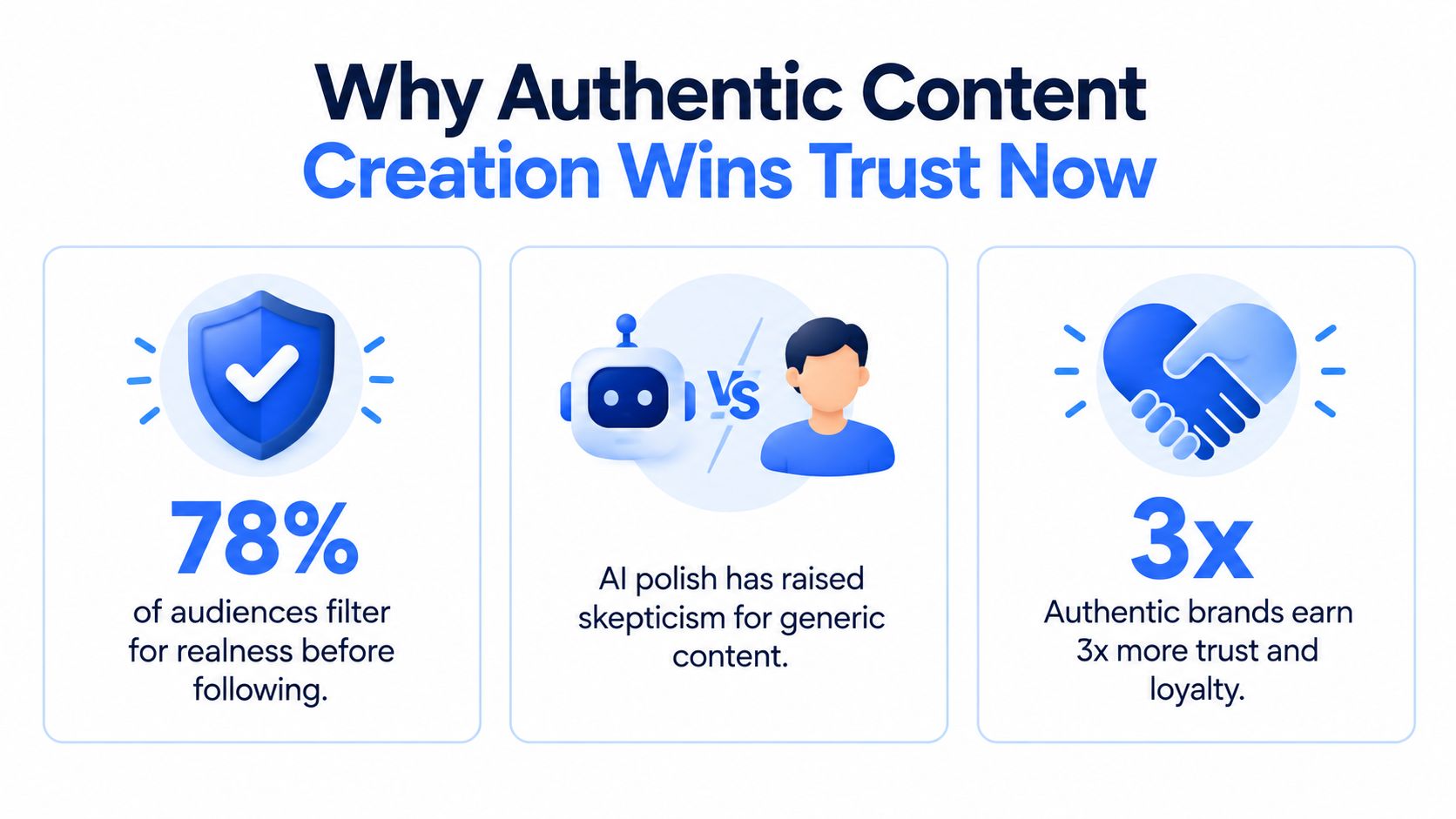
Trust in online content is under pressure. A 2024 UK survey found that 81% of respondents were worried about the trustworthiness of online content, while a 2025 global trust report found that 69% of consumers were more skeptical because of AI generated fraud than they had been the year before. Those figures come from YouGov's research on labeling AI generated and digitally altered content.
Audiences don't inspect every post like forensic analysts. They use shortcuts. Does this sound like a person? Can I check the claim? Does the writer show how they reached the conclusion? Is the disclosure plain? Does the point match what they usually publish?
The Ipsos study gives the clearest signal. 72% of consumers say authenticity matters before deciding to follow a creator. In text and audio formats, the figure rises to 82%, compared with 73% for image and video audiences. The research covered 18 creators across beauty, tech, gaming, fitness, food, and lifestyle, with mean authenticity scores ranging from 6.2 to 7.5 on a 10 point scale. That narrow range suggests authenticity has become a baseline expectation, not a rare talent reserved for a few charming internet people. See the Ipsos study on creator authenticity.
Authenticity has more than one job
Most advice says “be real” and stops there. That's lazy advice.
Current research separates authenticity into distinct facets such as truthfulness, internal authenticity, ordinariness, and relatability. Earlier work on social media influencers identified dimensions including sincerity, truthful endorsements, visibility, expertise, and uniqueness, as discussed in research on multidimensional influencer authenticity.
For a LinkedIn creator, those signals work differently.
Truthfulness means the claim matches the evidence. Relatability means the reader recognizes the problem. Ordinariness means you don't present every decision as flawless. Transparency means you explain sponsorships, incentives, edits, or uncertainty.
The two most common words consumers used to define authenticity in the Ipsos research were transparent communication and relatable personality, each selected by 42% of respondents. That gives creators a practical filter. A post needs more than a smooth sentence. It needs a recognizable person and a visible reason to trust the sentence.
Polish without proof is a weak trade
AI makes generic positivity easy to produce. It can make every lesson sound neat, every failure sound useful, and every conclusion sound strangely certain. That smoothness can hurt you because audiences have learned to look for the missing human parts.
A 2026 survey found that 66% of consumers trusted search engine results as a top authenticity signal, 63% trusted user generated content, and 31% distrusted AI generated content entirely, according to Emplifi's survey on digital authenticity and AI.
Practical rule: Show the source, the decision, or the limitation. Ideally, show more than one.
Even profile presentation plays a role. If your photo looks like a corporate clone, your writing has to work harder. For a useful visual reference, compare your profile image with these trustworthy LinkedIn photo examples. The point isn't to look casual. The point is to look like the same person who wrote the post.
Define Your Voice Values and Proof Points
Voice isn't a collection of adjectives. “Warm, bold, insightful” tells you almost nothing. Every consultant has those words. Half the internet has them printed on a mug.
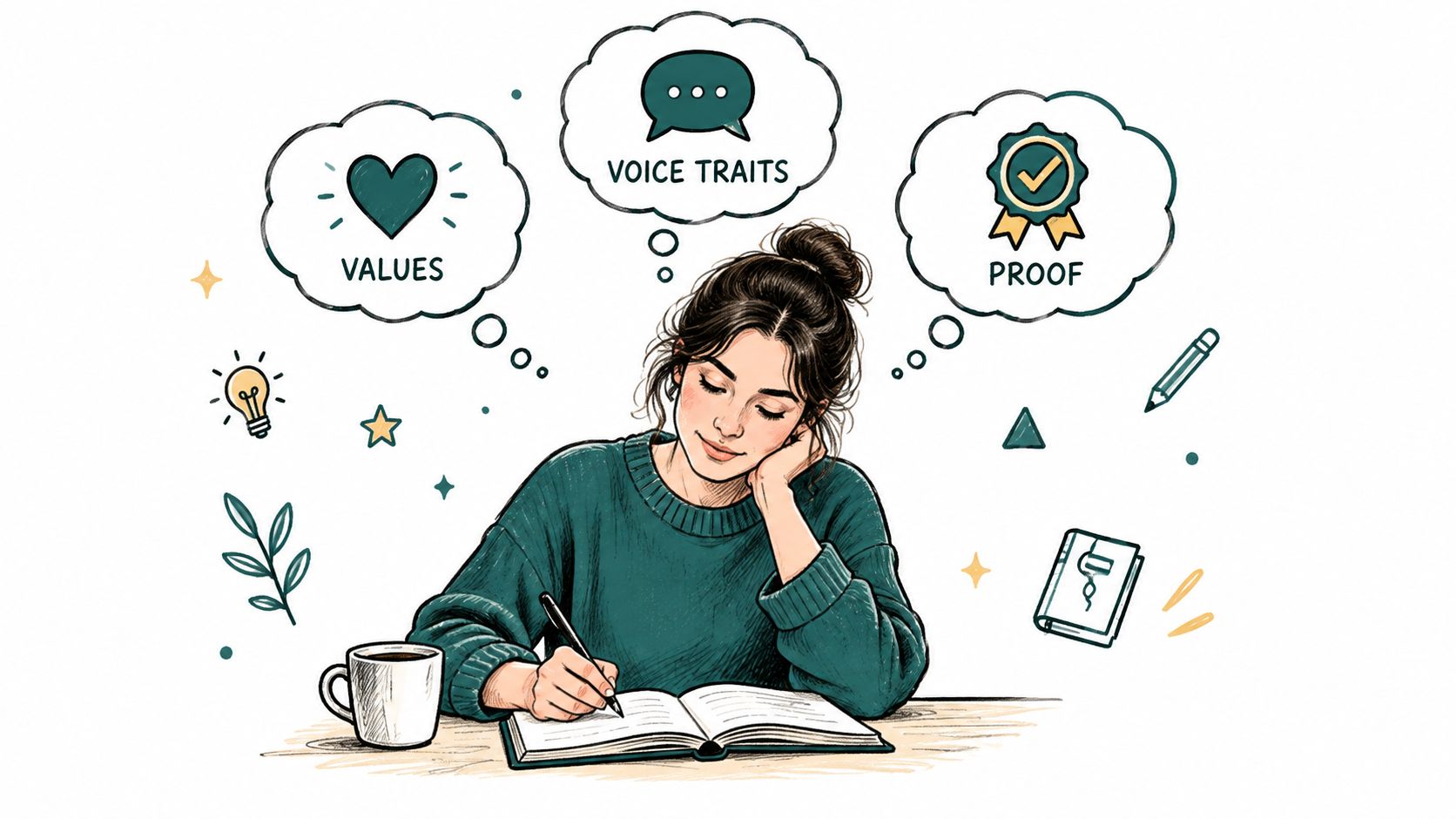
A usable voice brief needs three parts: how you sound, what you refuse to fake, and what evidence you can bring to a claim.
Build a one page voice brief
Start with a sentence you could say aloud to a client. Record it if needed. Then write down the words you naturally use, the sentence lengths you prefer, and the kind of humor you can carry without sounding like a brand account trying to be funny.
Your brief should answer these prompts.
- Voice: Are your sentences blunt, reflective, technical, playful, or patient?
- Values: Which trade offs matter to you? Speed over polish? Clarity over cleverness? Evidence over certainty?
- Boundaries: What won't you share? Which subjects need more proof before you publish?
- Proof points: What have you observed, built, tested, fixed, shipped, or learned?
- Reader promise: What should a reader reliably get from your posts?
Proof points don't need to be dramatic. A failed onboarding call can support a useful lesson. A customer objection can reveal a positioning problem. A spreadsheet can expose a bad assumption. Specificity beats theatre.
A strong post might say, “Three prospects asked the same question after the demo, so we rewrote the opening.” A weak post says, “Customer feedback is essential for growth.” The second sentence is safe. It also has the pulse of a damp paper towel.
Keep monetization visible
Academic research in 2024 described a persistent creator's dilemma, the tension between staying authentic while monetizing attention through sponsorships and branded partnerships. The research on the creator's dilemma connects the problem to the shift from informal posting toward professional content businesses.
The fix isn't pretending commercial motives don't exist. The fix is making them legible.
Disclose a partnership in plain language. Explain why you accepted it. Keep your normal vocabulary. Don't praise a product you wouldn't use without payment. Don't let a sponsor rewrite your opinion until the post sounds like it was assembled by three committees and a nervous parrot.
For brand identity work, a practical reference such as service business website design can help you separate visual consistency from personal voice. Your page can look coherent without forcing every sentence into the same template.
Use tools to preserve a voice, not replace one
A tool can compare your drafts with writing you approve. It can flag repeated phrases, soften accidental jargon, or suggest structures that fit your usual rhythm. It can't supply your judgment.
ViralBrain can analyze selected creator patterns, apply tone personalization, surface hooks, and help adapt a draft for LinkedIn. Treat that output as a rough assistant. Keep the claim, example, caveat, and final edit grounded in your own experience.
Use the guide to finding your voice as a working exercise. Write a short voice brief before you build a large content library. Otherwise, the library will faithfully preserve your confusion. Very efficient. Still confusion.
Hook and Structure Recipes That Feel Human
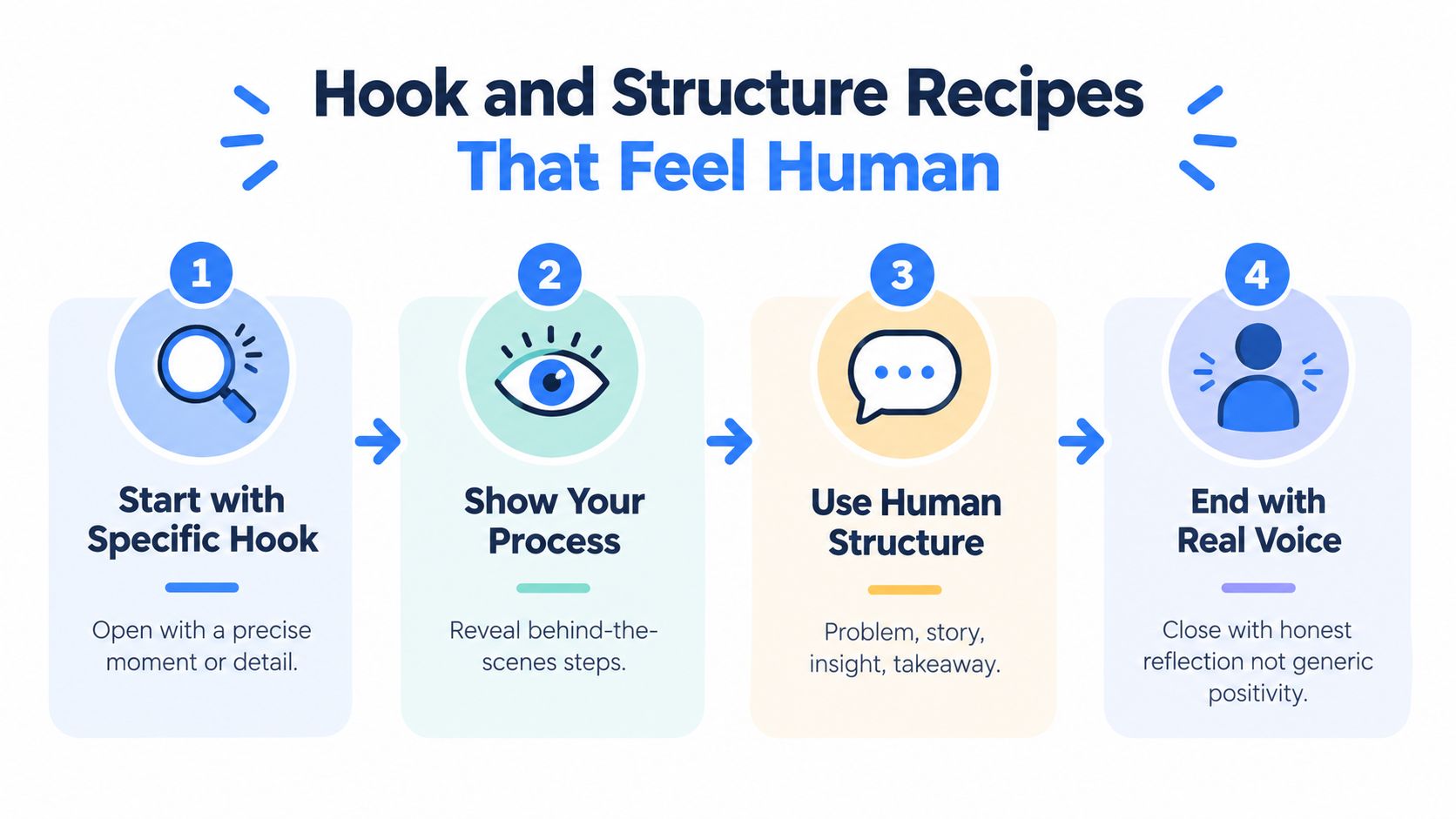
A human hook gives the reader a reason to believe the post has somewhere specific to go. It doesn't need drama. It needs a detail that generic content couldn't have produced.
LinkedIn format choice matters too. An analysis of 1.3 million posts found average engagement rates of 7.00% for native document posts, 6.45% for multi image posts, 4.50% for text only posts, and 3.25% for link posts, according to LinkedIn content format analysis from ContentIn. The same analysis reported that document and carousel posts generated 39% more reach and 30% more engagement than the average post.
That doesn't mean every idea deserves a carousel. It means format should follow the job.
Recipe one for a text post
Use this structure when the insight fits in one clean argument.
Hook: State a specific observation.
Tension: Explain what many get wrong.
Evidence: Show the decision, example, or process behind your view.
Takeaway: Give one action the reader can use.
Example:
Our best sales post started with a failed demo, not a success story.
Then explain what happened. Show the mistaken assumption. Share the change you made. Finish with the lesson.
The guide to making a good hook can help you generate openings, but don't accept the first polished line. Replace broad claims with a detail from your work.
Recipe two for a document post
Documents work well when the idea has stages, contrasts, or a process someone may save. Use one thought per page. Keep the opening page plain.
Page one states the problem. Page two shows the common mistake. The middle pages reveal your process. The final page gives a short checklist or decision rule.
A useful prompt is:
“Turn this lesson into a document for a busy B2B marketer. Keep the example concrete. Show the original assumption, the change, and the reason for the change. Remove generic advice.”
Don't stuff ten lessons into one file. That's not generosity. That's a filing cabinet falling down the stairs.
Recipe three for a multi image post
Use multiple images when the reader needs comparison.
Image one presents the before state. Image two shows the revised version. Image three explains the choice. Image four gives the principle.
For example, a founder could show an old landing page headline, the customer objection behind it, the revised headline, and the rule used to choose it. The content becomes useful because the reader sees the work, not just the verdict.
Before publishing, check four things.
- Specificity: Could another creator have written this without your experience?
- Process: Did you show at least one decision or constraint?
- Voice: Does the post sound like your approved samples?
- Ending: Does the final line reflect a real conclusion instead of “Keep going”?
A short video can reinforce the same craft principles when you need a visual walkthrough.
Repurpose Without Losing What Makes You Real
Repurposing saves time only when it preserves judgment. Copying a transcript into a LinkedIn post isn't a workflow. It's a content accident with punctuation.
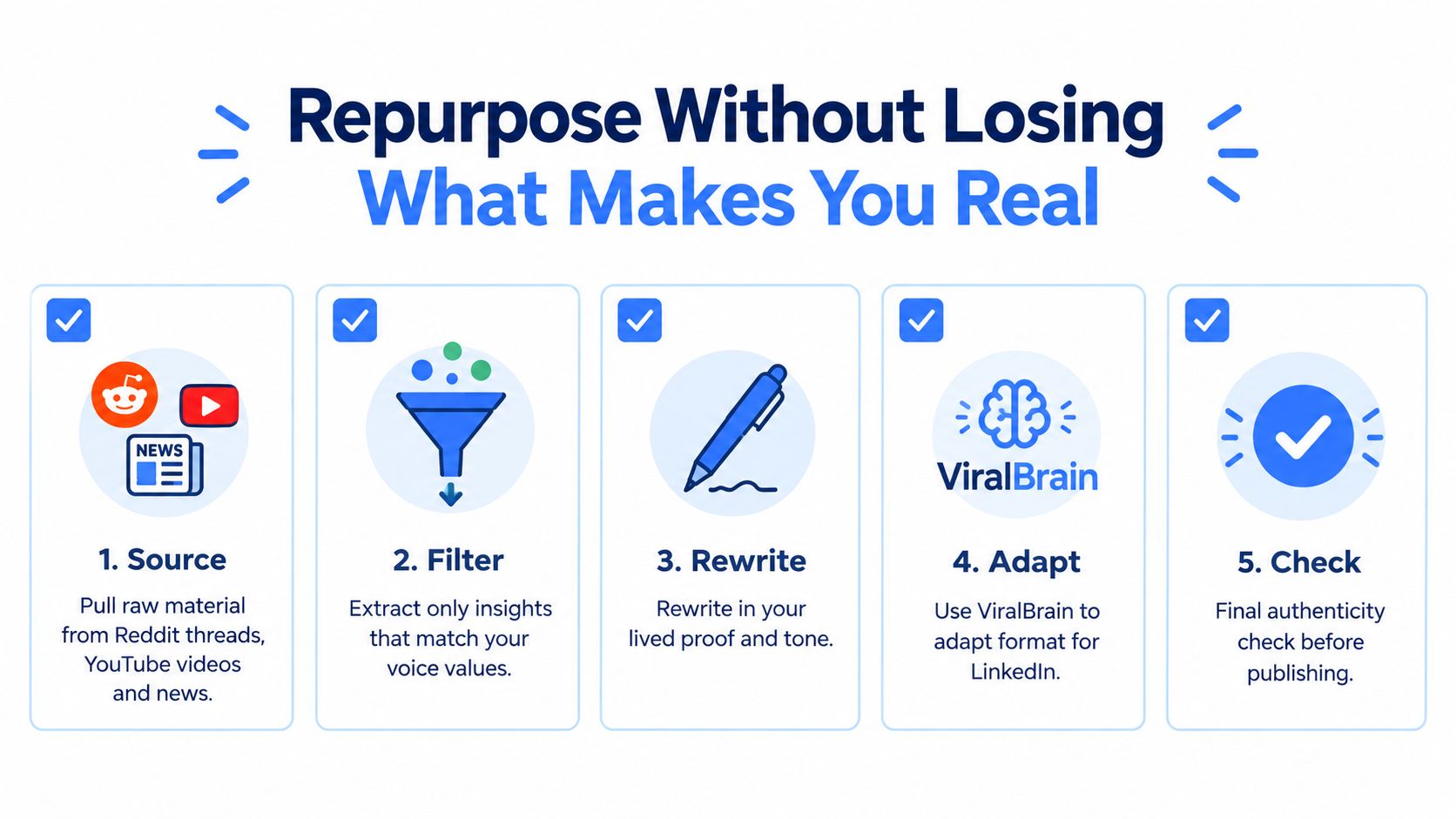
The raw material can come from Reddit threads, YouTube videos, news, customer calls, or your own notes. Each source has a different strength. Reddit often exposes language people use when they aren't trying to sound strategic. YouTube gives you a longer chain of reasoning. News gives you a timely event to interpret. Your own notes provide the part no tool can manufacture, your position.
Keep the source, change the job
Don't ask, “How do I turn this video into a post?” Ask, “What can this source help my reader decide?”
A Reddit discussion may become a post about customer language. A YouTube interview may become a breakdown of one operating choice. A news story may become a correction to a common assumption. The source supplies context. You supply selection and meaning.
A practical repurposing sequence looks like this.
- Collect raw material: Save the thread, video, article, or note with its original attribution.
- Extract one idea: Ignore the temptation to publish the whole source in smaller pieces.
- Add your position: State what you agree with, reject, or still don't know.
- Attach lived proof: Add an observation, example, constraint, or failed attempt from your work.
- Adapt the format: Choose text, document, or multi image based on how the reader needs to use the idea.
- Check the boundary: Confirm that the post doesn't imply you conducted the original research or had the original experience.
The content repurposing strategies guide can support the adaptation stage. ViralBrain's repurposing agents can help turn material from Reddit, YouTube, news, articles, and other sources into LinkedIn drafts shaped around a selected voice. The human edit still decides what the source means.
Automate the mechanical parts
Automation can handle transcription, extraction, headline variations, format changes, and first draft structure. Those are useful jobs because they reduce repetitive work.
Keep these parts personal.
Your anecdote must be yours. Your uncertainty must be accurate. Your limits must stay visible. Your conclusion needs to reflect a belief you can defend when someone challenges it in the comments.
If the source provides the information, you provide the accountability.
Run a final check before publishing. Can you name the original source? Did you add a genuine interpretation? Did you remove details you can't verify? Would the post still sound like you if the tool vanished tomorrow?
If the answer to the last question is no, the tool has become the author. That isn't efficient. That's identity outsourcing.
Measure What Matters and Iterate With Data
Authentic content creation needs measurement. Otherwise, “this feels like me” becomes permission to ignore weak ideas, unclear structure, or a message readers did not understand.
Likes count recognition. Saves show future use. Shares suggest social or identity value. Comments reveal whether people understood the idea, challenged it, or wanted more detail. Treat these as signals of truthfulness, relatability, and transparency, not as a single popularity score.
UGC provides a useful LinkedIn translation. Its trust signal belongs in specific proof points: a customer phrase in a document post, a user problem as the opening hook, or a text post built around what changed after implementation. Independent research on authenticity and UGC performance supports that direction. Use customer language and visible evidence where brand-heavy copy would otherwise make a broad claim.
Build a small review dashboard
| Metric | What It Signals | How To Use It |
|---|---|---|
| Saves | Practical value or future reference | Compare saved posts by topic and format |
| Shares | Social usefulness or identity value | Read who shared and what context they added |
| Comments | Understanding, disagreement, or confusion | Separate detailed responses from simple approval |
| Comment quality | Depth of reader involvement | Record recurring objections and phrases |
| Likes | Immediate recognition | Treat as supporting context, not the verdict |
| Source clicks | Interest in the evidence or next step | Check whether the source matches the promise |
Review patterns, not one lucky result. Which hooks produced thoughtful comments? Which topics earned saves? Did a document post explain a process more clearly than a text post? Did a stated limitation invite better discussion than a confident claim?
Use an evidence stack
A credible thought-leadership method can begin with a focused survey of about 75 to 100 respondents, followed by 5 to 8 structured expert interviews, then comparison with client data or benchmarks, according to research on transparent content methodology.
Small samples can reveal patterns. They cannot support fake precision. Keep surveys focused instead of adding unnecessary demographic questions or piles of open text boxes. Disclose how you collected the evidence. Readers do not need a laboratory report for every LinkedIn post, but they do need to know whether you are sharing an observation or making a broader claim.
Review weekly. Change one variable at a time when possible. If the hook, format, topic, and call to action all change together, the result teaches you very little. Use ViralBrain to compare format or hook patterns, then make the final choice from your evidence and audience context. Analytics should clarify the next decision, not create a prettier pile of numbers.
Your Authentic Content Creation System for LinkedIn
A sustainable system has five working parts.
Your voice brief defines how you speak. Your proof bank stores examples, observations, objections, and decisions. Your hook library gives you starting points without forcing recycled phrasing. Your format rules match ideas to text, documents, or images. Your review habit turns performance into better choices.
Keep the system small enough to use.
A practical weekly cadence
On the first workday, collect source material and add two observations from your own work. On the next day, choose one idea and write three hooks. Pick the hook with the clearest detail, not the loudest promise.
Then draft the post in plain language. Use a tool such as ViralBrain to compare patterns, personalize tone, adapt a source, or surface structural suggestions, but keep your proof and final judgment personal. Read the draft aloud. The sentence that makes you cringe is often the sentence trying too hard.
Before publishing, check:
- Truthfulness: Can you support every factual claim?
- Relatability: Does the reader recognize a real problem?
- Transparency: Have you disclosed incentives, sources, or uncertainty?
- Ordinariness: Did you leave room for limits or imperfection?
- Format fit: Does the chosen format help the reader use the idea?
- Voice fit: Would a client recognize the author?
AI era content makes generic positivity cheap. Specific detail remains harder to fake. Process visibility remains useful. A clear limit often earns more trust than another sentence about excellence.
Don't reduce authenticity to oversharing. Professional authenticity can mean showing expertise, explaining a trade off, naming a mistake, or refusing to claim more than the evidence supports. That's enough. You don't need to turn your private life into a content calendar.
Start next week with one post built from a real observation, one source you can name, and one conclusion you can defend. Measure saves, shares, and comment quality. Then change the system based on what readers do, not on what your vanity hoped they'd do.
ViralBrain helps you analyze creator patterns, personalize drafts to your voice, repurpose Reddit, YouTube, news, and other sources, then refine LinkedIn posts with hooks, suggestions, profile tools, and analytics. Visit ViralBrain to build a faster publishing workflow without handing over the parts that make your content yours.
Grow your LinkedIn to the next level.
Use ViralBrain to analyze top creators and create posts that perform.
Try ViralBrain free