
Comment for Better Reach on LinkedIn That Actually Works
Learn how to comment for better reach on LinkedIn with proven tactics, real examples, and a 30-day playbook that turns replies into profile views and leads.
Grow your LinkedIn to the next level.
Use ViralBrain to analyze top creators and create posts that perform.
Try ViralBrain freeThe most popular LinkedIn commenting advice is to leave more comments. That's a tidy way to fill a calendar with work nobody asked for. If you want to comment for better reach, start by choosing better conversations, then give people a reason to answer.
Short, empty comments waste the chance to show what you know. But don't confuse that with a documented penalty for brevity. A useful sentence can do more than a paragraph of polite fog.
Why Most Comment Advice on LinkedIn Is Backwards
Counting comments is easy. Judging whether they reached a potential buyer takes work. That's why I'd choose 10 relevant comments over 50 hollow ones as a working rule, not a promised performance ratio.
LinkedIn says engagement quality depends on who interacts, not just how much activity a post receives. Its example distinguishes relevant marketing professionals engaging with a marketing post from repeated activity by people without professional relevance, according to its explanation of feed relevance.
That's a poor foundation for the usual volume contest. You can finish a busy commenting session without giving anyone a useful reason to remember you.
Replace activity targets with audience targets
Before you write, name the people you want to reach. A founder looking for finance buyers needs a different set of conversations from a recruiter building relationships with engineers.
Then define a useful outcome. An author's reply might matter. A profile visit from a target account might matter more. A qualified conversation gives you something stronger than a screenshot of impressions.
A comment quota tells you whether you typed. It doesn't tell you whether the right person cared.
For a sales team connecting public discussion with prospecting, Ever Outbound Inc.’s resource on LinkedIn appointment setting for B2B belongs alongside the commenting plan. Keep the distinction clear. Participating in a public thread doesn't earn you permission to send an immediate pitch.
Stop treating praise as a strategy
“Great post” can be sincere. It's still a weak business development plan.
Empty praise offers little for the author to answer and little for a reader to evaluate. My recommendation is blunt. If your comment could sit under almost any post, rewrite it or leave a reaction instead.
Don't manufacture disagreement to appear interesting, either. Choose a point you can extend, clarify, or challenge with a reason. Professional relevance comes before writing cleverness.
How the LinkedIn Feed Decides Who Sees Your Comment
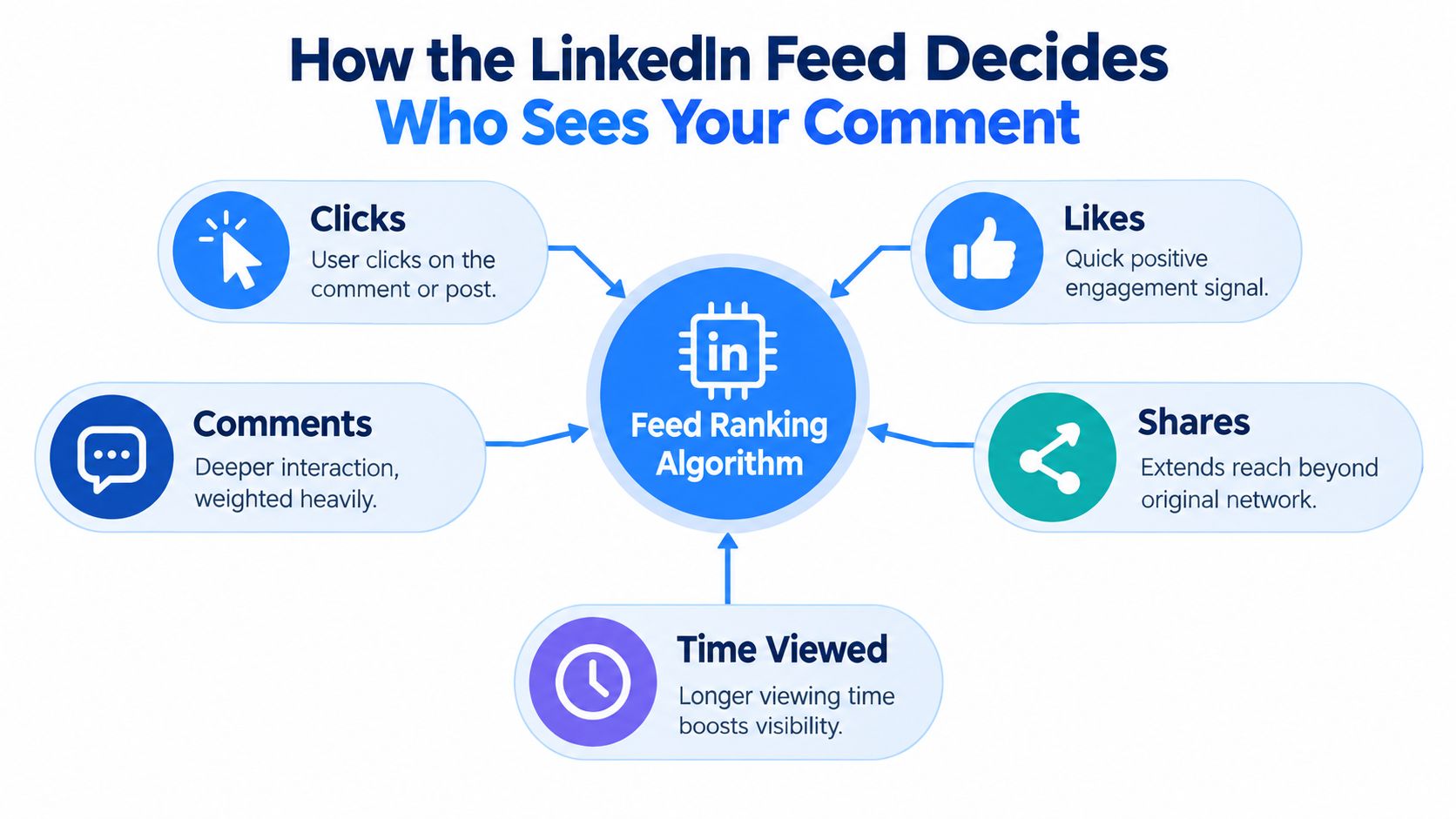
LinkedIn's engineering team lists clicks, likes, comments, shares, and time viewed among the actions its feed systems track. It describes relationship signals and ranking stages that combine into a personalized feed, rather than a public scoreboard where every interaction has an identical value, in its feed engineering overview.
The diagram maps those inputs at a high level.
Use the mechanics without inventing weights
The public explanation doesn't give you a dependable formula for calculating a comment's reach. Don't turn it into one.
Nor should you assume that evidence about post ranking fully explains the order of replies inside a thread. A comment can contribute to a discussion without receiving broad distribution itself.
The practical decision is where to participate. Consider the relationship between your work, the author's subject, and the people already responding. Previous conversations and visible professional overlap are useful selection clues, not confirmed ranking multipliers.
Treat feed mechanics as a filter for your effort, not a promise of distribution.
Check the professional fit
A crowded discussion about a topic outside your expertise offers plenty of possible readers. It may offer very few relevant readers.
A narrower discussion can be worth your time when you understand the problem and can help someone think through it. That's an editorial recommendation, not a claim that small accounts always outperform large ones.
Use the guide to LinkedIn algorithm changes for additional context. Keep your operating rule simpler than the documentation. Choose a conversation you can improve, then judge the response you receive.
Pick the Right Posts Before You Write a Word
Open the replies before opening the comment box. The headline tells you what the author wants to discuss. The thread tells you what people still need.
Use this visual as a reminder to inspect the conversation rather than just the post.

Build a shortlist worth reading
Start with authors whose readers overlap with your market. Check the actual replies instead of assuming the author's audience matches the people you want.
Look for a practical problem, an unanswered question, or a claim that needs a boundary. Read the full post and several replies before deciding what's missing. Otherwise, you risk arriving late to repeat the person directly above you.
- Audience fit means relevant people are visibly participating, not merely that the author has a large following.
- Topic fit means you can contribute from your knowledge, work, or verifiable evidence.
- Thread health means people are exchanging ideas rather than collecting acknowledgments.
- An open angle gives you something useful to add without redirecting the discussion toward yourself.
A shortlist of five to ten posts is a proposed routine, not a daily quota. Some days, fewer deserve your attention. The internet will survive your absence from the others.
Skip attractive distractions
Reject a post when the audience is irrelevant. Skip it when you have no real angle, when your contribution already appears in the thread, or when participating would require pretending to know more than you do.
Those are separate problems. Don't solve any of them by writing longer.
For a post about sales handoffs, a useful opening might identify a missing owner between the first call and the next meeting. Follow that observation with a question about how the author assigns responsibility.
That gives the author a specific issue to answer. It gives readers a clearer view of your judgment. Choose the gap before writing the hook.
Comment Formats That Actually Earn Replies
Use a concrete observation followed by a focused question as your default. Change the format when the discussion calls for evidence, a correction, or a simple acknowledgment.
Don't assign universal reply rates to comment formats. The author, audience, topic, and wording change the result. The table below gives editorial expectations to test, not measured benchmarks.
Comment Formats Compared on LinkedIn Reach Signals
| Format | Reply rate | Thread depth | Profile visits | Best for |
|---|---|---|---|---|
| Short reaction | Little reason to reply | Usually closes the exchange | Weak reason to investigate | Sincere acknowledgment |
| Specific example | Gives the author something concrete to address | Can support practical follow ups | Demonstrates applied knowledge | Advice and process posts |
| Respectful counterpoint | Invites clarification when well supported | Can expose useful limits | Makes your reasoning visible | Broad claims with exceptions |
| Open question | Depends on relevance and specificity | Can develop through answers | Limited without your own insight | A genuine gap in the post |
| Customer evidence | Gives readers evidence to examine | Can prompt questions about context | Demonstrates relevant experience | Claims you can substantiate |
A 2025 study of 991 LinkedIn posts found that tags significantly increased expected comments, while hashtags and tags increased reactions. It found interdependence among comments, reactions, and reposts, but didn't establish a winning comment template, according to the peer reviewed analysis of LinkedIn engagement.
Mention someone when their expertise belongs in the discussion. Don't tag a collection of acquaintances and call it distribution.
Write something answerable
Consider this illustrative comment on a sales process post.
The handoff needs a named owner before the prospect leaves the call. When ownership stays shared, the next action can stay unclear. How do you assign responsibility?
It identifies a mechanism and asks about a specific decision. The question belongs to the observation instead of arriving as a decorative ending.
A counterpoint should name the condition where advice stops working. Customer evidence needs real permission, context, and a result you can substantiate. Don't borrow a customer's credibility to dress up an opinion.
When someone answers, continue the substance. Acknowledge their point, add information, and ask a narrower follow up if needed. The guide to responding to comments can help structure that exchange without making every response sound identical.
A Time Zone Playbook for Global B2B Teams
Consider a hypothetical SaaS founder selling to people in New York, London, and Singapore. Their current habit is to comment whenever they finish writing their own post. That schedule follows the founder's convenience, not the buyers' availability.
Keep research separate from participation. A content research workspace can help prepare angles before the founder opens LinkedIn.
Plan around availability, then test it
I'd give this founder a proposed 20 minute daily budget across research, participation, and follow up. That's a scheduling choice, not a proven optimum. Split the work across local windows only when it fits the team's working day.
| Window | Proposed task | What to observe |
|---|---|---|
| Singapore working hours | Review relevant regional conversations | Whether target buyers participate |
| London working hours | Add an original contribution to a selected post | Whether the author or relevant readers answer |
| New York working hours | Continue an existing substantive thread | Whether the exchange develops into a useful conversation |
Rotate responsibility across the week if nobody can cover every window. Nobody needs to become the night watchman of the comment section.
Research hooks before these sessions. Save the question a post raises, the missing condition, or the example you can substantiate. Don't copy another creator's opening and pretend it's your experience.
Use the video as a separate viewing resource.
Separate speed from the outcome
Reported timing analyses measure different things, including post reach and comment reply rates. Their methods aren't sufficiently clear to support a universal deadline, as the discussion of comment timing evidence illustrates.
Test buyer availability instead. Add a new comment when you have an original contribution. Reply inside an existing thread when your point depends on that exchange.
Coordinate coverage, not applause. Share relevant discussions with colleagues, but don't require everyone to comment. A team calendar should organize attention, not manufacture agreement.
Measure What Matters in 30 Days
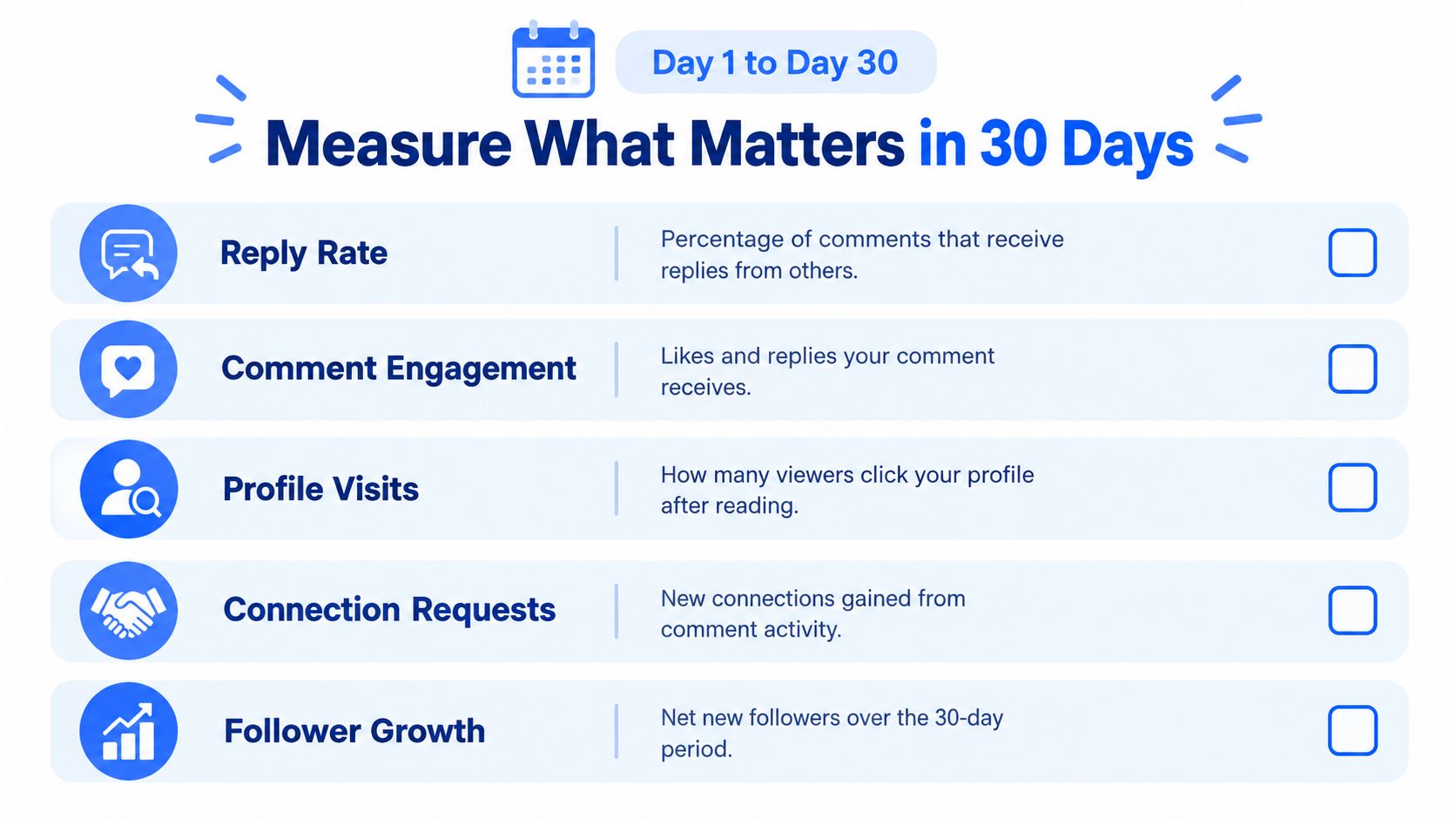
Run a 30 day test, but treat it as a practical comparison rather than a controlled experiment. Record the activity and the outcome separately. Otherwise, a busy week can look productive by default.
Use this checklist to keep the main signals visible.
Establish a baseline you can compare
As a proposed schedule, record your current routine for the first ten days. Use the remaining twenty to apply the more selective approach. Keep your own posting frequency and topic mix similar, and log unusual events that could affect results.
The LinkedIn post analytics guide provides additional measurement context. Don't mistake an account level increase in profile views for proof that a particular comment caused it.
| Spreadsheet field | Recording rule |
|---|---|
| Post and comment | Save the discussion and your contribution |
| Format and timing | Note the approach and audience's local window |
| Reply rate | Divide comments receiving replies by comments written |
| Substantive responses | Separate useful answers from acknowledgments |
| Thread depth | Record continued exchanges |
| Returning participants | Note people who come back |
| Profile views | Record available identity information without guessing |
| Connections and conversations | Log accepted requests, qualified discussions, and meetings |
Use your baseline instead of borrowed targets
Buffer analysis summarized by NetInfluencer reported that 83% of LinkedIn profiles performed better on posts where the account replied to comments, while explicitly warning that the observational findings don't establish causality. That supports testing replies on your own posts, not promising the same result from outbound commenting, according to the report on replying and engagement.
More replies are useful only when the people and conversations matter to your objective.
Don't invent a universal target range for qualified conversations. Compare against your baseline. Continue formats that produce relevant exchanges, revise those that attract the wrong audience, and stop those that consume time without useful responses.
Five Rules to Pin to Your LinkedIn Routine
Keep a short operating checklist. You need something you'll use before opening the feed, not another document to admire.
- Go where buyers gather. Choose conversations by the people participating, not the size of the author's audience.
- Contribute a specific point. Give the reader an observation, example, or reasoned disagreement. Ask a focused question when you need an answer.
- Skip forced contributions. Silence beats pretending to have an angle. You don't owe every post a paragraph.
- Protect a small daily window. Reserve ten minutes as a starting habit rather than drifting through an hour. Expand deliberately if your measured results justify it.
- Review meaningful outcomes monthly. Watch relevant replies, identifiable profile views, and qualified conversations. Keep impressions in context.
Make the next session concrete
Choose a target niche, save a small set of relevant authors, and inspect their current discussions. Prepare your own angle before typing. After publishing, record the comment and return when someone adds substance.
To comment for better reach, spend less effort proving you were present. Spend more effort giving the right person something worth answering.
ViralBrain offers niche creator discovery, analysis of post hooks and structures, and drafts suited to your voice. Visit ViralBrain to research relevant creators and prepare discussion angles, then write comments grounded in what you know.
Grow your LinkedIn to the next level.
Use ViralBrain to analyze top creators and create posts that perform.
Try ViralBrain free