
8 Employee Advocacy Best Practices for LinkedIn
Use employee advocacy best practices to set goals, train contributors, measure results, manage risk, use AI tools, and build posts people want to share.
Grow your LinkedIn to the next level.
Use ViralBrain to analyze top creators and create posts that perform.
Try ViralBrain freeYour employees aren't a free ad channel. Give them bland copy, unclear rules, or pressure to post, and you won't get advocacy. You'll get silent employees, awkward reposts, and a content feed that sounds like it was approved by a committee of robots.
A useful program is voluntary distribution led by expertise. Employees share ideas, lessons, customer problems, and useful company content because it helps their audience, not because a manager is counting shares. The strongest programs combine simple tools, clear guidance, training, and measurement. A major 2024 to 2025 benchmark found that 61% of organizations rate employee advocacy as extremely or very important to business strategy, while 72% use a dedicated platform and 67% provide training and resources (benchmark report).
The eight practices below treat advocacy as a measurable content system. They connect hooks, topics, calls to action, audience response, posting speed, peer comparisons, structure, and repurposing to real program decisions. Likes matter less than saves, shares, profile visits, messages, leads, and useful replies. AI can help draft, test, personalize, and repurpose content, but people still need to check facts, voice, consent, privacy, permissions, conflicts, and disclosure.
1. Track Engagement Metrics by Content Hook Type
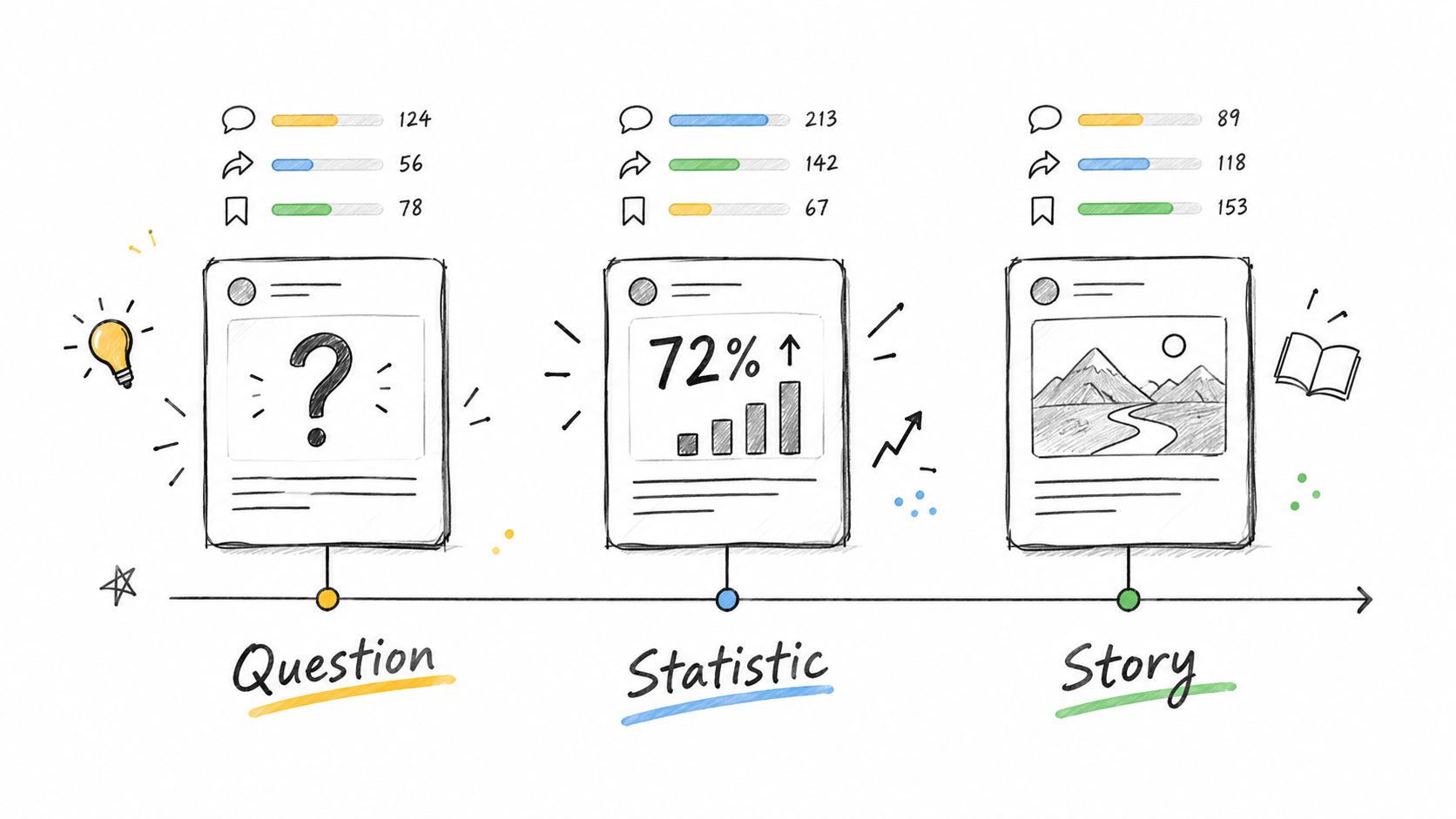
A question, a statistic, and a personal story invite different reactions. Treating them as one content category hides the useful part of your data. Sort recent posts by hook type, then compare the actions that matter to your goal.
Start with a spreadsheet. Log the hook, topic, reach, likes, comments, saves, and shares for 20 to 30 recent posts. The count comes from your own sample, not a universal benchmark. Use it to find patterns in your audience, not to manufacture a benchmark for everyone else.
Measure the actions people repeat
Saves suggest that someone expects to use the post later. Shares suggest that the idea is useful or credible enough to pass along. Likes are easy, so they belong in the record, but they shouldn't dominate the decision.
Test one hook type at a time. A SaaS founder might compare question hooks with contradiction hooks, then find that questions earn more saves. A B2B marketer might see a contrarian position beat generic industry advice. A sales professional might learn that curiosity based openings lead to more direct messages than product claims.
Use the same measurement window each week. Compare similar topics where possible, since a strong topic can make a weak hook look clever.
Practical rule: Keep the hook constant in your notes, but change only one variable in the next test. Otherwise, you're measuring soup.
Study proven opening patterns in this guide to LinkedIn hook examples, then compare your results with the reporting discipline used in B2B email analytics features. The tools differ, but the principle is the same. Record the event, define the useful action, and stop treating attention as one undifferentiated bucket.
2. Measure Call to Action Clarity Against Click Through Rates
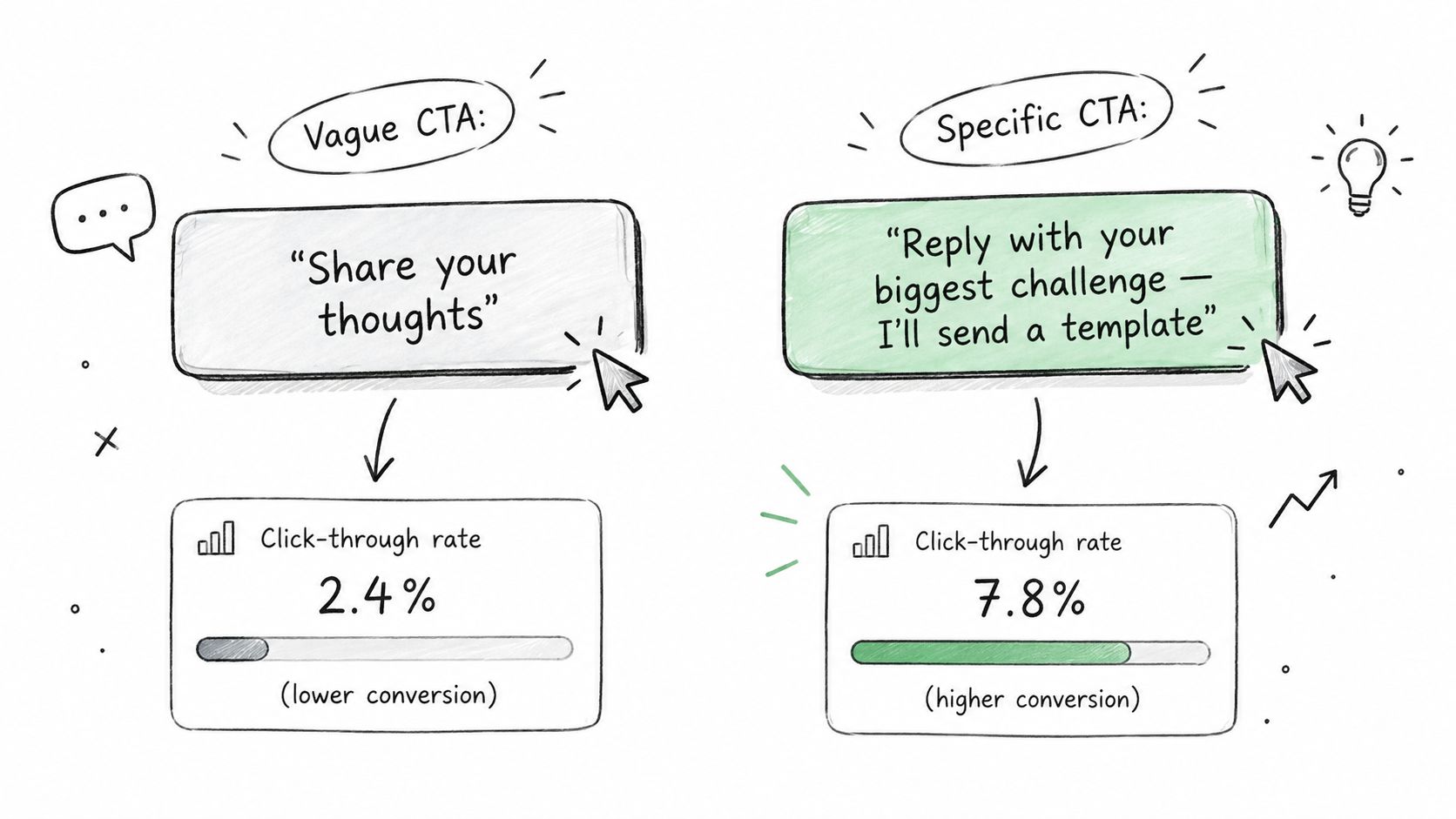
A vague call to action creates vague data. “Thoughts?” may collect polite comments, but it tells you little about what readers believe, need, or plan to do. A specific request gives people a smaller task and gives your team a cleaner signal.
Compare “share your thoughts” with “name one sales objection you hear most often.” Compare “learn more” with “send me the template.” The second version in each pair tells the reader what action to take. It also gives the employee a reason to start a conversation.
Separate response types
Don't combine comments, replies, direct messages, and clicks into one engagement total. A comment can show public interest. A message can show private intent. A click can show curiosity, but it doesn't prove buying intent.
Change one CTA while keeping the topic, format, and audience similar. Log the response type, response quality, and next action. If employees want leads, a high comment count may matter less than a smaller set of relevant messages. If they want community input, a simple question may be enough.
Practical CTAs include:
- Ask for one detail: “What would you change first?”
- Offer a useful asset: “Reply with the word framework and I'll send the template.”
- Use a low effort choice: “Which causes more trouble, unclear ownership or weak follow up?”
- Make the next step visible: “Read the full method, then tell me which part you'd test.”
Don't promise an incentive you can't deliver. If an employee offers a template, someone needs to have the template ready. Trust evaporates quickly when the CTA is bait.
Use this CTA performance metrics guide to structure your log, then review whether the response matches the business goal. A CTA isn't decoration at the bottom of a post. It's the measurement point that tells you what the post was built to do.
3. Benchmark Your Performance Against Creator Peer Groups
A global average can make a weak program look normal. It can also make a small, focused account look poor when it serves a narrow audience. Employees need a comparison group that resembles their work, audience, posting habits, and stage of growth.
Build a private list of 10 to 15 creators in the same niche. Choose people who are slightly ahead of the employee's current position, not celebrity accounts with radically different reach. A founder selling developer software should study technical founders, engineers, and relevant operators, not every popular business creator on LinkedIn.
Compare patterns, not personalities
Review the group monthly. Look at topic mix, posting consistency, opening style, post format, and the type of response people leave. One unusually popular post can distort a weekly view, so don't let a single spike rewrite your strategy.
A B2B marketer may find that peers publish regularly around customer problems rather than company announcements. A sales professional may notice that strong creators share practical lessons from difficult deals. A solopreneur may discover that peers with similar audiences get more useful replies from teaching posts than from promotional ones.
Don't copy their wording. Copying turns advocacy into imitation, and audiences notice. Use peer content to identify a gap. Perhaps your advocates explain features while peers explain decisions. Perhaps your team posts links while peers publish a clear point before offering a resource.
The LinkedIn engagement rate benchmarks can help frame the comparison, but don't treat any benchmark as a verdict. Your own audience, topic, and business goal still decide whether an action matters.
A peer group should sharpen judgment, not replace it.
Share the findings with employees in plain language. “Similar creators post more often” is weak advice. “Their strongest posts answer one customer question and end with one clear ask” gives an employee something they can use without turning them into a copy machine.
4. Analyze Post Structure Patterns in High Performing Content
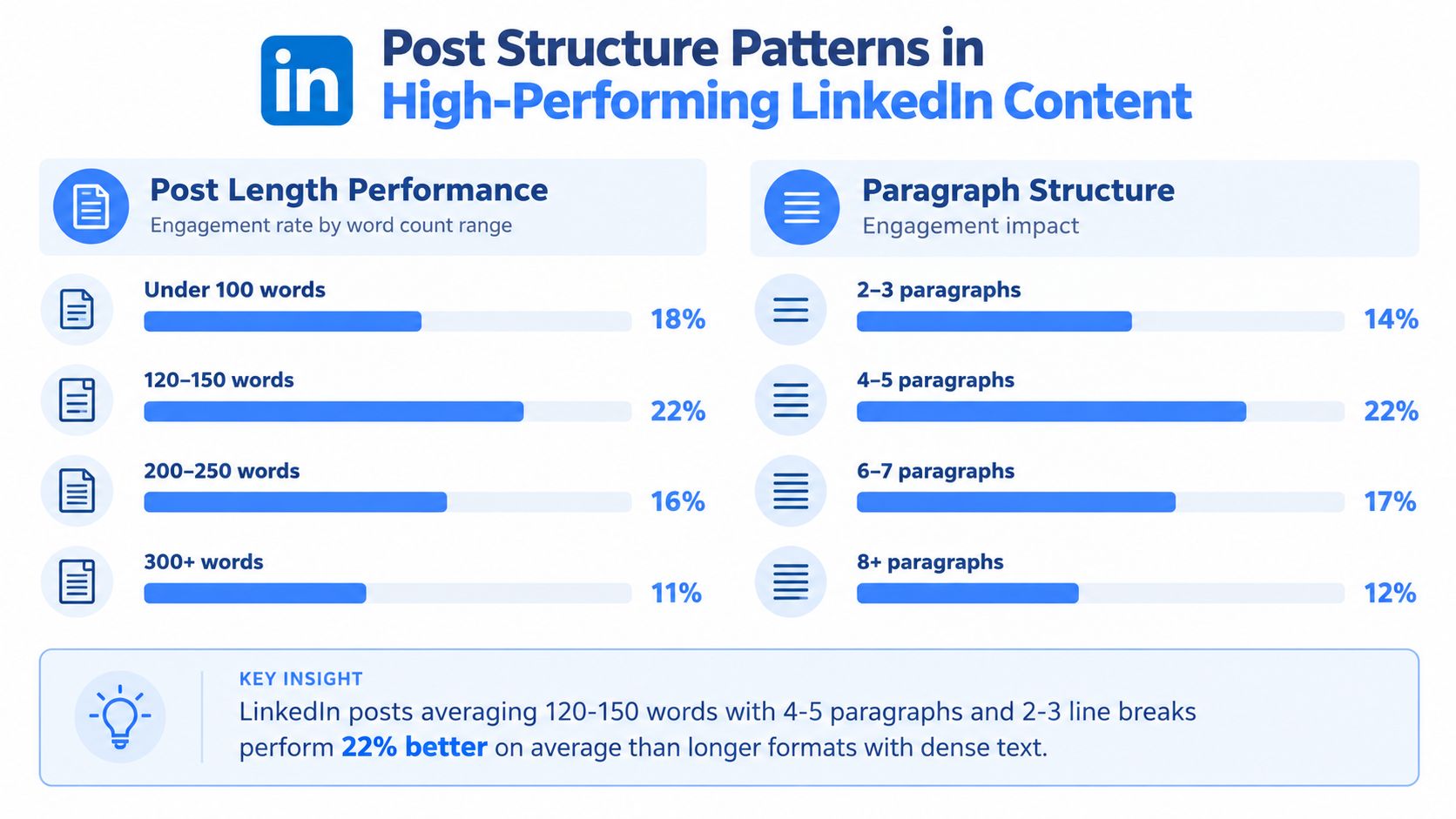
High performing posts often have a shape. They open a useful tension, explain the point, give evidence, then offer a next step. The shape varies by audience, so your team should study its own winners before adopting a formula from someone else's feed.
Export 15 to 20 strong posts into a document. Record opening length, paragraph count, sentence length, total words, line breaks, use of examples, and number of calls to action. Then compare those features with saves, shares, comments, profile visits, and messages.
Look for repeatable building blocks
A content creator may find that her best posts use a short opening, several compact paragraphs, and one clear ask. A founder may learn that his audience responds better to concise explanations than long essays. Those are useful observations only after the team checks enough comparable posts to avoid mistaking one lucky result for a rule.
Don't claim that a particular word count causes engagement unless your own test supports it. Structure can correlate with performance while the topic, timing, or author carries the actual weight. Your analysis should say what the data shows, then state what it cannot prove.
Use a simple test plan:
- Hold the topic steady: Compare posts about similar problems.
- Change one structure element: Alter the opening or paragraph length, not everything at once.
- Record business actions: Include profile visits, messages, and leads where available.
- Review weak posts: A failure often reveals where the structure loses attention.
Watch the accompanying LinkedIn post structure video as a prompt for analysis, not as proof that one format works for every advocate. Then create a short internal template with optional parts. Employees need a scaffold, not a script.
The point is not to make every post look identical. It is to reduce blank page anxiety while leaving room for experience, opinion, and a human voice.
5. Track Topic and Theme Performance Across Your Feed
Employees often share what the company wants to promote. Audiences respond to what they need. Those aren't always the same thing.
Tag each post with a small set of topics, such as customer problems, product lessons, hiring, team culture, industry changes, personal learning, or practical frameworks. Keep the categories broad enough to use consistently. If every post gets a unique label, your taxonomy has become a hobby.
Let audience response set the mix
Review 30 to 40 posts per category before making a strong decision. That sample is a practical working rule for your own analysis, not a verified market statistic. Compare saves, shares, comments, messages, and leads, then look for differences in response quality.
A founder might assume fundraising content will attract the most attention, then discover that team decisions create better conversations. A B2B marketer may learn that internal methods earn more saves than industry news. A sales professional may find that lessons from lost deals create more useful replies than victory announcements.
The answer doesn't mean you should abandon every low performing topic. Some topics serve recruitment, customer education, or trust even when they produce fewer public actions. Give each topic a job, then judge it against that job.
Use five to seven broad categories, rotate them through the calendar, and review the mix regularly. If one theme dominates, employees may repeat themselves and audiences may stop caring. If every post promotes the product, advocacy starts to resemble a company feed with different profile photos.
Evidence beats preference: If your team loves industry commentary but customers save practical frameworks, the calendar should reflect customers.
Document the winning topics as prompts employees can adapt. “Write about product news” is empty. “Explain a customer problem you solved, what changed, and what another team could test” gives the employee a starting point without dictating the ending.
6. Measure Time To Engagement and Velocity of Response
Total comments hide timing. Two posts can reach the same count while producing very different signals. One may draw relevant replies soon after publication. Another may build slowly. The difference helps you assess the opening, posting window, and early author activity as a connected system.
Record engagement at one hour, three hours, and 24 hours after each post. Use the same checkpoints across tests, then compare posting days, times, topics, and employee activity. A small sample cannot establish a universal best hour. Audiences may span time zones, and some subjects need longer to prompt a response.
Use the first hour as a test window
Employees should answer genuine replies soon after publishing when they can. A useful response adds context and may develop a brief reaction into a substantive discussion. Coordinated comments from colleagues create noise and make the velocity measure less reliable.
A founder might find that afternoon posts receive earlier responses than morning posts. A global team may need separate regional tests. A sales advocate may see comments arrive quickly while profile visits appear later, showing why early speed cannot define success by itself.
Track four signals:
- Time to first relevant response: Exclude obvious spam and unrelated activity.
- Early response quality: Record questions, shared experience, disagreement, and other meaningful reactions.
- Twenty four hour performance: Compare the wider result with the early pattern.
- Author activity: Note whether the employee replied during the first hour.
Velocity is a diagnostic, not a target to maximize. A fast response cannot repair a weak claim. Use these observations to choose posting windows, improve openings, and set response expectations. Do not reward employees for monitoring notifications or manufacture activity that makes the program look healthier than it is.
7. Segment Audience Response by Engagement Type
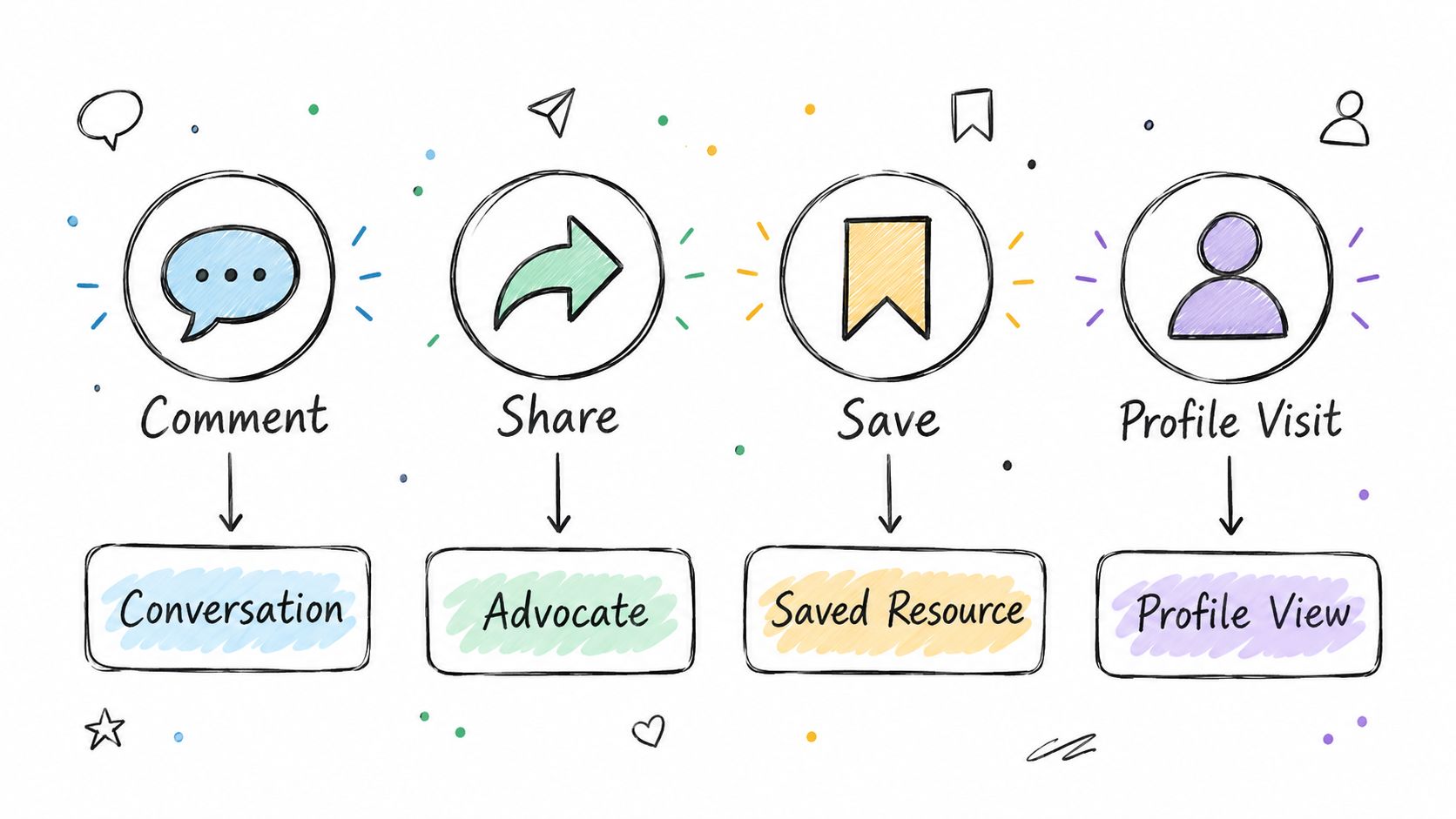
Employee advocacy becomes measurable only when each action has a defined meaning. A comment, share, save, profile visit, follow, message, and lead represent different stages of audience response. Combining them into one engagement total turns a content system into a popularity contest.
Start with the business outcome. Lead generation may prioritize qualified messages and profile visits. Recruitment may focus on relevant conversations with candidates. Thought leadership may value saves and shares from the intended audience. Brand awareness may require wider distribution, but reach alone cannot prove trust or demand.
Record each action in a separate field, then trace the next observable step. Do commenters follow the employee? Do people who share visit the profile? Do profile visitors start conversations? A simple CRM connection or manual log can support this analysis where privacy rules allow it.
The useful metric is often the sequence, not the count.
A SaaS founder might find that saved frameworks lead to stronger sales conversations than posts with many comments. A marketer might see shares bringing new profile visitors while comments come mainly from existing contacts. A sales professional might observe that profile visits precede useful deal discussions. These are testable hypotheses, not portable benchmarks. Review the quality and business relevance of each response before assigning value.
Define the fields consistently:
- Comment: Public participation, assessed separately for relevance and substance.
- Share: Distribution to another audience.
- Save: A private indication that the content may be useful later.
- Profile visit: Interest in the employee behind the post.
- Message or lead: A stronger business signal, though it still does not equal a sale.
High comment counts can include arguments, bot activity, or low-intent reactions. A smaller set of thoughtful replies may support better decisions. Use the resulting patterns to refine topics, hooks, CTAs, audience targeting, and follow-up rules. Do not reward employees for inflated activity or claim conversions the tracking cannot demonstrate.
8. Test Repurposing Velocity Against Content Decay
A useful post doesn't become useless because a day has passed. It may still help new followers, employees who missed it, or audiences in another time zone. But reposting everything creates fatigue, and repeating weak content only spreads the weakness.
Choose the strongest evergreen posts, then test how their performance changes after a gap. Compare the original with an edited version and a fully reframed version. Record saves, shares, comments, profile visits, messages, and response quality rather than counting reach alone.
Change the reason to return
An exact repost may work when the original idea remains useful and the audience has changed. A new opening can make the point relevant to a different problem. Fresh evidence can turn an old lesson into a current one. A new ending can invite a better conversation.
A creator might repost an evergreen framework with a different example. A founder may turn a previous lesson into a short story from a later project. A marketer may convert a text post into an image or a team discussion prompt. The idea stays, but the context earns another look.
Space tests apart and watch for audience fatigue. The provided plan suggests testing reposts at least two weeks apart, which is a practical starting point rather than a universal rule. Keep a record of the waiting period, the format, and the result.
Use only content that still reflects the employee's views, company policies, and current product reality. Remove claims that have aged badly. Check links, customer permissions, confidential details, and disclosure before publication.
A simple note can explain the repeat: “New followers asked about this, so I'm sharing the framework again.” That is more honest than pretending the post was created from scratch. Repurposing should reduce production waste while preserving judgment. It shouldn't turn the feed into a recycling bin.
8-Point Employee Advocacy Performance Matrix
| Title | Implementation complexity | Resource requirements | Expected outcomes | Ideal use cases | Key advantages |
|---|---|---|---|---|---|
| Track Engagement Metrics by Content Hook Type | Medium, requires categorization and ongoing tracking | Historical post data, spreadsheet or analytics dashboard | Identify highest-performing hook types (saves, shares, comments) | Creators testing formats; teams refining content mix | Data-driven hook selection; reduces wasted formats |
| Measure Call-to-Action Clarity Against Click-Through Rates | Low–Medium, structured A/B tests recommended | Tracking of replies/CTRs, consistent CTA variations | Higher CTA conversion and better-qualified responses | Lead generation posts; content aiming for direct actions | Optimizes for measurable business outcomes |
| Benchmark Your Performance Against Creator Peer Groups | Medium–High, needs segmentation and comparative analysis | Access to peer analytics, segmentation by niche/follower size | Realistic growth benchmarks and gap analysis | Creators seeking context for growth targets | Prevents misleading comparisons; reveals actionable gaps |
| Analyze Post Structure Patterns in High-Performing Content | Medium, manual or tool-assisted pattern extraction | Sample of top posts, analytical or annotation tools | Repeatable post templates and faster writing with higher engagement | Writers with blank-page issues; teams standardizing formats | Produces reliable structures to replicate success |
| Track Topic and Theme Performance Across Your Feed | Medium, requires tagging and aggregation | Tagging system, 30–50 posts per category, analytics | Clear view of which topics drive engagement and growth | Editorial planning; content calendar optimization | Focuses effort on audience-preferred topics |
| Measure Time-to-Engagement and Velocity of Response | Medium, needs time-window tracking and correlation | Hourly/early-engagement tracking tools or manual checks | Optimal posting times and stronger early-momentum hooks | Timing optimization; boosting algorithmic reach | Improves chance of algorithmic amplification |
| Segment Audience Response by Engagement Type | High, granular tracking and outcome mapping | Detailed analytics, CRM/linking for downstream outcomes | Understand which actions (share, save, comment) drive results | Outcome-driven marketers and growth teams | Prioritizes engagement that converts to business value |
| Test Repurposing Velocity Against Content Decay | Low–Medium, repeat testing at set intervals | Scheduling tools, tracking repost performance and audience overlap | Determine repost windows and expected decay rates | Creators maximizing content ROI; evergreen pieces | Extends content lifespan; multiplies return on effort |
Build the System Before You Chase Reach
Start with a voluntary goal. Decide whether the program supports qualified conversations, recruitment, customer education, thought leadership, or another clear outcome. One program can serve several goals, but each needs its own measurement path. Otherwise, every positive signal gets claimed as success.
Assign owners from marketing, internal communications, HR, legal, and relevant business teams. Give them practical approval rules. Employees should know what needs review, what they can publish independently, where confidential information starts, how to disclose their role, and whom to contact when a post raises a concern.
Run a small pilot group first. Choose willing employees from different roles, not only people who already post often. Give them topic prompts, sample hooks, CTA options, training, and a simple workflow for review. The 2024 to 2025 benchmark found that 32% of advocates had not received formal training or a social media policy (benchmark findings). That gap is a governance problem, not a motivation problem.
Give people structure without taking their voice
Provide guidelines, not talking points. Employees need boundaries around privacy, customer information, regulated claims, conflicts of interest, brand representation, and disclosure. They don't need to paste corporate copy into a personal profile.
Adobe recommends a cross functional employee group, clear social media guidance, a weekly email digest, and pre populated comments to make sharing easier (Adobe employee advocacy guide). Use those ideas as workflow choices, not mandatory scripts. The employee should be able to add experience, disagreement, context, and plain language.
AI tools such as ViralBrain can support ideation, hook testing, tone personalization, pattern translation, image creation, and repurposing. A human must check facts, voice, privacy, permissions, conflicts, and disclosure before anything goes live. AI can make a draft faster. It can't grant consent or take responsibility for a claim.
Measure business signals, not office theatre
Track reach, saves, shares, comments, profile visits, messages, leads, response quality, and posting consistency against a baseline. Hootsuite recommends using UTM tracking, calculating earned media value, connecting advocacy to business goals, and identifying top advocates as part of a broader measurement approach (Hootsuite measurement practices).
Use a dashboard that separates participation from outcomes. Participation tells you whether the workflow is usable. Activity tells you whether employees are publishing. Engagement tells you how audiences react. Business outcomes tell you whether the program deserves more investment.
Recognition can include useful feedback, learning access, public appreciation, or opportunities to contribute to content planning. Be careful with leaderboards. They can reward volume, encourage low quality posting, and make a voluntary program feel like a sales quota wearing a party hat.
The historical evidence explains why employee distribution can expand reach. A Conference Board report found brand messages were eight times more likely to be shared when first distributed by employees, and reported $1,900,000 in advertising value for programs involving 1,000 active participants (Conference Board report). The same report found only 8% overlap between company followers and employees' followers, which helps explain why employees can reach distinct audiences. Those figures describe historical findings, not a promise for your program.
If employees need to sound like a company brochure, the program is already broken. Give them useful material, clear limits, and room to speak like people. Then measure whether their content helps anyone do something worth doing.
ViralBrain helps employees turn proven LinkedIn patterns into drafts in their own voice, with tools for hooks, structures, CTAs, analytics, tone personalization, and repurposing. Visit ViralBrain to build a more useful employee advocacy workflow without forcing everyone to publish the same corporate copy.
Grow your LinkedIn to the next level.
Use ViralBrain to analyze top creators and create posts that perform.
Try ViralBrain free