
LinkedIn Content Strategy for Personal Branding That Works
Build a repeatable LinkedIn content strategy for personal branding with proven pillars, hooks, formats, and cadence that drive real engagement in 2026.
Grow your LinkedIn to the next level.
Use ViralBrain to analyze top creators and create posts that perform.
Try ViralBrain freeMost LinkedIn personal branding advice starts with the wrong question: how often should you post? Then it moves to hooks, formats, and copying creators who already get attention. That order creates busy accounts with no clear reason to follow them.
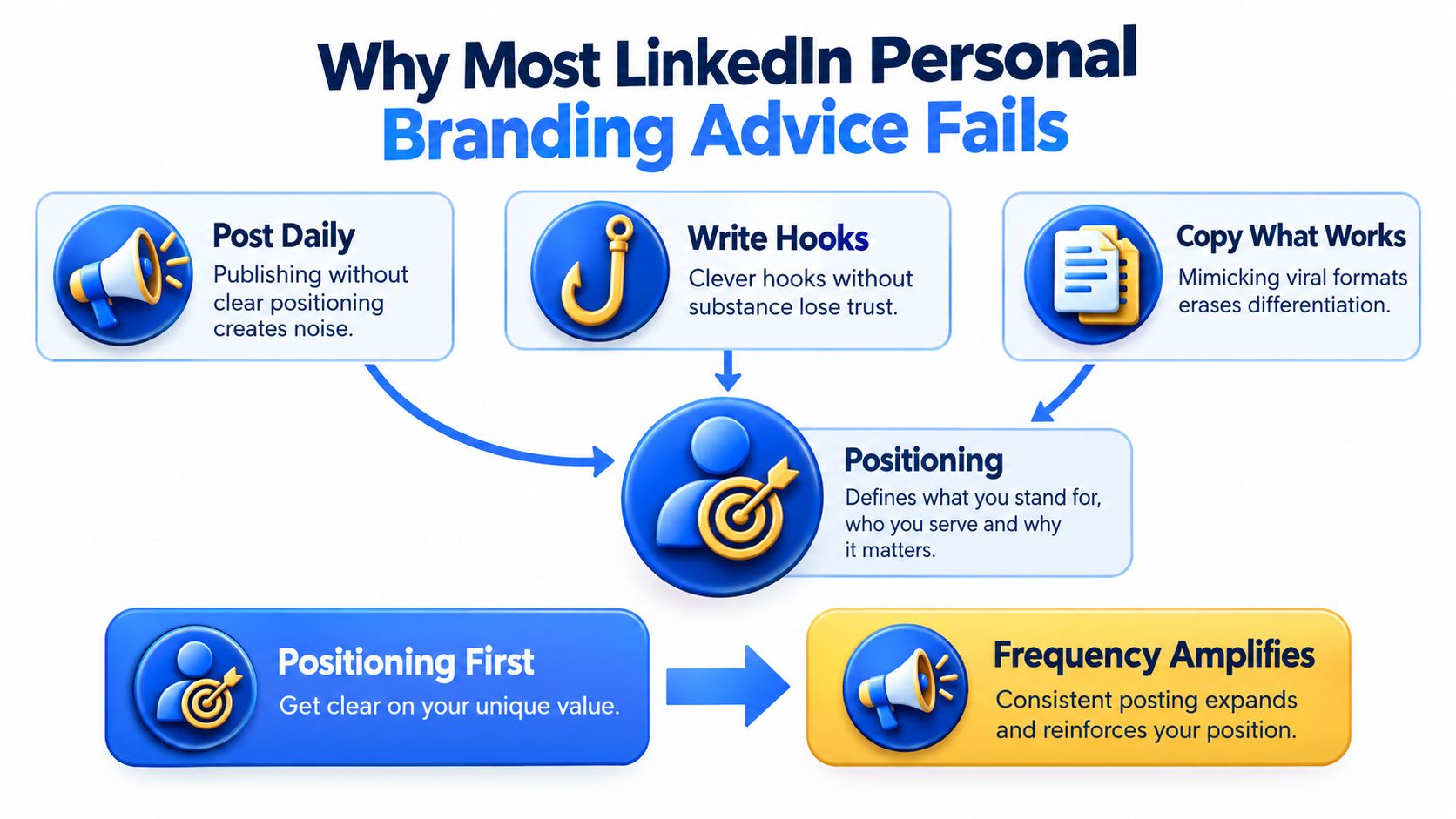
A strong LinkedIn content strategy for personal branding starts with positioning. Pick a narrow audience. Make a clear promise. Choose the problems you want people to associate with your name. Frequency can amplify that signal, but it can't create one from nothing.
The benchmarks support a creator led approach. Personal profiles average 2.60% engagement, compared with 1.74% for company pages, according to Metricool's LinkedIn statistics. Your profile is the strategic unit. Treat it like a media channel with a point of view, not a noticeboard for recycled corporate updates.
Why Most LinkedIn Personal Branding Advice Fails
“Post daily” sounds useful because it's easy to measure. So does “write better hooks” or “copy the format that went viral.” None of those answers fixes a vague reputation.
If your profile covers leadership on Monday, demand generation on Wednesday, and personal productivity on Friday, more publishing won't make the pattern clearer. It will make the confusion more regular. Your audience may see the posts, but they won't know why your next one deserves attention.
Positioning comes before distribution
A narrow thesis gives your content a job. It says who you help, what you believe, and which recurring problems you can solve.
Use this sequence:
- Choose the audience: Name the people you want to attract, such as B2B growth leads at early stage software companies.
- Make a promise: State the useful change your content helps them make, such as building a repeatable demand system without relying on random campaigns.
- Choose the problems: Focus on a small set of issues you understand from real work.
- Set your boundaries: Decide what you won't post about, even when a broad topic is trending.
A good thesis might be: “I help B2B growth teams turn founder expertise into a consistent LinkedIn demand channel.” That thesis gives you room for strategy, production, measurement, and lessons from execution. It doesn't force you into posting about every popular topic on the platform.
Practical rule: Frequency amplifies positioning. It doesn't replace positioning.
Hooks matter after the reader understands what kind of expertise you offer. Formats matter after you know which ideas deserve distribution. Measurement matters after you can connect a post to a clear audience and problem. Fix the anchor first, then build the machine around it.
Pick Your 2 to 3 Content Pillars That Compound
Content pillars aren't broad subjects. They're repeatable problem categories your audience can attach to your name.
“Leadership” is a subject. “Hiring junior operators,” “managing up without politics,” and “giving feedback that changes behavior” are usable pillars. Each one points to a recurring situation, a defined audience, and a practical lesson.
Choose 2 to 3 pillars, not a crowded menu of interests. Guidance on content pillar strategy is useful here because the test isn't whether a topic sounds impressive. The test is whether you can sustain it while attracting the people you want.
Run the decision test
Every possible pillar should pass three checks:
| Criterion | Pass / Fail |
|---|---|
| It matches a real recurring question in your work | Pass if clients, colleagues, or buyers ask about it repeatedly |
| You have at least 50 usable ideas ready to write | Pass if you can name practical examples, mistakes, frameworks, or opinions |
| It attracts the people you want as clients, employers, or collaborators | Pass if the audience connects directly to your professional aim |
The first check protects you from theory without experience. The second protects you from a pillar that runs dry after three posts. The third stops you from collecting attention from people who'll never matter to your work.
Narrow broad topics into useful territory
Start with a broad label, then ask what specific decisions sit inside it.
“Leadership” can become feedback systems for first time managers. “Marketing” can become turning customer interviews into demand content. “Sales” can become diagnosing stalled B2B deals before adding another discount.
Write each pillar as a problem you can help solve. “I post about hiring junior operators” is stronger than “I post about people.” The first gives you a clear content filter. The second gives you an empty notebook and a mild headache.
Two or three pillars beat five to seven because repetition creates recognition. Your audience sees a consistent point of view, while the platform gets a clearer pattern from your output. You can still use personal stories, industry reactions, and experiments, but they should serve one of the chosen pillars rather than become unrelated side quests.
For each pillar, keep a simple idea bank with customer questions, mistakes, strong opinions, examples, checklists, and lessons from recent work. Review the bank before writing. The best post idea is often sitting inside a question you answered last week.
Set a Posting Cadence You Can Actually Keep
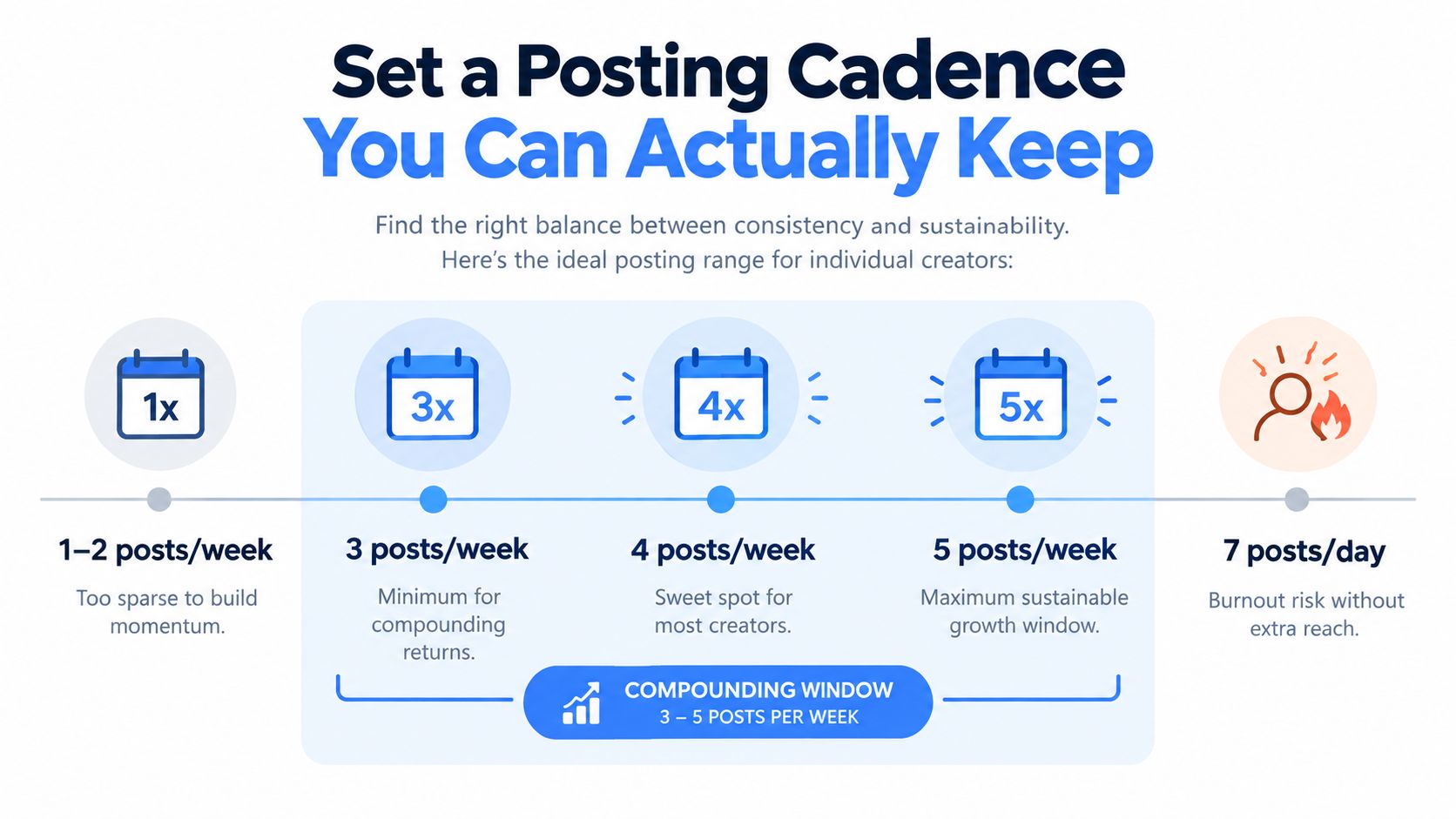
Posting daily is popular advice because it turns strategy into a calendar. It also ignores the fact that most professionals have clients, meetings, and work that doesn't involve arranging line breaks in a LinkedIn draft.
Buffer's benchmark found that posting 2 to 5 times per week can produce about 1,182 more impressions per post and a 0.23 percentage point engagement lift compared with posting once per week. The same analysis found that 6 to 10 posts per week produced about 5,001 more impressions per post and a 0.76 percentage point engagement lift. See the full LinkedIn posting frequency analysis from Buffer.
That doesn't mean everyone should publish ten times weekly. Higher output needs more ideas, editing, design, and comment time. Without support, the extra volume often turns into weaker opinions repeated with different furniture.
Use a default rhythm
A practical starting schedule looks like this:
- Tuesday: One written teaching post.
- Thursday: One opinion, story, or breakdown.
- Sunday morning: One practical post tied to a pillar.
- Every other week: One substantial carousel or document post.
- Each day: Useful comments on five target accounts.
A separate creator dataset found that 91% of top creators publish at least once every three days, while image based posts were the most common format at 59%, according to Copyblogger's LinkedIn personal branding statistics. The pattern points to steady publishing with visually scannable content, not occasional essays followed by silence.
Comments shouldn't become a performance ritual. Read the post, add a relevant observation, share a useful counterpoint, or explain a practical detail. If video fits your pillar, a guide to video marketing on LinkedIn can help you think through the production side without turning every post into a tiny television pilot.
Recover without drama
Missed a week? Don't publish five rushed posts to compensate. Return to the normal rhythm, use one proven pillar, and make the next post easy to finish.
At 30 days, check consistency, saves, meaningful comments, profile visits, and messages from relevant people. At 60 days, look for recurring themes in the posts that attract the right audience. Adjust the pillar or format only after you have enough comparable work to spot a pattern.
Write Hooks and Choose Formats That Get Read
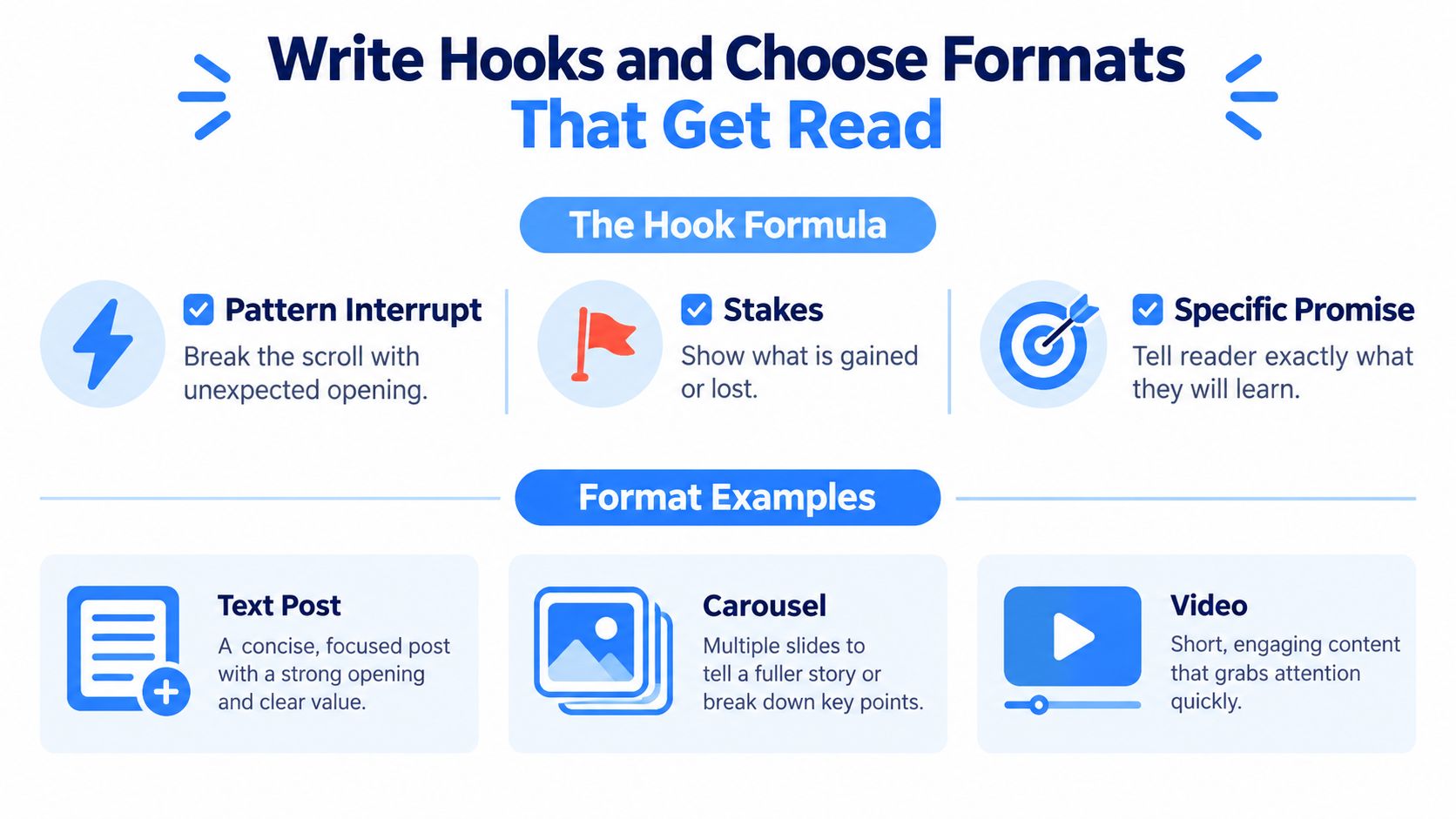
A hook shouldn't only stop the scroll. It should earn the next line by creating a specific gap between the reader's current belief and a useful payoff.
Use this structure:
Pattern interrupt + stakes + specific promise
The pattern interrupt breaks expectation. The stakes show why the topic matters. The promise tells the reader what they'll get if they continue.
Rewrite the weak opening
Generic: “Here are some tips for better feedback.”
Sharper: “Most feedback fails before the conversation starts. Use this preparation step to change behavior, not just describe the problem.”
Generic: “I learned a lot from building a personal brand.”
Sharper: “Posting more didn't fix my profile. Naming one buyer problem did.”
Generic: “Carousel posts are useful on LinkedIn.”
Sharper: “Your carousel loses readers on slide two when it tries to teach five ideas at once. Give each slide one job.”
Try cutting the hook after eight words. If the remaining idea still hints at a payoff, you probably have tension. If it becomes a vague sentence about growth, success, or lessons, keep editing.
Clever wording won't rescue thin thinking. The post needs a real observation, a clear example, or a useful decision rule.
Match the format to the job
- Short text: Use it for a sharp opinion, a small lesson, or a single mistake.
- Carousel: Use it when the idea has a sequence, comparison, or visual framework.
- Document post: Use it for dense teaching that readers may save for later.
- Poll: Use it when you need a simple audience signal, then add your own analysis.
- Long form essay: Use it when the topic needs context, trade offs, or a detailed argument.
Independent benchmark data puts personal profile engagement at about 3.85%, while carousel and document posts reach roughly 6.6% to 7.0%, according to Cleverly's LinkedIn benchmark data. That makes multi slide educational content worth testing, but a carousel still needs a strong idea. Design is not a substitute for judgment.
For a repeatable drafting workflow, use this LinkedIn post draft guide. Before publishing, check the hook, audience, pillar, proof, format, and final takeaway. Remove any sentence that exists only because LinkedIn posts apparently enjoy taking up space.
Repurpose One Idea Into a Week of Posts
Repurposing works when you change the job of the content, not when you paste the same thought five times.
Start with one useful insight from a longer post. Then give that insight different shapes for different reading modes. A deep reader may want the full argument. A scanner may want a compact sequence. A visual learner may prefer a document. A debater may respond to a disagreement.
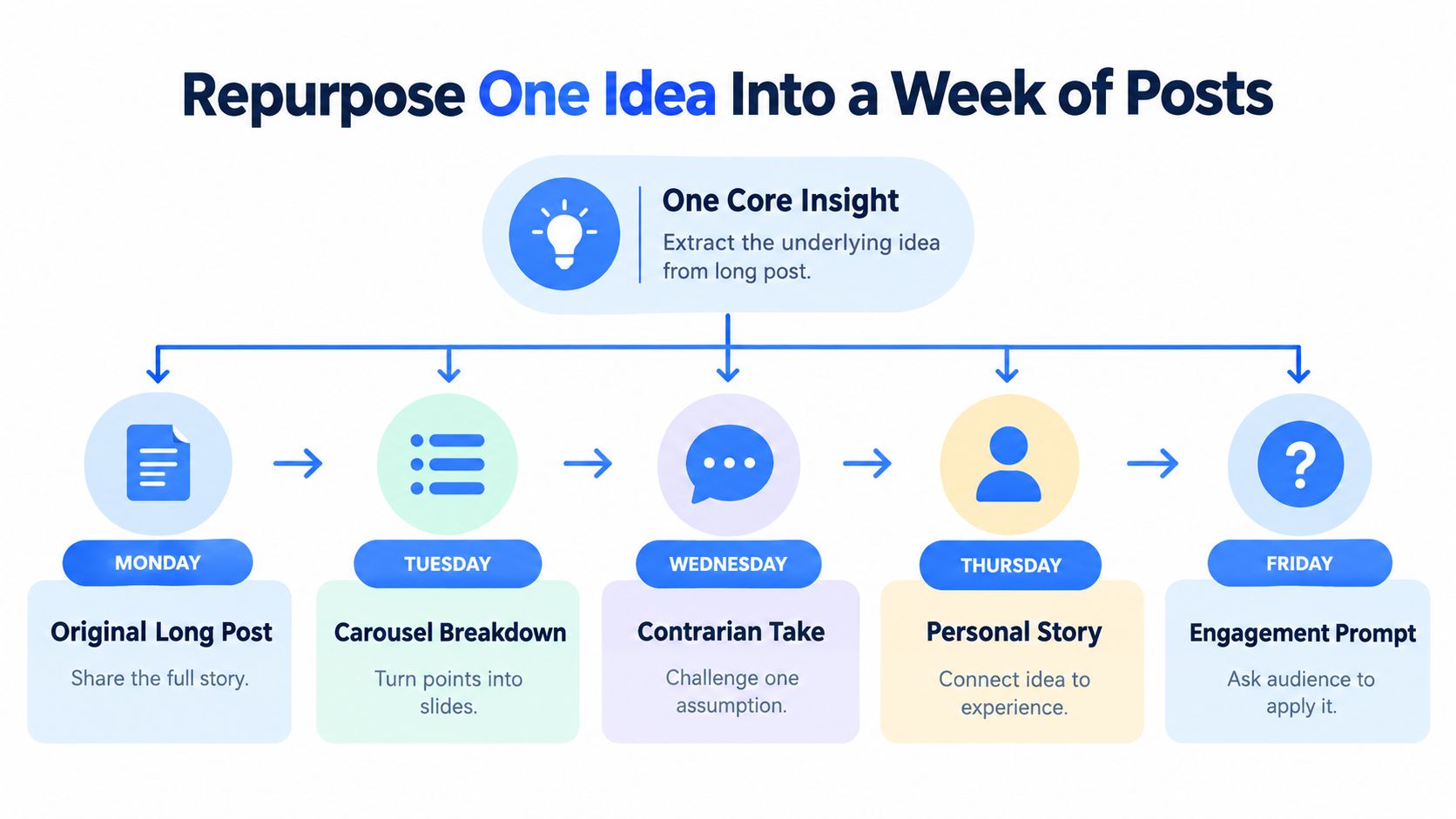
Use one seed, five jobs
Take the seed idea compound positioning. The point is simple: repeated focus on a narrow problem makes your expertise easier to recognise.
- Monday essay: Explain why broad personal branding creates weak associations, then show how a narrow thesis builds over time.
- Tuesday story: Describe a moment when a vague profile attracted the wrong conversation. End with the positioning change.
- Wednesday carousel: Turn the idea into a visual sequence, audience, promise, problem, proof, repeat.
- Thursday contrarian take: Argue that more content can reduce clarity when every post targets a different buyer.
- Friday short tip: Give readers one prompt, “What problem do people ask you to solve twice in the same month?”
The idea stays stable. The angle, format, and reader action change. That keeps the week coherent without making followers feel as if they've been trapped inside a content loop.
A useful source of prompts is this collection of LinkedIn post ideas for 2026. Use it to find angles, not to outsource your point of view.
Fill in the template
Next week, write:
- Seed insight: “My audience assumes ___, but the better approach is ___.”
- Long post: Explain the evidence and practical context.
- Story: Show when the old assumption caused trouble.
- Carousel: Break the better approach into steps.
- Contrarian post: Challenge one popular version of the old advice.
- Short tip: Give one action the reader can take today.
Don't paraphrase the same post every morning. Followers learn to skip familiar packaging. Change the reader's task instead.
Measure What Matters and Ignore What Does Not
Likes are easy to see, which is why people overvalue them. They feel like progress without forcing you to ask whether the right people care.
A useful measurement system separates signal metrics from vanity metrics. Signal metrics help you choose better topics and audiences. Vanity metrics describe distribution, but rarely explain whether your positioning is attracting useful attention.
| Metric | What it Tells You | Action to Take |
|---|---|---|
| Comment depth | Whether the idea created real thought | Review repeated objections and questions |
| Saves | Whether the post has future utility | Build a related guide or document |
| DMs from target buyers | Whether attention reached relevant people | Create more content around that problem |
| Profile visits after a post | Whether curiosity extends to your expertise | Improve the hook or profile promise |
| Likes | Immediate approval or recognition | Treat as context, not a strategy |
| Impressions | Distribution volume | Compare with audience quality |
| Follower count | Audience growth | Check whether new followers fit your thesis |
A post can collect likes while profile visits stay flat. That usually means the content entertained people or triggered easy agreement, but didn't make them want more from you. Don't call that a positioning win.
Review once a week
Use five prompts:
- Top post: Which post attracted the strongest relevant response?
- Worst post: Where did readers stop caring?
- Comment themes: What questions or disagreements appeared repeatedly?
- Inbound messages: Did target buyers, employers, or collaborators reach out?
- Positioning tweak: What should the next week make clearer?
Use LinkedIn's native analytics, or follow this practical guide to see LinkedIn post analytics. Early results can be noisy, especially from a small account. Watch the quality of conversations before you chase a bigger audience.
At the 90 day checkpoint, ask whether the right people are noticing you, not whether more people are noticing you. A smaller group of relevant readers can teach you more about your positioning than a broad spike from an unrelated topic.
Your 30 Day LinkedIn Content System
A month is long enough to build a working habit and short enough to prevent endless planning. Treat it as a test of your positioning, not a campaign that must look impressive from day one.
Days 1 to 7, define the signal
Spend about 90 minutes drafting during the first week. Write your positioning statement, choose two or three pillars, complete the About section, and create an idea bank for each pillar.
By day seven, you need a written statement that names your audience, promise, and problem categories. You don't need a perfect sentence. You need a sentence that helps you reject weak ideas.
Days 8 to 14, test the opening
Use roughly 45 minutes a day to draft variations of the same ideas. Test pattern interrupts, stakes, and specific promises across short text, carousels, and documents.
Log 10 hook variants by day fourteen. Read them aloud. Delete the ones that sound like corporate wallpaper. Your private draft process should catch vague openings before your audience has to do the work.
Days 15 to 21, lock the rhythm
Spend about 30 minutes per day creating, scheduling, or preparing posts. Follow the Tuesday, Thursday, Sunday rhythm, then add the longer asset when you have enough substance.
By day twenty one, you need a confirmed posting rhythm you can keep during a busy week. If video suits your topic, a LinkedIn video maker for marketers may help with production, but don't add video because the format looks modern. The idea still has to earn attention.
Days 22 to 30, review and refine
Keep the same daily time budget. Review top and weak posts, comment themes, profile visits, saves, and messages from relevant people. Then adjust one pillar, hook pattern, or format choice.
By day thirty, document the metric review. Keep pillars that attract useful conversations. Refine those that show interest but poor fit. Drop only what has had a fair test.
Three mistakes cause most early stalls:
- Publishing without private hook testing: The first sentence gets treated as decoration.
- Chasing follower count: A larger audience can still produce weaker business conversations.
- Abandoning pillars after three weeks: Slow recognition is normal when your profile is building a new association.
The exit criteria are simple. A positioning statement by day seven. Ten logged hook variants by day fourteen. A confirmed rhythm by day twenty one. A documented review by day thirty. Repeat the cycle with better evidence instead of starting from scratch every month.
ViralBrain helps founders, marketers, and professionals turn proven LinkedIn post patterns into drafts suited to their topic and voice, with tools for hooks, repurposing, profile feedback, and analytics. If you want a more repeatable way to build your personal brand system, visit ViralBrain and use it to plan, draft, and refine your next month of posts.
Grow your LinkedIn to the next level.
Use ViralBrain to analyze top creators and create posts that perform.
Try ViralBrain free