
What AI Writing Patterns Are and How to Edit Them
AI writing patterns explained with measured signals, common post structures, a batch check and editing rules you can apply to every draft today.
Grow your LinkedIn to the next level.
Use ViralBrain to analyze top creators and create posts that perform.
Try ViralBrain freeA study of 1,100 working professionals found that AI assisted messages could look more professional while making readers doubt the sender. With medium to high assistance, readers questioned authorship, confidence, caring, sincerity and ability, according to the workplace communication study. A cleaner sentence can still create a credibility problem.
That changes how marketers should edit AI writing patterns. Removing awkward phrases helps. But the harder job is preserving evidence that someone made a judgment and stands behind it. Perfect grammar can't do that job for you.
What AI Writing Patterns Are and Why Readers Notice Them
Think of a machine knitted sweater. The rows look uniform, with the same tension throughout. A hand knitted sweater may have small, uneven stitches. Both keep you warm. Only one suggests someone occasionally lost count.
AI writing patterns work like those repeated rows. They're recurring habits in sentence shape, paragraph order and word choice. A phrase on its own tells you little. A repeated combination across many drafts gives you something worth checking.
The writer's desk is familiar. The habits on the page need closer inspection.
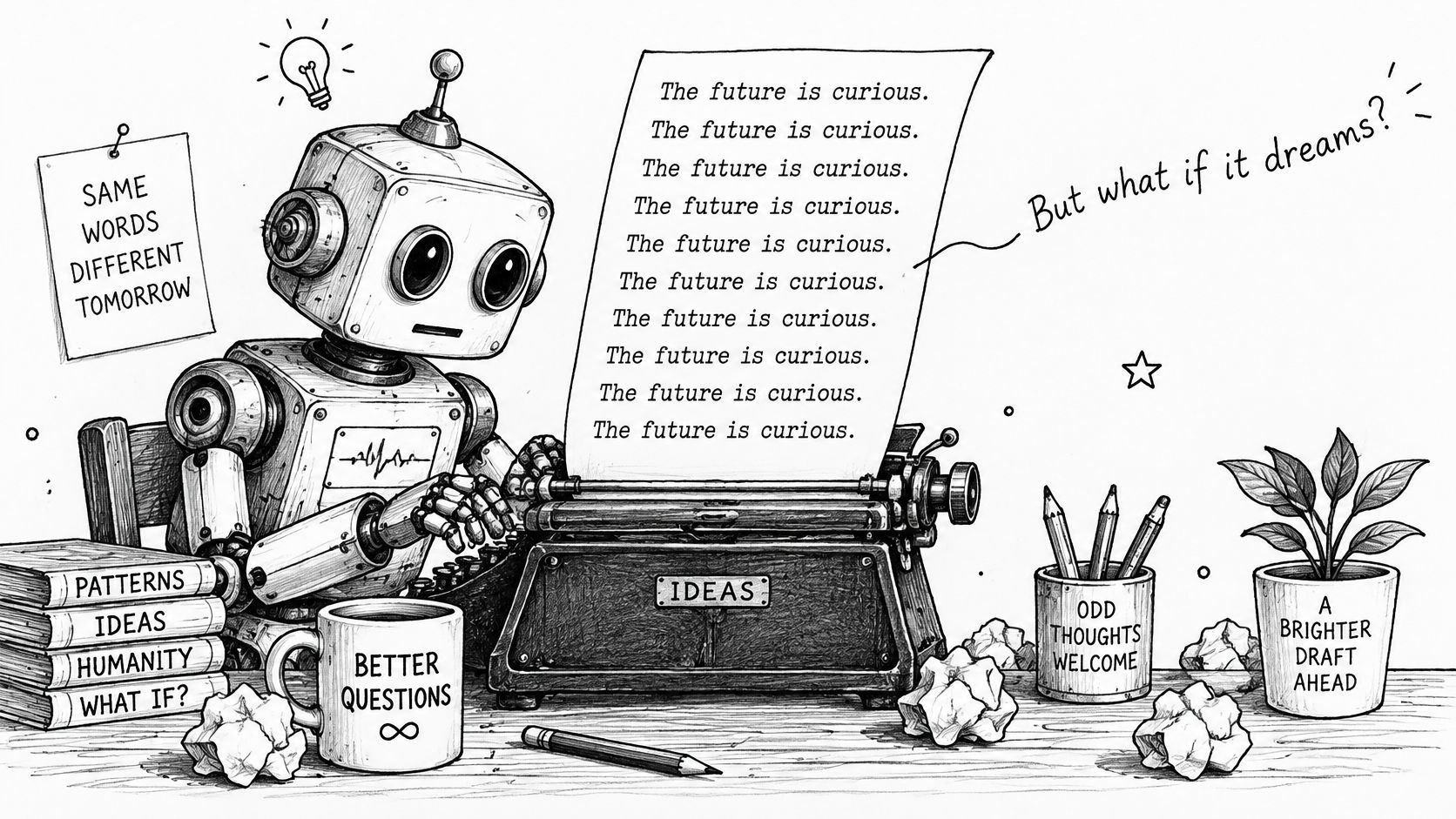
Look at several layers
At sentence level, check length, clause types and whether the writer names the actor. At structure level, examine how a post opens, develops its argument and finishes. At word level, look for favored vocabulary and repeated connectors.
Research using a balanced corpus of 4,346 human and generated essays examined measurable stylistic differences through classification methods. It found that classification improved with document length and training data, as described in the stylometric analysis of generated writing. The useful lesson is to examine recurring distributions rather than prosecute individual words.
For a broader definition, what AI generated content means provides context beyond writing style.
Working rule
A pattern is a reason to inspect a draft, not a verdict on its author.
A steady rhythm may make a post easier to skim past. That's an editorial concern, not proof of machine authorship. Human writers can use every construction discussed below, sometimes because those constructions are exactly what the subject needs.
The Measured Signals Behind AI Writing Patterns
Measured differences between AI and human writing
| Signal | AI writing | Human writing | What it looks like |
|---|---|---|---|
| Average sentence length | 21.3 words | 24.8 words | Shorter sentences and potentially flatter rhythm |
| Topic sentence plus elaboration | 42% of cases | 28% of cases | Claim first, explanation second |
| Topic plus argument plus evidence | 24% of cases | 36% of cases | Evidence and reasoning arrive less often |
| Analytical or interpretive structure | 14% of cases | 22% of cases | Less interpretation in AI text |
| Mixed or nonlinear development | Not reported | 14% of cases | Human texts use less linear development |
| Present participial clauses | 2 to 5 times human rate | Baseline | Frequent ing phrases within sentences |
| Nominalizations | 1.5 to 2 times human rate | Baseline | Abstract nouns replace actions |
| Agentless passive constructions | About half human rate in the studied GPT model | Baseline | Fewer passive sentences without an actor |
| Word signature camaraderie | About 150 times human rate | Baseline | Seen in some model versions |
| Word signature unease | 60 to 100 times human rate | Baseline | Seen in Llama variants |
The sentence length and paragraph structure figures come from comparative corpus research on human and AI writing. The grammar and vocabulary ratios come from Carnegie Mellon's analysis across writing genres.
Structure tells a more useful story than length
The average sentence length row undermines a common editing shortcut. Human sentences were longer in this corpus. Making every sentence shorter won't automatically make a draft resemble human writing.
The next rows matter more for an argument. Generated text leaned toward stating a topic and elaborating. Human writing more often included an argument with evidence or offered interpretation.
My editorial reading is that a draft can remain coherent without doing enough intellectual work. It explains its claim, then explains it again in a fresh shirt. Ask what evidence changes the reader's understanding.
The missing AI figure for mixed development matters too. It prevents a complete comparison. Don't fill that gap with confidence.
Grammar can contradict the usual advice
Present participial clauses use an ing phrase, such as “Drawing on customer interviews, the team revised its offer.” Nominalizations turn actions into nouns. “We evaluated the proposal” becomes “We conducted an evaluation of the proposal.”
Neither construction is bad by nature. Repeated use can make a draft dense or mechanically smooth.
The passive finding is especially useful. The studied GPT model used fewer agentless passives than human writers. So passive voice can't serve as a universal AI warning light.
Vocabulary differences were large for particular models. But these were model and genre averages, not rules for judging a lone post. Keep a word when it earns its place. An ordinary noun shouldn't need a defense lawyer.
Hooks, Structures and CTAs That Repeat
Post elements with typical AI versions and stronger swaps
| Element | Typical AI version | Stronger swap |
|---|---|---|
| Hook | Broad trend claim, then a promise of value | A specific number, failure or scene from your work |
| Structure | Claim then explanation in most paragraphs | Claim, evidence, then interpretation with varied paragraph lengths |
| Transitions | Moreover and Additionally between points | Plain transitions or the next point stated directly |
| Closing line | Summary that repeats the post | The sharpest point or a concrete next step |
| Call to action | Generic invitation for feedback | An action tied to the topic |
| Lists | Three neat bullets in parallel phrasing | Fewer bullets with relevant messy detail retained |
These are editing comparisons, not measured frequencies for every model. Use them to locate weak writing, regardless of who produced it.
Replace the empty opening
A broad hook might say that customer research is becoming essential. A stronger opening could describe a real moment from the writer's work, provided it happened. For example, a writer could explain which customer objection forced them to change a proposal.
The distinction is specificity with ownership. A dramatic opening without supporting detail only delays the disappointment. Use this guide to building a hook in writing to assess what the opening promises.
Next, examine paragraph order. After making a claim, provide the observation or source that supports it. Then explain what you think it means. The corpus findings above support checking this sequence, though they don't establish a winning LinkedIn formula.
Stop polishing the joins
For transitions, try deleting “Moreover” before rewriting anything else. If the relationship remains obvious, leave it out. If it becomes unclear, explain the actual relationship, such as cause, contrast or a limitation.
For closing lines, remove the recap when it merely repeats the opening. End with the decision the reader can make.
A useful call to action might ask the reader to inspect their next draft for unsupported claims. That gives them something concrete to do. An invitation to share thoughts offers less direction.
Lists deserve the same scrutiny. Keep an exception, disagreement or condition when it changes the advice. Parallel phrasing is tidy, but tidiness doesn't excuse missing information.
Borrow a proven post's structure. Write your own sentences and supply your own evidence.
Rewrite the weakest element first. Changing the entire post can erase the parts that already sound like you.
How to Check a Batch of Drafts for Machine Patterns
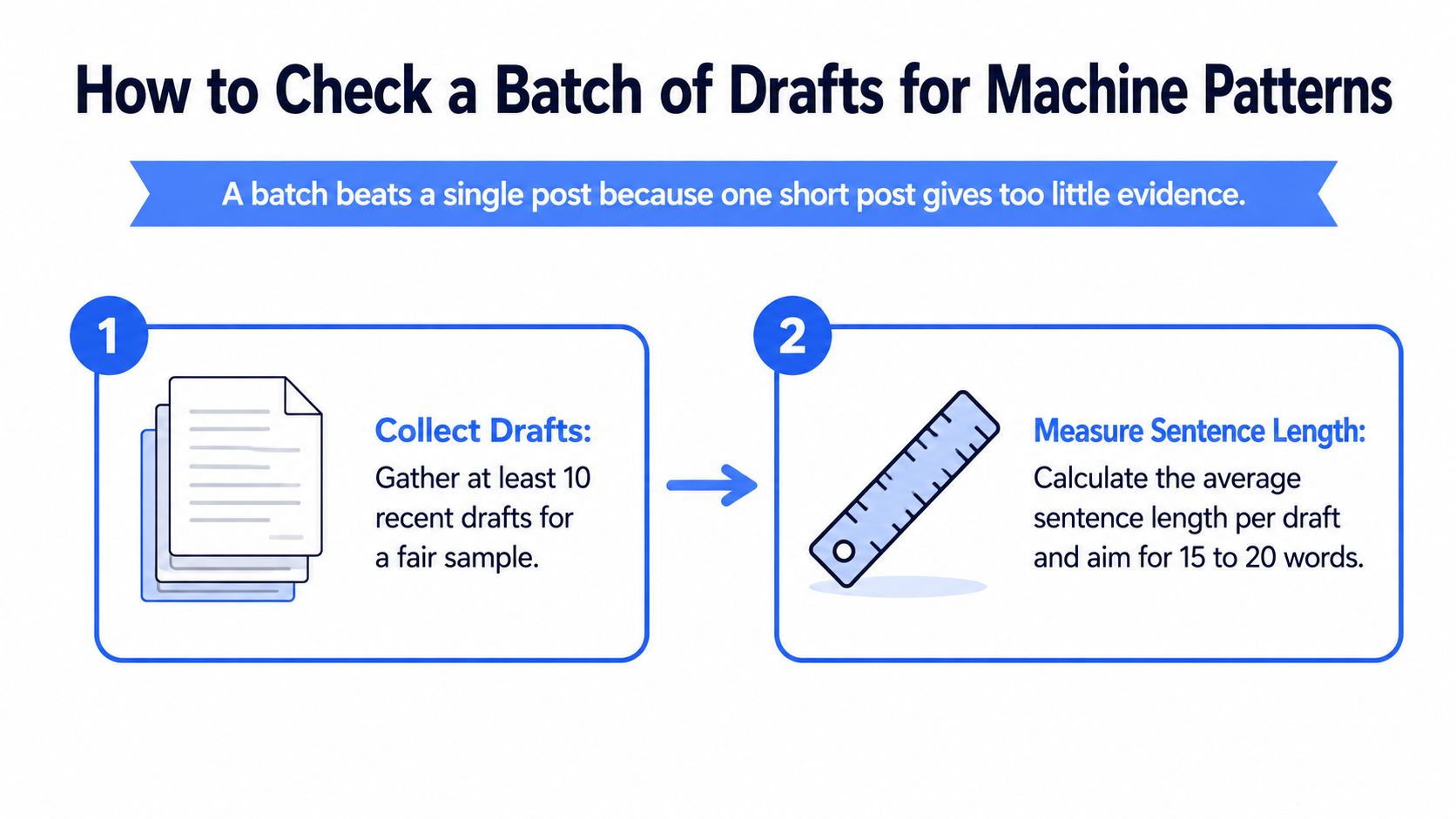
Ten drafts reveal what one post can hide. A single piece might pass on instinct; a batch exposes the habits you repeat without noticing. The stylometric research discussed earlier supports that distinction, though it doesn't establish a universal minimum sample.
Use this workflow as an editorial check rather than an authorship test. Keep the goal in view: controlled resemblance with visible judgment. A draft polished until no trace of you remains reads as professional and still fails to earn trust.
Run the checks in order
-
Collect the drafts. Gather at least ten recent drafts in a document or spreadsheet. Keep formats comparable so a long article doesn't distort your reading of short posts.
-
Measure sentence length. Calculate the average for each draft and compare it with the plain language range in the editing table below. Use the result to find dense passages, not to force every sentence into the same size.
-
Label paragraph openings. Mark each as a broad claim, specific number, story or direct statement. Count the share of broad claims to see whether you repeatedly delay the useful material.
-
Check paragraph development. Count claim followed by elaboration, then compare your result with the corpus table above. That comparison is context, not a pass mark.
-
Record repeated language. Collect recurring connectors, opening phrases and closing lines. Repetition across unrelated topics deserves more attention than necessary technical vocabulary.
-
Inspect grammar habits. Count opening ing phrases and passive sentences that omit the actor. Treat them separately because the measured research doesn't support grouping them into a single AI score.
-
Use your own baseline. Compare the results with posts you wrote before using AI assistance. Your established habits matter more for voice than an average drawn from unrelated authors.
-
Limit detector influence. Treat a detector score as a weak prompt for review, especially on short text. A score is a hint, not proof of authorship or a performance target.
Choose the first repair
When several measures sit unusually high against your baseline, inspect the paragraph with the densest overlap. Rewrite that passage, then check whether the same problem recurs elsewhere. Fixing one bad page beats sanding all ten into the same smooth surface.
For a video alongside the written workflow, use the player below.
How to Edit Drafts Without Flattening Your Voice
Editing rules with targets and sources
| Rule | Target | Source |
|---|---|---|
| Sentence length | 20 words or fewer for most sentences | FDA plain language guidance |
| Average sentence length | 15 to 20 words | Office of Personnel Management guidance |
| Ideas per sentence | One idea per sentence | Federal plain language guidelines |
| Passive voice | Rewrite when the actor is known and relevant | Federal guidance cited above |
| Paragraphs and web drafts | Keep paragraphs short; cut print copy substantially for web use | FDA guidance cited above |
| Filler | Remove padded transitions and decorative claims | Plain language guidance cited above |
The FDA guidance linked above also notes that web readers process text more slowly than print readers, which is the reasoning behind shorter paragraphs and leaner pages. Treat every target in the table as a clarity tool rather than a measurement of authenticity.
One caution before you start cutting. The human samples measured earlier averaged 24.8 words per sentence. Editing every draft down to a 15 to 20 word average pushes your text away from measured human writing, which is the opposite of the goal. Apply the targets where a draft is genuinely tangled. A clean draft that already carries your opinion does not need a haircut.
Start by separating claims that need separate evidence. Name the person or team responsible for each action. Then remove setup the reader does not need in order to follow the point.
Vary the shape, protect the meaning
Swapping ordinary words for unusual synonyms is the weakest edit available. The stylometric study discussed earlier measured how classification accuracy shifts with document length and training data. It never tested synonym substitution, so nothing in it tells you a thesaurus beats a detector. Assume word-level swaps are cosmetic until evidence says otherwise.
Vary the construction when the idea calls for it. Give a complicated limitation enough room to land. Let a direct conclusion stay short. Split paragraphs when the subject changes, rather than after an arbitrary count of sentences.
Voice check
Keep the detail you can defend. Cut the sentence you included only because it sounds accomplished.
Preserve verified numbers, actual mistakes and opinions you hold. Manufactured personal detail fools no one for long. Fake vulnerability stays fake, whatever the punctuation.
For a practical starting point, finding your writing voice means identifying the choices you make naturally, including where you hesitate or disagree.
A voice sample has limits
A 2025 evaluation tested more than 40,000 generations against writing from over 400 authors. Models struggled with nuanced blog and forum styles, even with user examples, according to the evaluation of personalized writing.
That supports a modest goal: controlled resemblance plus visible human judgment, with room for variation by topic. A post that keeps your hedges, your corrections and your one awkward analogy reads as written. A post polished to a uniform average reads as processed. Polish has a trust cost, and maximum consistency is its own formula.
The editing rules improve shape. They cannot supply a point worth making. Decide what you mean before asking software to make it sound like you.
Results, Trust and How Much AI Stays in Each Post
Concise writing improved measured usability by 58 percent, scannable writing by 47 percent, and objective writing by 27 percent compared with promotional copy. Combining the changes produced a 124 percent improvement, according to Nielsen Norman Group's comparison of web writing styles.
Those tests measured web usability, not LinkedIn engagement. They support clearer presentation. They don't promise more leads, comments or sales.
The same research found that web users generally scanned rather than read every word. Put the useful point early and make supporting evidence easy to locate.
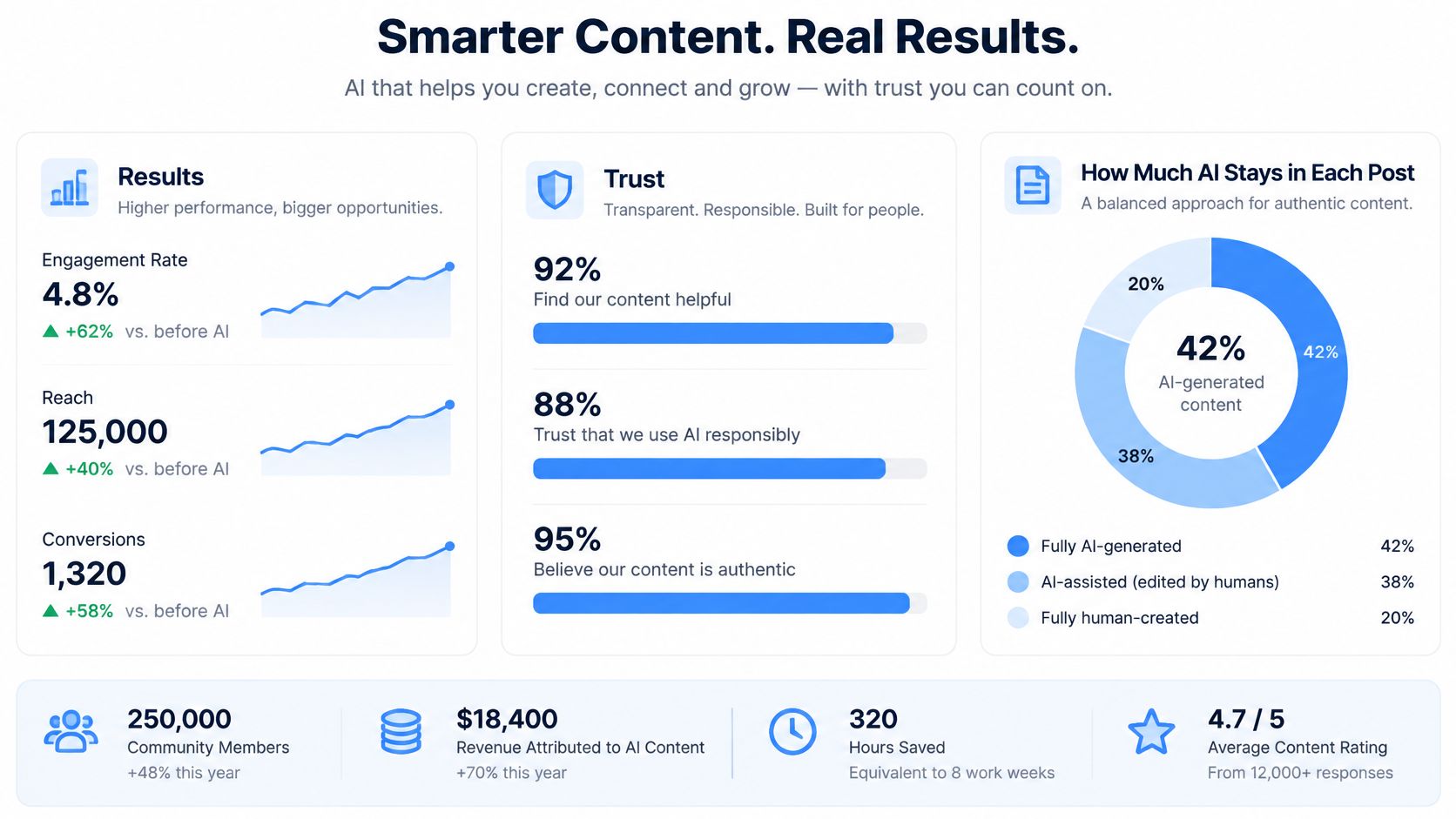
Readability and trust deserve separate attention when reviewing a content dashboard. The illustration below isn't evidence of a measured business result.
Give assistance a risk budget
The workplace study in the opening adds a different concern. Readers can judge a message as professional while questioning the person behind it. That study doesn't establish the ideal level of assistance for LinkedIn posts.
My recommendation is to allocate assistance according to the claim's consequences.
| Post type | Suggested division of work |
|---|---|
| Routine announcement or repurposed article | AI drafts and tidies, author verifies |
| Formatted practical list | AI organizes, author checks exceptions |
| Founder claim or customer result | Author supplies the claim and evidence, AI helps compress |
| Personal lesson or disputed opinion | Author writes the substance and approves every implication |
These are editorial categories, not validated risk scores. A routine announcement can still contain a serious error. A customer story needs permission and verification, regardless of who writes it.
For higher stakes posts, retain a relevant detail from direct experience. Don't disclose private information merely to demonstrate that a human was present.
Study patterns without importing someone else's voice
As a practical exercise, collect five to ten strong posts from your niche. Note the hook type, paragraph order and closing action. Rebuild those structures around your own topic, using manual notes or a post analysis tool.
Keep the resulting draft accountable to its sources and author. A post can read smoothly while leaving the reader unsure whether anyone actually believes it.
This week, run the eight step check on your last ten posts. Mark the two measures furthest from your own baseline, then rewrite the paragraphs where they overlap. Keep the changes that improve clarity without removing your judgment.
ViralBrain analyzes creator posts for hooks, structures and calls to action, then helps generate drafts for your topics and voice. Visit it to study those patterns, build a draft, and apply the checks above before publishing.
Grow your LinkedIn to the next level.
Use ViralBrain to analyze top creators and create posts that perform.
Try ViralBrain free