
Reverse Engineering Winning Posts Step by Step
Reverse engineering shows which parts of a strong post you can reuse. Get the scorecard, the workflow, and the stop rule.
Grow your LinkedIn to the next level.
Use ViralBrain to analyze top creators and create posts that perform.
Try ViralBrain freeReverse engineering a post means naming the reusable parts of something that already worked, then testing those parts with your own facts instead of copying its sentences. The software discipline formalized in 1990 offers a useful starting point, recover the design behind the finished thing.
The popular advice is to collect viral hooks and fill in the blanks. That skips the awkward part. You still need something worth saying, evidence you can defend, and readers who care.
A famous opening can't lend you its author's reputation. Borrow the pattern. Bring your own receipts.
What Reverse Engineering Means for Posts
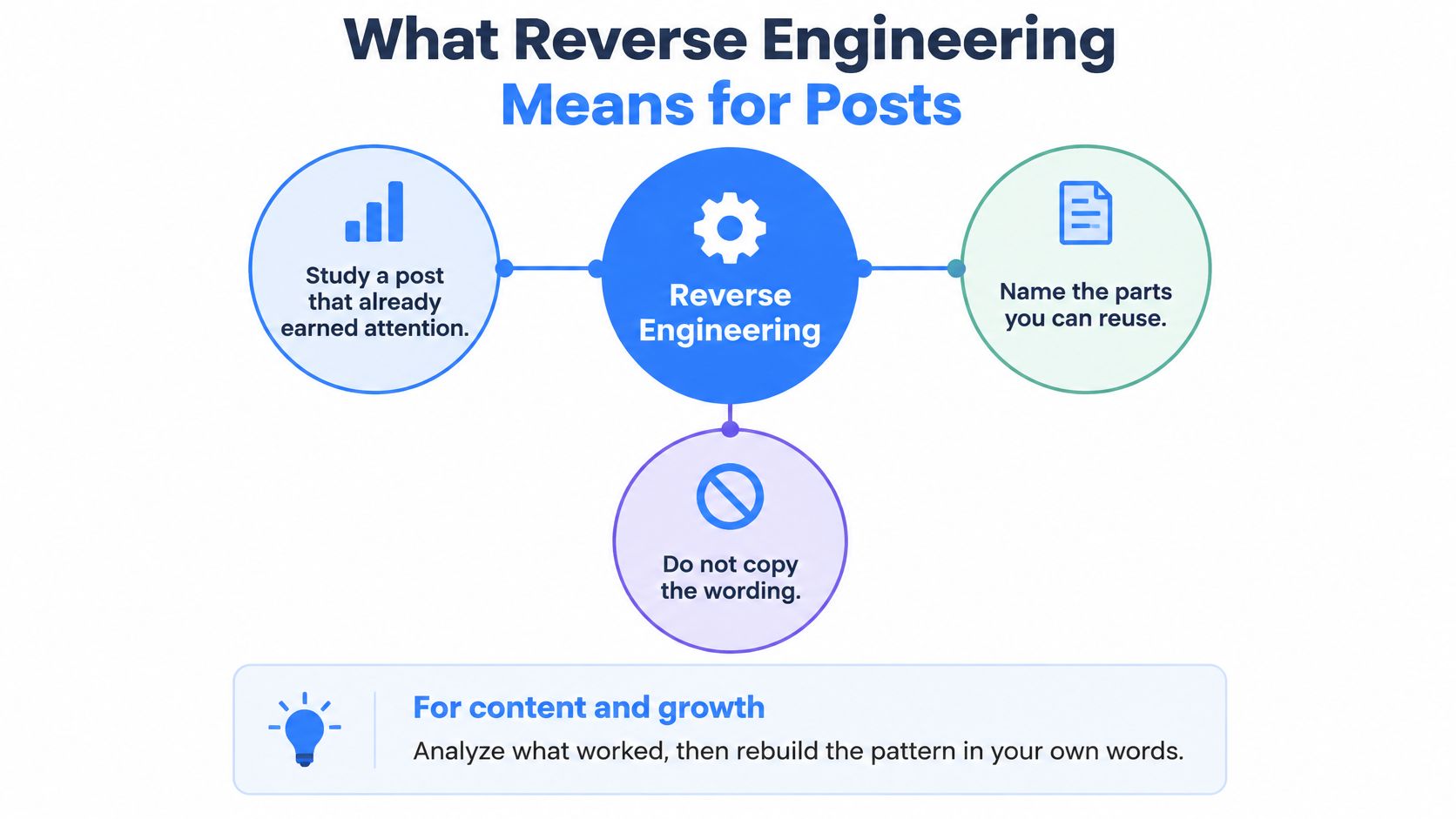
Reverse engineering for content means studying a post that earned attention and identifying the choices you could reuse. You work backward from the finished post to its design.
Say a founder saves a LinkedIn post about losing a deal. The post opens with an admission, describes a tense buyer conversation, and ends with a practical rule. The founder can recover that sequence without borrowing the deal, the dialogue, or the author's wording.
Think of a chair. The finished post is the chair. The hook, promise, proof, and ask are the joints that carry weight. Copying the paint won't fix a weak joint.
Recover the Design
The software meaning provides a useful distinction. The survey of software reverse engineering traces the foundational taxonomy to Elliot Chikofsky and James Cross in 1990, defining the work as identifying components and relationships, then representing them at a higher level of abstraction.
For a post, that higher level is a plain note such as failure, revealing scene, changed practice. It's more useful than saving another impressive paragraph you'll never open again.
This method suits founders, marketers, and salespeople who publish on LinkedIn but hear little from potential buyers. It gives them something smaller and more testable than an instruction to write better.
People paste a famous opening and expect the same result. The opening was never the whole machine.
Keep the arrangement that helps readers understand. Replace everything that belongs to the original writer.
A large creator's vague success story may attract replies because readers already know their work. A smaller account may need a concrete scene before anyone believes the claim.
Audience, offer, and evidence affect whether a pattern travels. Use the scorecard on your next saved post to separate a useful design from an attractive surface.
The Parts Worth Keeping From a Strong Post
Post parts to record before you rewrite
| Part | What to record | What strong looks like | How to reuse it |
|---|---|---|---|
| Hook | First one or two lines | Names a cost, conflict, or odd result fast | Keep the tension, swap in your fact |
| Promise | The result the reader expects | Says what they will know or avoid by the end | Match a result you can actually deliver |
| Structure | Order of the blocks | Story then lesson, mistakes list, or before and after | Keep the order, write new scenes |
| Proof | Number, name, or concrete scene | A real result, not a vague win | Use your own number or drop the pattern |
| Ask | Last line | One clear comment, reply, or follow request | Ask for one thing tied to the promise |
| Length | Line count or short, medium, long | Long enough for the proof, short enough to finish | Match length to how much proof you have |
| Format | Text, image, or document | The format carries the proof, it does not decorate it | Pick the format your proof needs |
| Audience fit | Who the first lines speak to | A job, a problem, or a stake they recognize | Rewrite if the crowd is not yours |
Write Notes You Can Use on Monday
Start with the hook. Record what creates the gap between what readers expect and what happened. A useful note names the tension, such as a busy pipeline hiding weak buyer commitment. Great hook tells your future self nothing.
Next, name the promise. What will someone understand or avoid after reading? The promise can be implied, but your note should make it explicit.
Record structure as the order of blocks. Admission, scene, explanation, rule is usable. Storytelling is a category, not a writing plan.
For proof, capture the evidence type and what it supports. A screenshot of a busy calendar proves activity. It doesn't establish that the meetings helped close business. Don't ask evidence to do a job it can't do.
The ask should follow naturally from the promise. If the post explains a sales mistake, a request for readers' experiences makes sense. Asking for follows, comments, shares, and messages turns the ending into a checkout screen.
Separate Packaging From Substance
Record length without treating it as a secret formula. Line count changes with screen size. What matters is whether the writer spends space establishing evidence or repeats the same claim in different clothes.
For format, note why the writer used an image or document. A marked up proposal might need a visual. An ordinary opinion doesn't need a decorative chart.
For audience fit, inspect the opening lines. Can a reader recognize their job, problem, or stake without guessing?
Say you're analyzing a founder's lost deal post. Your filled note might describe the hook as admitting that activity was mistaken for commitment. The proof is a documented buyer objection that contradicts the founder's earlier assumption. The ask invites readers to identify the warning they tend to ignore.
That's a pattern rather than a set of lines to paste. Another founder could use their own failed renewal or stalled proposal.
If you can't rewrite the pattern using your own facts, you don't have the part yet. You only have admiration.
How to Read Why a Post Worked
Start with the like count hidden. Read the words before you inspect the applause.
Write the promise in a sentence before opening the comments. If you can't name it, consider other explanations for the response, including the creator's reputation, an existing debate, or a joke that landed.
Read the Replies for Clues
Sort visible comments into these buckets, treating each as a clue rather than a verdict.
- Personal stories. Readers describe a similar experience. Look for the scene or detail they recognized.
- Arguments. Readers dispute the claim. Check whether they disagree about substance or merely react to the wording.
- Practical questions. Readers ask how to apply the idea. Your version may be able to answer what the original left unfinished.
A story comment doesn't prove that specificity caused the post's reach. An argument doesn't prove buying interest. Read what people said before assigning meaning to the count.
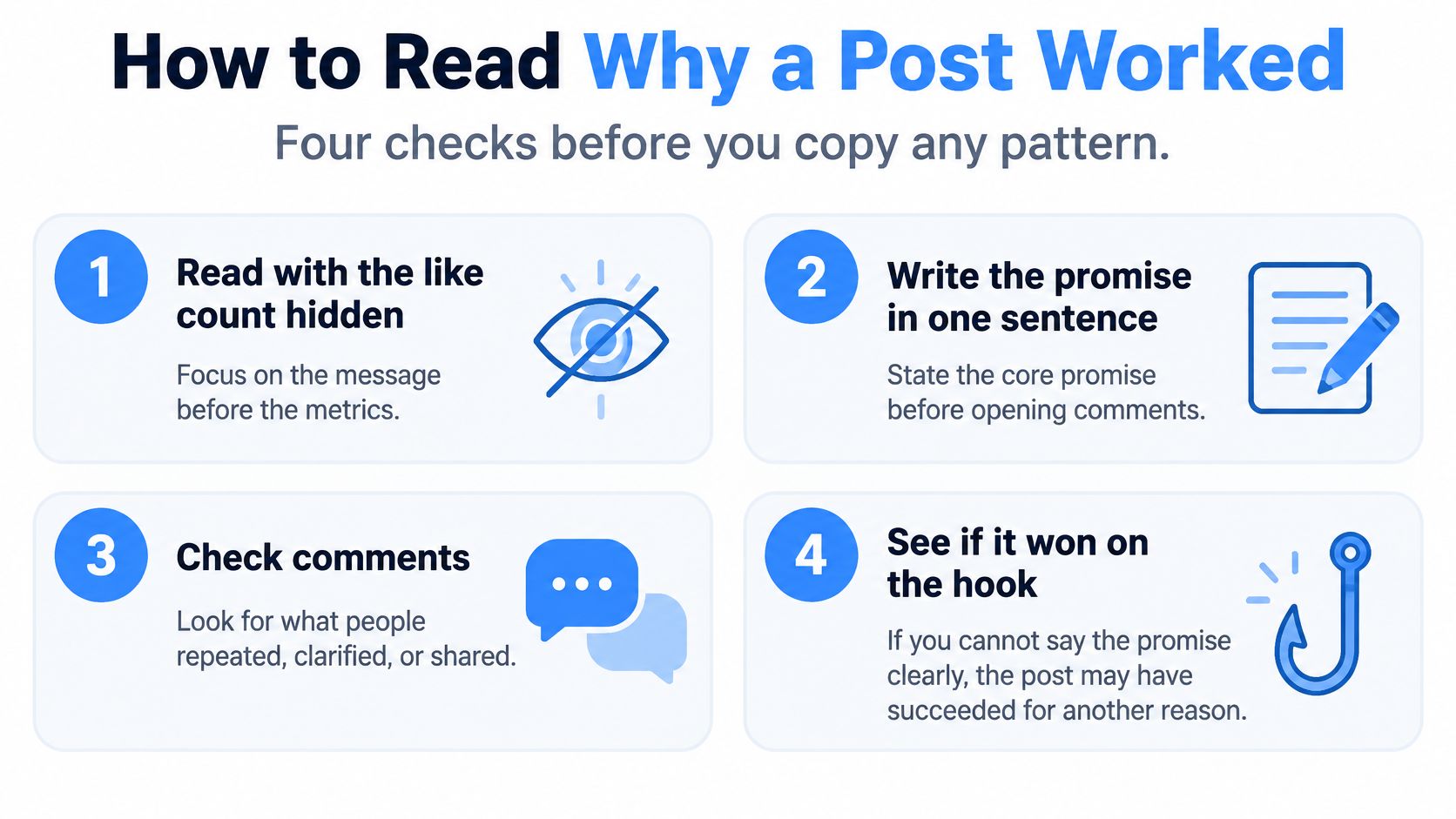
Next, compare five posts from the same creator as a practical reading exercise. Mark recurring opening shapes, proof types, and endings. Repetition gives you a candidate pattern. A single large result gives you a candidate explanation.
Finally, separate reach from response. For a post intended to start buyer conversations, thoughtful replies are more relevant than casual approval. Saves can suggest usefulness when you can access that information, but you usually can't inspect another creator's private results.
Match the Measure to the Job
A LinkedIn post analytics guide can help you distinguish the available measures before choosing what to record. Keep the intended action beside each result so a large impression count doesn't become evidence of sales interest.
The same discipline applies across channels. If you publish on Pinterest, Pin Generator's guide to track Pinterest growth with Pin Generator provides a separate reference for that channel's measurement work. Don't assume a LinkedIn reply and a Pinterest action mean the same thing.
Replies from the creator's friends and entertaining posts with no useful promise are weak evidence for a buyer focused rewrite.
Treat the interpretation as provisional. You can observe a post's design. You can't recover every reason people saw it, trusted it, or responded.
Tools and Methods for Analyzing Posts
A useful analysis method leaves you with a pattern to test, not a sentence to copy. Match the tool to the question, then check whether the pattern fits your audience and your proof.
| Method | Tool | Cost | What it gives | Limit |
|---|---|---|---|---|
| Manual scorecard | Blank note or spreadsheet | Free | Full control over post parts and comment categories | Takes time for each post |
| Side by side read | Document with five posts | Free | Shows which parts repeat | Limited to one creator |
| Pattern library | ViralBrain | Plans listed on ViralBrain's website | Hooks and structures from many creators in one niche | Still needs your proof and a posting test |
| Time log | Spreadsheet column for minutes | Free | Shows effort against relevant responses | Only as good as the records kept |
Choose the Method That Answers Your Question
Use a manual scorecard when you're learning to separate the promise from the opening line. Log the date, source, post parts, and comment categories. A note or spreadsheet you already have will do.
For a closer look at one creator, put five posts in separate blocks in a side by side document. Mark repeated choices by hand, and keep each post's subject visible. Otherwise, a recurring topic can look like a recurring structure.
A pattern library broadens the sample. ViralBrain analyzes LinkedIn posts to surface hooks and structures, which can reduce the work of collecting examples. Treat its patterns as candidates, not instructions. A label cannot prove your story or establish that the same approach suits your audience.
Keep comparisons relevant with a competitor content analysis method. Compare creators who serve similar readers. Unrelated accounts may fill a spreadsheet, but they offer little basis for a useful test.
Measure the Work, Not the Novelty
A time log shows whether the method is worth the effort. Record drafting time, editing time, and the responses tied to your goal. The point is to compare the work with the result, not to reward novelty.
A Rochester Institute of Technology maintenance study compared engineers using a commercial software engineering tool with engineers who were not. It found a significant productivity impact. The study measured software maintenance effort, not content performance, so it does not show that a writing product will improve replies.
Borrow the evaluation discipline: compare similar tasks and record the actual output. If drafting gets faster but brings no relevant response, you may have saved time, but you have not met a conversation goal. A pattern is worth keeping when it helps you produce work that fits the audience and earns the response you intended.
Three Post Shapes Taken Apart
These are composite teaching examples, not famous posts with their names removed. Each shows a structure you can test using records from your own work.
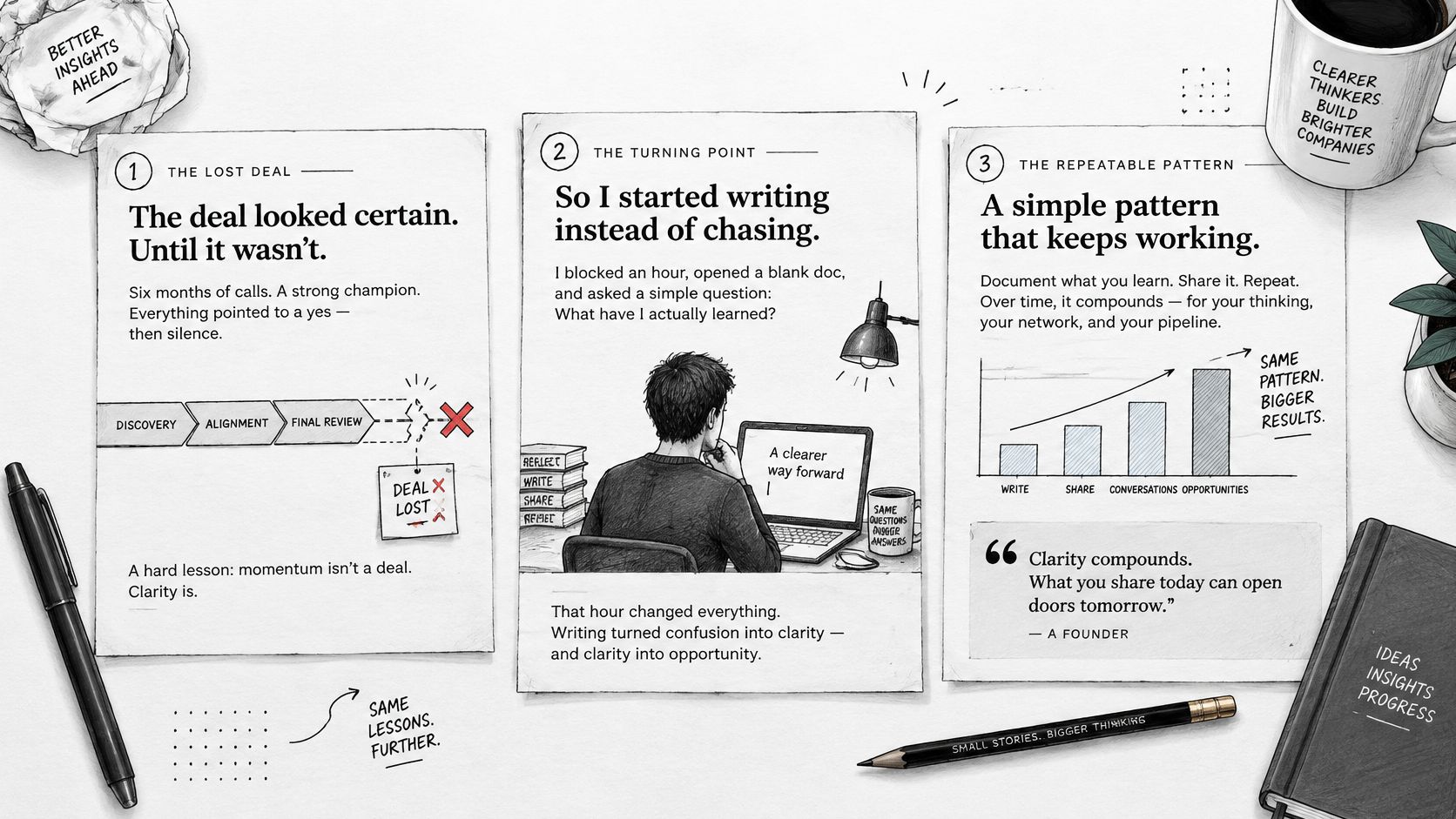
The Lost Deal Story
The hook admits a specific failure. Say a founder describes losing a deal after mistaking enthusiastic calls for agreement about the buying process.
The middle shows the moment the mistake became visible. Perhaps the buyer asks who approved the rollout, and the founder realizes that person never joined a discussion.
Proof comes from the actual deal record. Use the recorded meeting count or time in the pipeline only if you can verify it. The revealing scene may be enough when a number would distract.
The ask invites readers to name the warning they keep missing. The reusable sequence is failure, notice, changed rule.
Your log entry could say that an admission leads to a scene that changes how the writer qualifies a deal. Stop if you need to invent a tidy failure to make the sequence work. Fiction is allowed in fiction. Label it accordingly.
The Mistake List
Consider a post about three pricing errors. This is a proposed writing shape, not a claim that a particular count performs better.
Each item contains a mistake, its cost, and a correction. Discounting before confirming scope might lead to unpaid work, with a written scope check as the proposed fix.
The proof is the actual cost you observed. Time spent rebuilding a proposal can be useful evidence when money lost can't be established.
The ask names a decision the reader can inspect in their current deck. Your log should record a counted list with a visible cost attached to each mistake.
A list of tips with no consequences is a brochure wearing work boots.
The Before and After
The opening states the old practice, then describes the observed change. Say a team moves from shared responsibility for follow up to a named owner.
Show the changed constraint. Explain who owns the action, where it's recorded, and what happened afterward. Don't credit the new process for results you haven't checked.
The ask invites readers to identify an outdated practice they still use. Your log captures old practice, changed constraint, observed result.
Channel context matters when adapting these examples. If you plan to build a Reddit SEO strategy, Bazzly's guide provides a separate starting point for that work. Keep the community's expectations in view rather than dropping a LinkedIn sales ending into every discussion.
Treat an example as a lesson. Several matching posts from the same creator justify testing a pattern. A viral stranger isn't a strategy.
When the Pattern Should Stay in the Notes
Stop when the proof won't transfer. A creator may describe a vague win and receive useful replies because readers already know the business behind it.
You don't inherit that context by copying the opening. Replace the vague claim with evidence from your work. If you don't have suitable evidence, choose a different source post.
Test What Survives a Calm Voice
Sometimes the voice is the product. Readers follow a person for blunt criticism, familiar jokes, or a recurring character.
Try describing the argument without the insults or catchphrase. If there's no useful point left, the pattern may offer little for your account. Borrowed swagger has a short shelf life.
Wrong audience is another stop. A post that helps job seekers impress recruiters may have a clever opening and no useful connection to your buyers.
Check the opening lines against the people you want to reach. Rewrite the stakes for their situation only when you have a genuine reason to do so. Otherwise, select a closer example.
If a draft needs another person's exact phrasing to remain interesting, leave it in the notes.
Stop Before You Borrow the Evidence
Structure and order are useful working material. Another person's story, result, and distinctive lines aren't your evidence.
This is an editorial boundary, not a blanket legal ruling about what anyone may copy. Keep source links in your private notes and write from your own experience. Give credit when discussing someone else's published argument.
The same boundary matters when repurposing your material. Podmuse's guide to maximize your podcast's social media reach is relevant when the recording and its evidence belong to you. Changing formats doesn't create new proof.
Use a conservative retirement rule for your experiment. After two tests without a specific response from the right people, retire the pattern. That's a workload rule, not statistical proof that the structure can never work.
Don't run another version with a louder hook just to rescue the idea. Louder isn't data.
Likes from peers who routinely return favors don't count as a pass. A useful early signal is an unfamiliar reader in the target job sharing a relevant story or asking a concrete question.
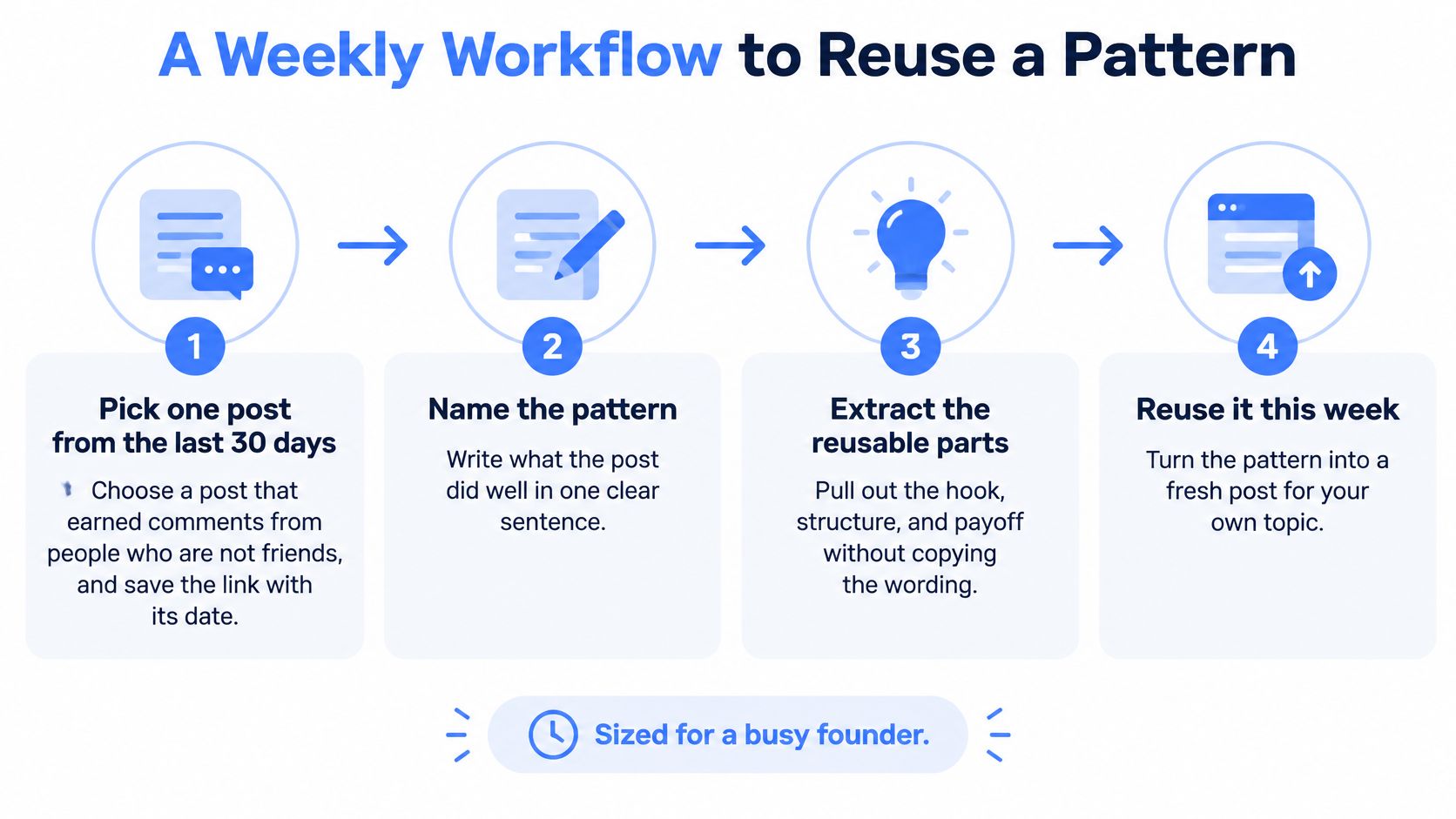
A Weekly Workflow to Reuse a Pattern
Treat this as a small editorial experiment. The timings below are suggested working limits, not measured performance benchmarks.
Choose a single source post and produce a single draft. Keep the question narrow enough to answer, such as whether a failure story starts useful conversations with sales leaders.
Collect and Check the Evidence
-
Pick a source post. Allow about five minutes. Choose something published within the last 30 days that received substantive comments from people who don't appear to be regular friends. Save its link and date. You can't fully verify personal relationships from public replies, so record uncertainty rather than pretending you can.
-
Fill the working scorecard. Spend about seven minutes on hook, structure, proof, and ask. Write the function of each part in your own words. Keep this note separate from the original so the sentences don't remain beside your draft like a tempting answer sheet.
-
Choose a single borrowed part. Take about three minutes. Use the structure or opening shape, not the structure plus the joke plus the ending. A narrow change makes the result easier to interpret, even though an ordinary posting test can't isolate every cause.
-
Find your own evidence. Use the remaining ten minutes of the collection block to list three facts from your work that could support the promise. Check meeting notes, support conversations, draft revisions, or process records. If none supports the argument, stop and choose another source post.
Those steps give the collection and evidence check a suggested 25 minute limit. The limit prevents an afternoon of saving posts from masquerading as writing.
Draft Without the Source Beside You
-
Write in your speaking voice. Set aside about 12 minutes for a rough draft. Close the original post and work from your pattern note. Describe what happened before trying to make it sound polished. Remove phrases you remember from the creator, especially distinctive openings and endings.
-
Read it aloud and cut. Allow about six minutes. Delete lines that don't help deliver the promise. Check whether the evidence supports the claim as written. Change a claim about improved sales into a claim about clearer ownership if that's all your records establish.
-
End with a relevant ask. Use about two minutes. Invite an answer that follows from the post. A piece about proposal confusion might ask readers which approval step causes trouble. Delete unrelated requests to follow, share, and book a call.
The drafting block totals a suggested 20 minutes. If you're adapting material you've already published, a content repurposing method can help you choose a suitable source without forcing every existing idea into the same shape.
Publish, Observe, Decide
-
Publish by hand and leave a judgment window. Allow a few minutes to check formatting and publish. Wait at least 48 hours before the first review as a practical house rule, not a claim about when distribution ends. If that window hasn't passed by Friday, move the decision to the next review. Sort replies into stories, arguments, and practical questions.
-
Review on Friday. Reserve about 10 minutes. Keep the pattern as a candidate when the intended readers respond with relevant stories or real questions. If the response is weak, log that result without inventing a rescue explanation. Apply the retirement rule when the experiment has had its planned attempts.
The common shortcut is jumping from saved post to draft. Then the writer blames the subject when the missing piece was evidence from their own work.
Keep a small log containing the date, source post, borrowed part, your proof, and what commenters did. Add the next action in plain words, such as test a different example, answer the buyer's question, or retire this shape. Make that entry before saving another post.
ViralBrain provides creator analysis, reusable hook and structure patterns, and drafts customized to your topics and voice. Visit ViralBrain to find a pattern worth testing, then bring your own evidence and judge the replies.
Grow your LinkedIn to the next level.
Use ViralBrain to analyze top creators and create posts that perform.
Try ViralBrain free